Your Leadership Network's Website Is Your 24/7 Sponsorship Pitch (And Most Aren't Pitching)
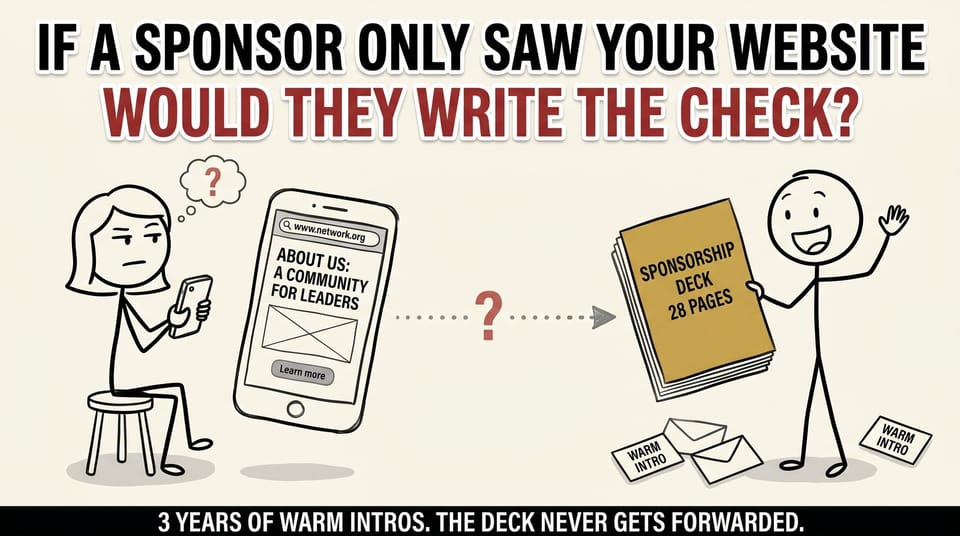
Table of contents
A corporate sponsor lead pulled up the website on her phone during our call.
"This is the network you've been telling me about?"
The founder on the other side of the screen had been talking for ten minutes about her advisory board. About the program that placed women on nonprofit boards. About the event tracks where C-suite leaders actually showed up and listened.
None of that was on the homepage.
The site led with a generic "About us" paragraph. The calendar lived on Eventbrite. The sponsorship case was a PDF deck buried two clicks deep, behind a contact form.
The sponsor lead was polite. She also did not write a check.
This is the post I write after the sixth conversation in a row with a leadership-network founder who has the same problem in a slightly different costume. The community is real. The credibility is real. The website is a brochure that hides both.
If you run a leadership network, an executive women's community, an industry council, a board-placement program, a peer-advisory group, or a curated membership organization that depends on corporate sponsorship for any meaningful share of its revenue, this is for you.
The private pitch trap
The founder I opened with had been running her real pitch through warm intros and a private PDF deck for three years.
It converted when she was in the room. It died every time she sent the deck and waited.
That gap is the trap. The private deck creates the illusion that the pitch is working. The warm intros feel like a flywheel because they keep coming. The conversion rate inside in-person meetings is high because she is bringing the credibility into the room.
What the deck-and-warm-intro motion hides is the cost. Three things specifically.
It caps growth at the founder's calendar. Sponsorship revenue is bottlenecked by how many warm intros the founder can chase. Forty intros a year converting at 25% is ten new sponsors. Eighty intros means hiring a partnerships lead or burning the founder. Past a certain point the model stops scaling because the founder is the channel.
It removes the network from the sponsor's discovery flow. Corporate-philanthropy and corporate-partnerships teams search the web for partner organizations. They use search terms like "women executive leadership network Chicago" or "nonprofit board placement program." If the network's real case lives in a PDF behind a contact form, the team's search returns nothing useful and they evaluate a competitor's site instead.
It puts every sponsor decision through a manual relay. Each new sponsor lead requires a personalized intro, a personalized deck, a meeting, a follow-up, a forwarding of materials. None of this scales. None of it accrues to the organization as a permanent asset. When the founder takes a week off, the pipeline pauses.
The website is the only piece of the pitch that scales without the founder. And in most leadership networks I have seen, it is actively unselling the network by leading with the most generic possible version of the story.
What corporate sponsor leads actually scan for
I have watched corporate sponsor leads, brand-partnerships managers, and corporate-philanthropy decision-makers read sponsorship-prospect websites in real time, both on screen-share calls and over their shoulder at events.
They are not reading the way you think.
They scan for three things, in this order, in roughly the first eight seconds. If those eight seconds do not deliver, the PDF deck does not get opened in good faith.
One: caliber. Who is on the advisory board, who has spoken at events, what companies have sponsored before. Logos, names, and titles do the work here. The sponsor's job is to find networks that match her own organization's brand level. If your homepage hides the board and the past sponsors, she concludes the network is smaller, newer, or less credible than it actually is. She is making a fast pattern-match call.
Two: outcomes. What does this community produce that a sponsor's brand wants to be next to? Board placements. Career transitions. Industry-specific impact. Public conversations. Numbers help. "150 women placed on nonprofit boards since 2019" lands. "12 governance trainings delivered" lands. "We empower women leaders" does not land because every leadership network's homepage says some version of that.
Three: brand safety. Does this organization look like one a sponsor's legal team, comms team, and board will approve? A site that feels like a thoughtful publication, not a Squarespace template with a stock-photo header, does more for brand-safety perception than any pitch deck. The proxy is craft. Sponsors infer organizational rigor from web craft.
If the first eight seconds deliver on caliber, outcomes, and brand safety, the sponsor lead reads the rest of the site in "looking for reasons to say yes" mode. If they do not, she reads in "looking for reasons to pass" mode. Same materials, opposite conversion.
The PDF deck is a tax on your team
The fallback most leadership-network founders run is the private sponsorship deck.
It is a beautiful 28-slide PDF. Updated once a year. Carried in the founder's email signature as a Dropbox or DocSend link. Sent to every warm sponsor intro within an hour of the introduction.
Three structural problems with the deck-as-pitch.
It is expensive to maintain. Every event added, every board change, every new sponsor logo, every metric refresh requires re-exporting the deck. The deck rots within ninety days if no one is updating it. Sponsors who receive an out-of-date deck downgrade their perception of the network's operational rigor.
It does not get forwarded. A sponsor lead might love the deck, but to convert it to dollars she has to internally champion it. She has to attach it to a Slack message to her boss, explain why this network specifically, and risk her own reputation forwarding a slightly-out-of-date PDF that her boss will skim for ninety seconds. Most of the time, the internal championing does not happen. The deck dies in her inbox.
It removes the network from the sponsor's discovery flow. As noted above, when the real case is behind a PDF and a contact form, the network is invisible to the sponsor's research process. Competitors with public, web-native sponsorship pages get the inbound.
The deck is not useless. It belongs in the sales toolkit for warm-handed conversations. It does not belong as the primary sponsorship surface, because every minute the founder spends maintaining the deck is a minute not spent making the website carry that load.
What a sponsorship-ready website actually contains
The shift is from "online brochure" to "credibility asset a sponsor can forward to their boss without you in the room."
Seven elements that show up on the homepages of leadership networks that close sponsors.
Board and advisory caliber, named, with headshots, on the homepage. Not on a separate "About" page. On the homepage, above the fold or close to it. If your board has CEOs and senior executives, those names and titles do thirty seconds of credibility-building per visitor. Hiding them costs more than displaying them ever could.
Flagship programs described in sponsor language. Outcomes first, mechanics second. "Board Connect places vetted women leaders on 12-18 nonprofit boards a year" before "Board Connect is a quarterly cohort program that matches members with board opportunities." Sponsors do not buy mechanics. They buy outcomes their brand wants to be associated with.
A real sponsorship page that contains the case, not a teaser for the case. Audience composition with numbers. Past sponsors with logos. Sponsorship tiers with what each tier actually looks like in practice. A sample sponsor's twelve-month experience laid out concretely. The PDF deck becomes optional supporting material, not the entire pitch.
Member and program stories. Two or three. Specific. Real names where possible. Anonymized where required. A reader-friendly story does more for sponsor conviction than any metrics dashboard, because the sponsor is buying a vision of who their brand will sit next to in your room. Stories make that vision concrete.
Past sponsor testimonials, written, with names and titles. Not anonymous quotes. If past sponsors will not go on record, you have a sponsor-satisfaction problem the website cannot solve. If they will, those testimonials are the highest-leverage piece of social proof on the site.
Event tracks and program calendar, integrated, not living on Eventbrite alone. Sponsors are evaluating whether your event cadence and quality matches their commitment level. A calendar that is one click from the homepage, that shows the next six months at a glance, that links each event to its own page with sponsor visibility detail, does sales work the founder otherwise has to do in calls.
A clear, named sponsorship CTA. Not a generic "Get in touch" form. A path labeled "Become a sponsor" or "Explore partnership" that leads to a page or a calendar booking. The CTA names the action and makes it the easiest next click.
These seven add up to a homepage that does the first 80% of the sponsorship sales call before anyone picks up the phone.
A small case study
One leadership network I have worked with had a Squarespace site that was four years old. The board had grown. The Board Connect program had matched seventy women to nonprofit board seats. Two new event tracks had launched. Three new corporate sponsors had come on board.
None of that was reflected on the site.
The audit took an hour. We pulled the site up on the founder's phone and walked through it the way a sponsor would. The board page was three clicks deep and used a stock-photo header. The sponsorship case was a Calendly link to "discuss partnership opportunities." Board Connect was mentioned twice on the site, in passing, never on the homepage. There were no member stories. There were no past-sponsor testimonials. The events calendar was a button that opened an Eventbrite list in a new tab.
The rebuild was scoped around the seven elements above. The board went on the homepage with headshots and titles. Board Connect got its own program page with the seventy-placement number in the first sentence. The sponsorship page became the case, not a teaser, with audience composition, past sponsor logos, three tiers laid out concretely, and a calendar-booking CTA labeled "Explore partnership" instead of "Get in touch." Two member stories went live, written like profile pieces by a real writer. The event calendar got pulled forward, integrated with the membership flow, and surfaced the next four events on the homepage.
The work shipped in eight weeks, not eight months. Nobody redesigned the logo. Nobody touched the color palette. The shift was structural, not aesthetic.
In the four months after relaunch, the founder reported that warm sponsor intros started landing with "I already looked at the site, this looks right for us" before the first call. Average call length dropped because the foundational credibility work was already done. The proportion of sponsor conversations that ended with "send me the deck and let me circulate it" went up.
The deck still exists. It is now a follow-up artifact, not the entire pitch. The website carries the foundational case 24/7 and the founder's time is spent on the conversations the site has pre-qualified.
This is the pattern across the leadership networks that have made the shift. It is not a redesign. It is a reframing of what the website is for.
What does not belong on the homepage
The flip side is also useful. A sponsorship-ready homepage is a curated surface. A few categories of content that consistently land in the wrong place.
Founder-led "About us" mission statements as the lead block. The mission belongs on the site. It does not belong as the first thing a sponsor sees. The sponsor is not buying the mission, she is buying the room. Lead with the room.
A blog feed that has not been updated in nine months. A stale blog feed signals "the team is small or stretched." Either commit to a publishing cadence or hide the blog feed from the homepage. Empty real estate is worse than no real estate.
A "Join our newsletter" lightbox that fires on entry. A sponsor lead evaluating the site is not the audience for a member newsletter capture. The lightbox interrupts the eight-second scan and shifts the visitor mentally from "evaluating a partner" to "being marketed at."
Stock-photo headers of diverse hands stacked together. This is the cheapest possible visual shorthand for "leadership organization" and every sponsor lead has seen it five hundred times. It signals lack of curation. Replace with real event photography or commissioned illustration.
A donation widget as the primary CTA. If your sponsorship revenue is meaningful, donation flow is a secondary path. Putting it primary tells the sponsor she is evaluating a charity-funded organization rather than a partner-funded organization. The framing matters.
The trim is as much of the work as the additions. Both are structural decisions about what the homepage is for.
The honest question
If a sponsor only saw your website, no PDF, no warm intro, no coffee, would they still see you as a serious partner?
For most leadership-network founders I work with, the honest answer is "probably not, without the deck."
That answer is fixable. It is also expensive to leave unfixed, because every sponsor round that runs on warm-intro-plus-PDF is a round that depends on the founder's calendar, not the organization's infrastructure. The cap on growth is the founder's bandwidth. The cost is the founder's evenings and weekends spent maintaining a deck that should not be the centerpiece.
The first move is to read your own homepage the way a corporate sponsor lead would. Pull it up on your phone. Time eight seconds. What did you learn about the caliber of the board? About the outcomes the network produces? About whether your sponsor's legal team would clear the brand association without a long conversation?
If the answer is "not much, you would need the deck," the diagnosis is clear. The fix is the next conversation you have with whoever owns the website.
Two pieces I have written previously sit alongside this one if you want the broader frame: Most B2B Service Firms Don't Have a Marketing Problem, They Have a Pipeline Problem covers the structural gap between marketing spend and pipeline, which maps cleanly onto the deck-and-warm-intro motion. The Founder Nobody Sees covers the cost of running an organization on personal bandwidth instead of infrastructure, which is the deeper version of this same problem.
The leadership networks that win the next sponsorship cycle will be the ones whose websites are doing the credibility work while the founders sleep. The ones still running deck-and-intro will keep capping out at their founders' calendars.
Pick which one you want to be.