
The "Minor" Support Ticket That Protects Lifetime Value
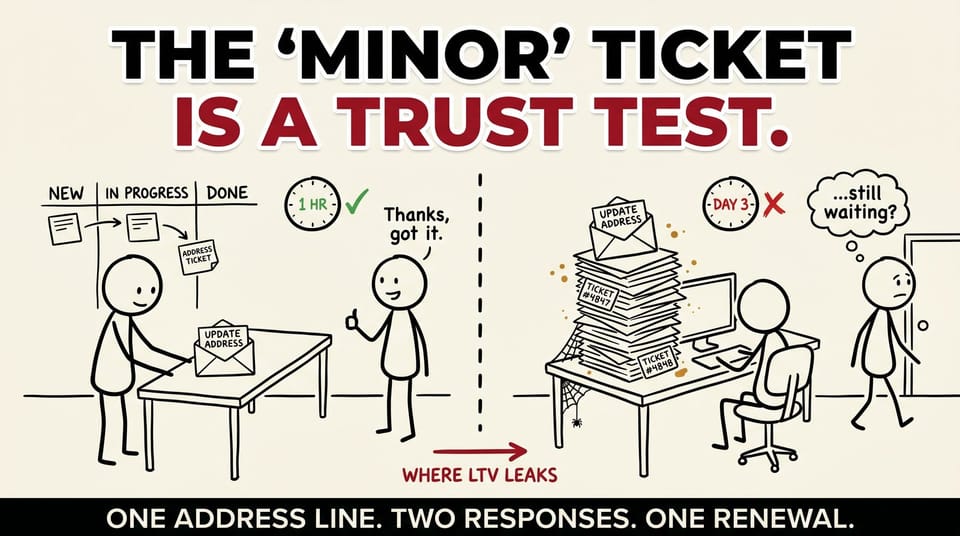
Table of contents
Most churn doesn't start with a big outage.
It starts with a "minor change" request that feels ignored.
Last month one of our retainer clients sent a ticket. One line of work. Update a contact address on their site. The ask was small enough that three years ago I would have called it a five-minute fix and routed it to whoever had an open afternoon.
Three days of dead air would have cost us the relationship.
What it cost instead was about 40 minutes of real ops handling. The numbers feel insurmountable until you compare them to the LTV that was riding on the response.
What we actually did, step by step
The four steps were boring. That's the point.
One. Ticket logged inside an hour, in the system. Client's exact ask transcribed verbatim. Estimated time-on-task captured even though the work wasn't billable. Assigned to a named ops person, not a queue. The ticket existed in the world as a real thing, not a Slack message that someone might remember.
Two. Plain-language reply inside two hours. Named what was happening, when it would be done, and how the client would see confirmation. No "thanks for your ticket #4847, we'll be in touch" energy. A human sentence written by a human and signed by name. The sentence read: "Hi Sarah, got the address update. We'll have this live on the contact page by end of day Wednesday and I'll send you a screenshot when it's done. If anything else on that page needs to change while we're in there, send it through this week." That last clause is the partner-not-helpdesk register.
Three. Status update mid-stream because the client hadn't asked for one. Sent once when the work shifted to a different ops person, sent again when the change went live in staging before pushing to production. The client did not need to know about the internal handoff. We told them anyway because the cumulative effect of unprompted updates is the thing that builds trust faster than any one big delivery does.
Four. Closeout note when it shipped. Plain language again. "Here's what changed, here's the screenshot, here's where we logged it on our side in case you need to reference it later, let us know if anything looks off."
Four steps. Forty minutes of actual ops time spread across two people. Not a heroic effort. Not a process worth a Medium post on its own.
Just the baseline of operational maturity that almost no agency I've worked with actually delivers on small work.
Why small work decides retention and big work doesn't
Big work has its own gravity. Quarterly business reviews force the relationship. Launches force the relationship. Renewal conversations force the relationship. The work shows up on calendars. It has stakeholders. It generates artifacts. Both sides of the relationship show up for it because both sides have to.
Small work has no gravity. There is no calendar. No stakeholder. No artifact unless the agency creates one.
Small work is invisible until you mishandle it. Then it is the only thing the client remembers.
If you have a $100K-a-year retainer with a B2B services client, the renewal conversation is rarely decided in the quarterly review. It is decided in the cumulative pattern of how their team felt the last 20 small requests went.
Did the agency take them seriously. Did the agency reply like a partner or like a helpdesk. Did the agency confirm and close the loop or leave it dangling. Did the agency need to be chased.
The "minor" ticket is the trust test. It is the moment the client checks whether you are still paying attention now that the contract is signed and the kickoff is six months in the rearview. They are not running a formal audit. They are not consciously evaluating you. They are simply registering, somewhere in their gut, whether their agency feels like a partner or a vendor.
Most agencies fail this test silently. They get the big work right and assume the small work doesn't count. The small work is "support," not "strategy." It is delegated to junior ops or queued through a helpdesk system that auto-replies and waits for a human to pick it up when convenient.
Three-day silences on small tickets compound. Not into an angry email. Into the conversation the client has at home: "I'm tired of having to follow up. I'm tired of feeling like a number to them. I'm not sure they're still really paying attention."
That conversation has happened before the renewal call ever shows up on the calendar. By the time the agency is presenting next year's scope, the decision is already made.
This is the pattern I watched play out at three different agencies before I built our ops differently. It is not a tooling problem. It is not a personnel problem. It is a structural blindness to the fact that small work is the trust test.
The five categories of "minor" tickets and how they actually convert to LTV
After tracking small tickets across our retainer book for the last two years, I started to see five categories. Each one converts to lifetime value differently.
Category one: cosmetic updates. Address changes, headshot swaps, fixing a typo someone caught. These are the cheapest to ship and the most expensive to fumble. They take 10 minutes of work and zero strategic thinking. When they sit in a queue for three days, the client reads it as "we are not important enough to be on your radar." When they ship inside the day with a confirmation, the client reads it as "they're paying attention even when nothing is on fire."
Category two: feature requests that sound small. "Can we add a section here?" "Can we change this CTA to say something different?" These look small to the client because they only see the front-end. They are usually 30-90 minutes of actual work. The trust test here is whether the agency replies with a real scope estimate inside the day or punts to "let's discuss this in our next call." Punting on small feature requests is how a five-figure scope-creep conversation starts six months later.
Category three: bug reports. "This isn't working." "The form is broken on mobile." Bug reports are emotionally loaded because the client is now blocked from doing their job. The trust test is response time and tone. Inside 30 minutes is the standard. The tone should acknowledge the inconvenience, not deflect to "we'll look into it." Bug reports handled well actually increase retention because they prove the agency can move fast under pressure. Handled badly, they accelerate churn faster than any other ticket type.
Category four: clarification questions. "How do I edit this page?" "Where do I update the metadata?" These are the easiest to dismiss as "training issues" and the most predictive of relationship health. A client who is asking clarification questions is engaged with the work. A client who has stopped asking has either figured it out or given up. Most agencies don't notice the difference until renewal.
Category five: small strategic asks dressed as tickets. "Can you take a look at this and tell me if it's any good?" "What do you think about this approach?" These look like small support tickets and are actually trust deposits. The client is testing whether the agency is still a strategic partner or just an execution vendor. Treating them like execution tickets is how you lose the strategic seat at the next QBR.
The pattern across all five: the cost of doing them right is small. The cost of fumbling them is the relationship.
Where AI fits, and where it doesn't yet
This is where the AI in support ops conversation gets interesting and where most teams are doing it wrong.
AI can do four useful things inside the small-ticket flow.
It can acknowledge receipt inside 30 seconds, in plain language, signed in a way that doesn't read like an autoresponder.
It can categorize the ticket into one of the five categories above and route to the right ops person.
It can draft a serviceable first reply that names what's being asked, gives a realistic timeline, and queues the right confirmation.
It can write the closeout note from the work-log so the human only has to skim and sign.
That sequence turns 40 minutes of human ops time into roughly 12 minutes of human ops time. It is real.
What AI cannot do yet, at the tone level your client can feel, is sound like a partner instead of a helpdesk.
The 40 minutes I described above included a human sentence that named the client's actual situation by name. That sentence is the thing the client remembers. AI gets close on the structural pieces and still feels off on the relational ones. The current frontier models can write fluent corporate English. They cannot, reliably, write the dry one-liner that signals "I know you, I know your business, this isn't a macro response."
The teams winning right now are using AI to handle the speed and a human for 90 seconds of tone calibration before the reply goes out. That sequencing turns 40 minutes of ops time into 12 minutes of ops time without losing the part the client actually rates you on.
Get the sequencing wrong and you ship a beautiful, well-formatted AI reply that reads like a corporate response template and erodes the relationship faster than no reply would have.
The signal that you've gotten it wrong: your reply sounds like every other agency's reply. The signal that you've gotten it right: your reply sounds like the partner you'd want if you were the client.
The one metric I now track
After watching a few accounts walk over the same small-ticket pattern, I started tracking one metric on every retainer.
The metric is small-ticket median substantive response time.
Not first acknowledgement. Those are easy to automate and don't actually signal anything about how the relationship feels. The metric is the first substantive reply: the one that names what's happening, when it will be done, and how the client will see confirmation.
If that number creeps above four hours on a retainer client, the relationship is silently eroding even if everything else looks healthy. We caught two accounts last year because the small-ticket median was sliding and we course-corrected before the QBR.
The metric is harder to game than NPS and more predictive than survey scores. It is the operational equivalent of return visits in retail.
If you don't have it tooled, here's the manual version. Pull the last 30 days of support tickets. For each one, log the time between client request and the substantive reply. Calculate the median. Anything above four hours is a yellow flag. Anything above 12 hours is a red flag and the account is at risk of silent churn.
You can run this exercise in 90 minutes. The conversations it surfaces are worth far more than 90 minutes of ops director time.
Why this fits the boring stuff series
This is Day 1 of a 5-day series on the boring operational stuff underneath AI.
The series exists because the AI pilot conversations I keep having with founders all skip the same step. The founders want to know which AI agent to evaluate, which vendor to pick, which use case to deploy first. The honest answer in 80% of cases is that the operational foundation underneath is not yet good enough to support an AI layer.
You cannot deploy an AI support agent on top of a team that can't manually answer a one-line ticket inside the day.
The AI will replicate the silences. It will replicate the macro tone. It will replicate the punt-to-next-call habit. It will do all of this faster and at scale, which is worse, not better, for retention.
The first thing to fix is the manual baseline. The boring stuff underneath the AI. The four-step response pattern. The five-category routing. The metric that catches drift early.
Once that's running well, an AI layer on top makes the team faster and the customer experience tighter. Layered on top of a broken baseline, the AI makes everything broken faster.
The rest of this week:
Day 2 is on the strategy doc as the AI training set. Why the document you wrote three years ago to align your team is now the most valuable corpus you have for any AI deployment, and why most of them are unfit for purpose.
Day 3 is on SLOs for AI agents. The contract you have to write with yourself about what "working" means before you turn a pilot loose on real customers.
Day 4 is on the AI-pilot rollback playbook. The thing nobody plans before launching a pilot and the thing every team needs by week three.
Day 5 is three boring-but-essential AI rules I share with founders before they spend a dollar on a tool.
If you've read the pipeline problem piece and the 42K/month hero piece, this series is the same shape applied to the AI side of the operation. The pattern is consistent. The hard work is not the new layer. The hard work is the operational foundation that decides whether the new layer makes you stronger or accelerates your weaknesses.
What to do this week
Run the small-ticket median exercise on your own retainer book. 90 minutes.
Look at every ticket under two hours of estimated work in the last 30 days. Pull the time-to-substantive-reply. Compute the median.
If it's above four hours, the relationship is at risk. Not because the tickets are bad. Because the small work is the trust test and the test is being silently failed.
The four-step pattern is in this article. The categorization is in this article. The metric is in this article. None of it is complicated. All of it is the boring operational maturity that decides whether your AI pilots will help you or accelerate the cracks already in your foundation.
What's one "tiny" support request that actually made or broke a client relationship for you?
If you're a $5-20M B2B services founder and you want to run the small-ticket median diagnostic on your own retainer book without doing it manually, I work with a small number of firms each quarter on operational diagnostics. The output is a quantified retention-risk read on your current book within two weeks.