The Fire Drill Test: What "We Need This Today" Reveals About Your Team
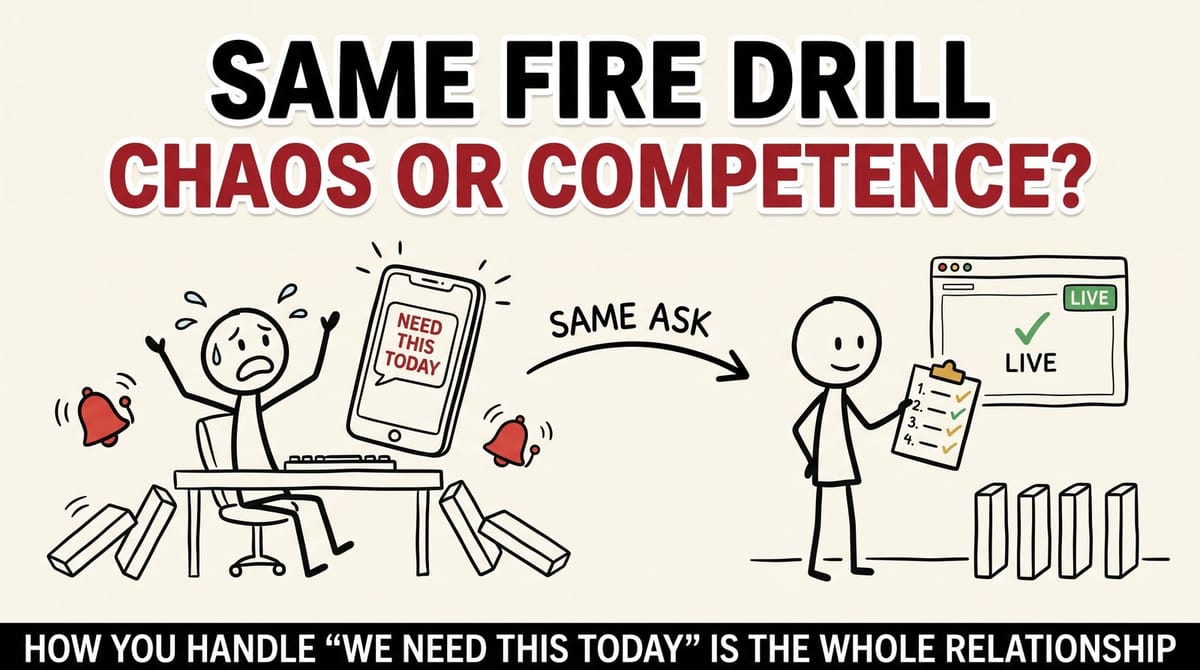
Most case studies are about the long game.
The six-month rebuild. The multi-quarter transformation. The slow, careful climb that photographs well in a deck and sounds impressive on a sales call.
Almost nobody writes about the other thing. The "we need this live today" message that lands with no warning and no calendar slot, and then quietly decides whether a client actually trusts you.
I've started paying close attention to those moments. Not because they're dramatic, but because they're honest. A fire drill strips away the polish. There's no time to look organized. You either have a path or you don't, and the client feels the difference in their gut before they can even name it.
This is a piece about that difference. What a fire drill actually tests, why it matters more than the big project, and the exact protocol we run so a rush request builds trust instead of burning down the week.
What actually happened
A few weeks ago, a nonprofit we'd supported for years sent us one of those messages.
They needed a blog post live on their site. Same day. They had the copy. They had the image. What they didn't have was time, and they needed it handled without a dozen back-and-forth emails.
No heads up. No slot on the calendar. Just: this matters, and it matters now.
Here's the thing about a request like that. The work itself was small. Publish a post, drop in the image, make it live. On a calm day, twenty minutes of focused work.
But it didn't come on a calm day. It came in the middle of everything else that was already scheduled, already promised, already moving. Other clients. Other deadlines. A team with a plan for the day that did not include this.
So the real question was never "can we publish a blog post." Of course we can publish a blog post. The real question was: can we absorb an unplanned, time-sensitive ask without dropping the six other things we already committed to this week?
That is the actual test. Not the task. The absorption.
Most teams fail the test not because they can't do the work, but because the work costs them everything around it. They say yes to the fire drill and silently default on three quieter promises to do it. The client who yelled loudest gets served. The clients who were patient get pushed. And nobody notices until the patient ones stop being patient.
The easy version, and the one we ran
The easy version of a fire drill looks like this.
Everyone stops. Everyone panics a little. Somebody heroically drops their real work, brute-forces the request, ships it, and then spends the rest of the afternoon trying to remember where they were before the interruption hijacked their brain.
It gets the task done. It feels productive. It even feels good, in a caffeinated, adrenaline sort of way.
It also quietly wrecks everything around it. The dropped work doesn't disappear. It just moves downstream, where it collides with the next thing, which collides with the thing after that. One fire drill, handled by heroics, can wobble a whole week.
We ran a different version. A boring one, honestly. And boring is the point.
First, one person took intake. Who needs this, what exactly do they need, where does it live, why does it matter, and by when. Five questions, ninety seconds. Not to slow things down or gatekeep. To make sure we solved the actual problem instead of a blurry guess at it. Half the panic in a fire drill comes from acting fast on a request you only half understand.
Second, one person owned it start to finish. Not a committee. Not a nine-person group chat where everyone assumes someone else has it. One name, one thread, one owner. When something is urgent, shared ownership is the same as no ownership.
Third, everyone else kept moving on what was already promised. The fire drill got a lane, not the whole highway. That's the discipline most teams skip, because it feels heartless in the moment to let one person handle the emergency while the rest keep their heads down. It isn't heartless. It's how you honor every client at once instead of just the loudest one.
The post went live that afternoon. Quietly. On time.
The part that actually built trust
Then the client noticed something.
The page had come across password-protected, and the excerpt text was reading wrong on the preview. Small stuff. The kind of thing that, handled badly, turns a win into "well, sort of, but we had to point out two problems."
We fixed both in a few minutes. And then we did the part most teams skip entirely.
We closed the loop. We told them it was handled, showed them it was live and clean, and made sure they walked away feeling taken care of, not like they'd created a problem by asking.
That last part matters more than the fix itself, and it's worth sitting with why.
When a client makes an urgent request, they are already a little braced. They know they're interrupting. They know it's not on the plan. Some part of them is waiting to feel like a burden, to hear a sigh in the reply, to sense that they've become the difficult account.
When you close the loop cleanly, you tell them the exact opposite. You tell them: this is what we're here for. You're not a problem. You're the reason we exist.
That's the moment a client stops being a client and starts being a reference. And references are the only marketing that has never once let me down.
Fire drills are a trust test, whether you designed one or not
Here's my honest take. Every brand has fire drills. Every service business, every internal team, every founder. You don't get to opt out of them. The requests will come, unplanned and inconvenient, at the worst possible time. The only thing you actually control is whether yours feel like chaos or competence.
Handled well, a rush request becomes a trust multiplier. The client retells that story in rooms you will never be in. "They had our back when it counted." That single sentence, spoken by a happy client to a peer at some conference or board meeting, has won us more work than any proposal I've ever written. You cannot buy that. You can only earn it, usually on a day you didn't plan for.
Handled badly, the same request becomes something else. Another agency horror story. A quiet, compounding sense on the client's side that maybe it's time to look around. And here's the uncomfortable truth: clients rarely fire you in the middle of a fire drill. They're too polite, or too busy, or too dependent in that moment. They just start planning their exit during one. The fire drill you fumbled in March becomes the "we've decided to go in a different direction" email in July, and you never connect the two.
Same request. Completely different outcomes. The difference isn't talent, and it usually isn't even effort. It's whether you had a path or you were improvising with your heart rate up.
This connects to something I wrote about recently: the bravest thing you can do under a deadline is often to move it, out loud, with a reason. Fire drills and deadline pressure are cousins. Both test the same muscle. Can you stay honest and calm when the pressure spikes, or do you default to heroics and hope? The teams that win long-term are almost never the ones who grind hardest. They're the ones who made the hard moments feel boring.
The math nobody runs on a fire drill
Here's the part that should change how you think about these requests entirely.
The blog post took a fraction of a day. The relationship it protected is worth years. That is the asymmetry at the heart of every fire drill, and almost nobody does the math on it in the moment.
When the request lands, your brain prices it as the task. Twenty minutes. A small interruption. Annoying, but minor. So it's easy to treat it as minor, to let it wait, to hand it off carelessly, to fix the surface and skip the loop.
But the client isn't pricing the task. The client is pricing you. In that unplanned moment, they're quietly answering a much bigger question than "will this post go live." They're answering "when things get hard and unpredictable, are these the people I want in the boat." A same-day request is a low-cost, high-signal way for them to find out, whether they realize they're testing you or not.
Which means the correct response is almost never proportional to the size of the task. A twenty-minute job can carry a five-year relationship. Treating it like a twenty-minute job is how you quietly lose the five years.
This is the same reframe I keep coming back to in the delivery work: the boring, small, unglamorous moments are the ones that actually compound. Nobody signs a renewal because of the heroic six-month project alone. They sign because, somewhere along the way, you made a hard Tuesday feel easy, and they never forgot it.
So run the math the client is running. Price the relationship, not the task. Then respond to the size of the relationship.
The fire drill protocol we actually run
You don't need a fancy system. In fact, fancy is the enemy here. You need a path simple enough to run when you're stressed, tired, and short on time, because that is the only condition under which you'll ever actually need it.
Here's the six-step version we use. Steal it, adapt it, shorten it. The goal isn't my exact steps. It's that you have steps at all, written down before the next emergency instead of reinvented during it.
1. Intake the five questions. Who needs this, what exactly, where does it live, why does it matter, by when. Ninety seconds. This single habit prevents most fire drill disasters, because most disasters are just fast, confident work on a misunderstood request.
2. Assign one owner. One name attached to the whole thing, start to finish. Not a team. Not a channel. A person. Urgency and diffuse responsibility cannot coexist.
3. Protect committed work. Decide, explicitly, what does not move. The fire drill gets a lane. The promises you already made to other people keep their lanes. If the emergency genuinely requires bumping something, you bump it on purpose and you tell that person, rather than defaulting on them silently.
4. Execute in one focused block. No multitasking, no half-attention. The owner goes heads-down and finishes. Fire drills punish divided attention worse than almost any other kind of work.
5. Fix fast, without defensiveness. Something will be slightly off. The excerpt, the setting, the formatting. When the client flags it, the correct response is speed and zero ego. "Good catch, fixed, here it is" beats a paragraph explaining why it happened.
6. Close the loop out loud. Tell them it's done. Show them it's clean. Make sure they feel like the request was welcome. This is the step that converts a task into a relationship, and it's the one almost everyone forgets because by then they're exhausted and already moving on.
Print it. Pin it. Put it somewhere a stressed person will actually see it. A protocol that lives only in your head is not a protocol. It's a hope.
The boundary that keeps fire drills from burning out the team
There's a shadow side to all of this, and I'd be lying if I skipped it.
If you get good at fire drills, you get more of them. Competence attracts urgency. The better you handle "we need this today," the more comfortable people get sending it. Handle enough of them badly and you lose clients. Handle enough of them without boundaries and you lose your team.
So the protocol has a seventh, unwritten rule: not every request that feels urgent to the sender is actually a fire drill. Part of running this well is being able to tell the difference between a true emergency and someone else's poor planning dressed up as one. A genuine same-day need gets the full protocol. A "can you also just quickly" that arrives every single afternoon is not a fire drill. It's a scope conversation wearing a costume, and the kind thing, for everyone, is to name it as one.
The teams that survive fire drills long-term do two things at once. They respond to real emergencies with total competence. And they gently, consistently, teach clients what a real emergency is. Both. Not one or the other.
That balance is how you stay responsive without becoming a doormat, and how the person who owned today's fire drill still has energy for tomorrow's real work.
What you can do this week
Look at your last three urgent requests. Be specific and be honest about each one.
Did you have a clear way to handle it? Or did you just muscle through, drop something quietly, and hope nobody noticed?
If it was mostly muscle and hope, that's not a character flaw. It just means you've been running on talent instead of on a path, and talent gets expensive when it's the only thing standing between you and chaos.
So write down your fire drill protocol this week. Five to seven steps, no more. Something a tired person can follow at 4pm on a Friday. Use mine as a starting point if it helps.
Then, the next time a "we need this today" lands, run the path instead of the panic. Watch how different the week feels on the other side of it. And watch what the client says afterward, because that's the real scoreboard.
The teams I trust most aren't the ones who never get surprised. They're the ones who made the surprise feel boring.
At Chykalophia, the boring-on-purpose delivery is the point. If your team keeps white-knuckling through rush requests and you'd rather have a partner who treats "we need this today" as a normal Tuesday, let's talk. And if you want more field notes on running a calm, trustworthy team under pressure, the rest of the writing lives at piotrkrzyzek.com.
Related reading: Scaling from 5 to 25 people without the chaos.
Get the next one by email
One practical fix every two weeks for owners of established B2B companies. Websites, conversions and operations, written plainly.

Peter Krzyzek
eter Krzyzek is co-founder and CTO of Chykalophia, the Chicago agency that builds strategy-led websites for established B2B companies, and co-author of Made to Sell.
Comments