
Most B2B Service Firms Don't Have a Marketing Problem. They Have a Pipeline Problem.
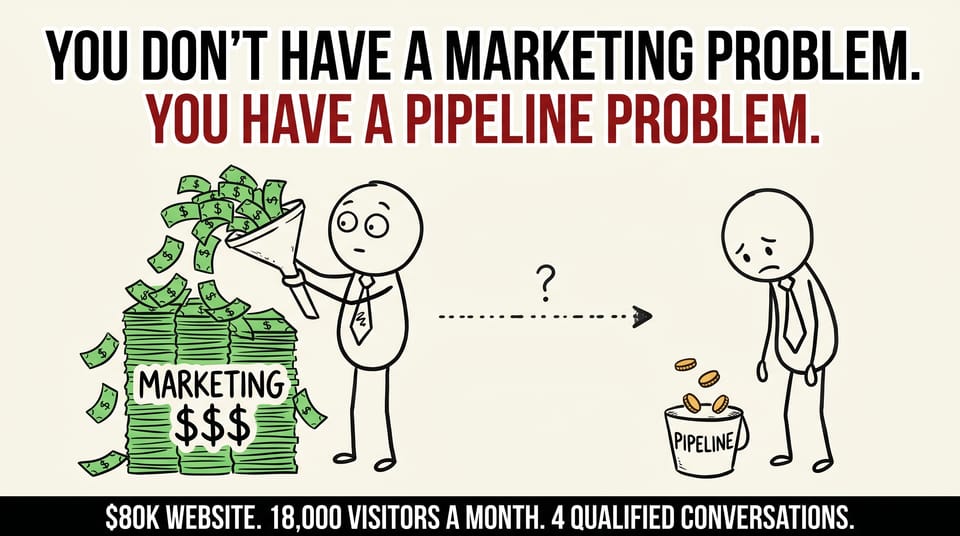
Table of contents
I was on a sales call last year when the founder on the other side told me something that lodged.
"My best month for new business in 2024 was worse than my worst month in 2019."
She wasn't being dramatic. She was 11 years into a successful B2B services firm. 30 people. Her marketing budget had quadrupled in those five years. Her pipeline had contracted. She'd hired three agencies in two years and was looking at a fourth.
I asked her to pull up her website analytics with me on the call. 18,000 visitors a month. Four qualified conversations.
She'd spent $80K on the site in 2021. It had won two design awards. She'd referred to it on three podcast appearances as "finally the brand we always knew we should be."
It was, in any meaningful sense, doing zero work for pipeline. Her sales team was running 80% on referrals because nothing else was converting.
She didn't have a marketing problem. She had a pipeline problem, and her marketing budget was the most expensive workaround for it.
This piece is the long version of that argument. It's the opening of a five-day series for B2B service firm founders, walking through five specific conversations you need to have with your website. By the end of this piece you'll have the framework, the math at your revenue level, and the diagnostic question to ask of your own site this week.
The pattern that produces the gap
I've watched this pattern in maybe forty B2B service firms over fifteen years of building their websites. It's almost always the same five stages.
Stage 1 (years 1-3): scrap. The founders are selling everything. The website is functional and unloved. Pipeline is whatever the founders' personal networks produce. This stage works fine for a small team chasing a small revenue target.
Stage 2 (years 3-7): word-of-mouth flywheel. Customers refer the next customers. The founders are still doing the selling but the inbound is real. Pipeline feels effortless. The website is mostly a credibility check, a place where the prospect confirms the firm exists and looks legitimate.
Stage 3 (years 7-10): the flattening. Growth slows. Referrals continue but they're not enough to fund the next hire, the next office, the next service line. The founders are stretched. The instinct says: invest in marketing.
Stage 4 (years 9-11): the build. A new website gets commissioned. An agency is hired. There's a kickoff. There are wireframes. There are three rounds of design review focused mostly on whether the hero photograph conveys "premium." The site launches. Everyone celebrates. The agency sends a final invoice.
Stage 5 (years 11+): the confusing flatness. Marketing spend grows. Pipeline doesn't. The firm hires a CMO or fractional. The CMO runs more programs. Pipeline still doesn't move proportional to spend. The conversation in leadership meetings becomes "why isn't marketing working?"
The honest answer is almost always: marketing isn't broken, the website isn't doing the conversion job marketing's outputs need it to do.
The website that got built in Stage 4 was designed by people whose excellence is communicating brand identity, not converting visitors into qualified sales conversations. Those are different practices. Most agencies are excellent at the first and silent on the second.
Why it's a structural problem, not a creative one
It's tempting to read the above and conclude "we just need a better agency." That's almost never the fix.
The agencies that built these sites have real talent. The founders who approved them are smart, experienced operators. The problem is that the discipline of "design a website that communicates the brand" and the discipline of "design a website that converts visitors into qualified pipeline" are two different practices, and the second one is rarely included in the first one's price.
A B2B website has two jobs at the same time. Job one is to communicate: tell people who you are, what you do, who you do it for, make them feel like you're credible, make the brand experience match the offer. Most agencies are excellent at this. They have brand systems, visual taste, storytelling instincts. The work product is recognizable as a deliverable.
Job two is to convert: take a stranger who landed because someone mentioned you, or because they searched something, or because they got an email, and walk them through a specific, measurable progression that ends with a qualified conversation.
Job two is a different practice. It requires conversion thinking, lead qualification mechanics, message-to-market fit testing, math. Most agency processes don't include a serious version of it. So the site ships strong on job one and silent on job two. And the silence becomes invisible because the site looks finished.
That's how you get a beautiful site that costs more to maintain than it earns. The agency isn't lying when they call it a success. By their definition (design, story, brand consistency), it is one. By the operator's definition (pipeline, qualified leads, revenue lift), it isn't. Both definitions are real. They just describe different artifacts.
Pipeline Contribution per Visitor: the metric most founders aren't tracking
Here's the metric to add to your dashboard if it isn't there.
Pipeline Contribution per Visitor (PCV): the dollar value of pipeline added per unique website visitor over a fixed period.
Calculated:
PCV = (qualified sales conversations from web × close rate × avg deal size) ÷ unique visitors
For the firm in my opening:
- 18,000 visitors per month
- 4 qualified conversations
- 30% close rate
- $50,000 average engagement
- Pipeline value created per month: 4 × 0.30 × $50,000 = $60,000
- PCV: $60,000 / 18,000 = $3.33
For context: a B2B service firm whose website is doing the conversion job reasonably well runs PCV in the $25 to $80 range. The gap between $3 and $40 isn't a 10x improvement opportunity, it's a structural delta.
Two things you can do with this number once you have it.
First, compare against your marketing spend per visitor. If marketing-spend-per-visitor is higher than PCV, the website is failing to capitalize on the traffic the marketing is buying. The fix isn't more marketing. It's making the website do its job before the next marketing dollar gets spent.
Second, compare PCV today to PCV a year ago. If it's flat or declining while marketing spend is up, you're funding traffic to a site that's structurally unable to convert it.
Almost no B2B service firm I've worked with had PCV calculated when we started. By the end of the engagement they always do. It changes the conversation in leadership meetings because for the first time the website becomes a measurable asset instead of a brand artifact.
Why founders don't see it
The founder usually senses it before the data confirms it.
She apologizes for the URL when she sends the link to a prospect. She sends a five-minute summary email instead of trusting the site to explain. The sales team learned to lead with referrals because everything else converts at single-digit percentages of what referrals do.
The marketing director either knows but can't change it, because the website was a brand decision and not a marketing decision, or doesn't know because they were hired after launch and inherited the gap.
The board asks why marketing investment isn't producing pipeline lift. The CMO points at content production. The content team points at distribution. Nobody points at the website because the website was the decision the founders made together and it's been quietly off-limits as a topic.
This is the pipeline problem in social form. It isn't invisible. It's politically inconvenient.
The honest move for a founder reading this is to make it OK to put the website back on the table. Not as a brand question. As a pipeline mechanism question. The two are related but the fixes are completely different.
A second case study
A second firm. Industrial services, $8M revenue, similar story but different specifics.
When we started: PCV of $1.80, 22,000 visitors a month, mostly from organic search and the founder's podcast appearances. Their site was beautifully designed but the homepage hero said "Engineering Solutions for Forward-Thinking Companies" and the only CTA was a contact form below the fold.
We didn't redesign. We rebuilt the hero (named the operator's actual problem, added a one-question diagnostic), restructured the second screen (added a configurator that returned a number specific to the visitor's category), changed the CTA architecture (one primary, three secondary, all routing to different starting points). Three months of work.
Six months after launch: PCV up to $24. Same traffic. Same brand. Different conversion mechanism underneath.
The numbers I'm not sharing publicly yet are theirs to share when they're ready (testimonial permissions are pending). The point is the gap from $1.80 to $24 wasn't a redesign. It was a structural rebuild of the things on the site that were supposed to be doing pipeline work and weren't.
The cost of inaction
It's tempting to read all of this and conclude "the site looks fine, the leads will come from referrals, it's not worth fixing right now." That math is almost always wrong, and it's wrong by more than founders realize.
For a typical $5M B2B service firm, the website's contribution to qualified pipeline should be in the neighborhood of 15-25% of total inbound. If your site is doing zero, that's between $750K and $1.25M of annual pipeline that doesn't exist because the site is functioning as a brand artifact instead of a pipeline mechanism. At a typical close rate, that's $150K to $375K in actual revenue annually, which translates to roughly $12K to $31K per month in pipeline contribution that's invisible because it never showed up.
The brochure-style site doesn't cost you visibly. It costs you in the absence of leads that should have come from it and didn't. That's the most expensive kind of cost. The kind nobody is monitoring.
I'll go deeper on this math in tomorrow's post. The specific case I'll work through is the homepage hero alone, the polite-handshake hero that costs a $5M B2B firm about $42,000 in monthly pipeline before any other conversion failure even enters the picture.
What this week covers
The next four days walk through specific conversations every B2B service firm founder needs to have with their website. Each day takes one of the five things your site should be doing for pipeline and shows what's broken when it isn't, what changes when it is, and what to do about it.
Tomorrow (Day 2): the hero. Why most B2B heroes give a polite handshake instead of doing pipeline work. What a working hero actually does (qualifies, makes a defendable promise, offers a measurable next step). The math: a polite-handshake hero costs a $5M B2B firm about $42K per month in foregone pipeline.
Day 3: the 8-minute, 7-signal diagnostic. A self-assessment you can run on your own homepage today. With the score I gave my own site (a 38, on a 100-point scale).
Day 4: three rebuilds, three receipts. Anonymized case studies of B2B service firms whose sites went from cost-center to pipeline-source. Real numbers, real time-to-impact, no names yet (testimonial permissions are still working through).
Day 5: the personal one. The emotional cost of admitting your own site isn't pulling its weight. Why most founders avoid running the diagnostic on themselves. Why the ones who do tend to find the conversation freeing.
What you can do this week
Three actions, in order of cost.
One: calculate your PCV. Pull last month's unique visitors. Get an honest count of qualified sales conversations from web inquiries (not referrals, not outbound, not events). Estimate close rate and average deal size. Divide as above. The number itself is the start of the conversation.
Two: decide whether the PCV you got is acceptable. The benchmark is $25 to $80 for a competent conversion site. If you're under $5, the gap is structural. If you're under $1, the website is functionally absent from your pipeline.
Three: if the number is uncomfortable, make the website a leadership-meeting topic that isn't a brand question. Make it a pipeline mechanism question. Most B2B service firms have never had that conversation cleanly. The ones that do tend to find their next year's marketing budget reorganizes itself around the new clarity.
If you want a thirty-minute walkthrough of your specific site against the framework, no pitch, just an honest read, I do a small number of these every quarter. Easier to spend half an hour than to spend another year wondering why marketing isn't producing pipeline.
A few related reads from the archive that work well alongside this one:
- The Founder Nobody Sees, the role that lets the brand work happen behind the scenes. Tangentially related, but the same instinct (let the work speak for itself, the brand will figure itself out) is exactly the instinct that produces websites that don't sell.
- The Crash, what my parents' real estate empire taught me about the cost of holding onto things that aren't working. The "good enough" website is the same instinct. We hold on because we don't want to admit we built the wrong thing.
This week is about the conversation most B2B service firm founders haven't had cleanly with themselves about their website. Five days. Five things your site should be doing for pipeline. Five fixes that don't require a redesign.
Tomorrow: the hero. The $42K/month one.
What did your site contribute to pipeline last month? An honest number, not a vibe.