How We Made a Healthcare Tracker Feel Trustworthy (Without a Single Flashy Feature)
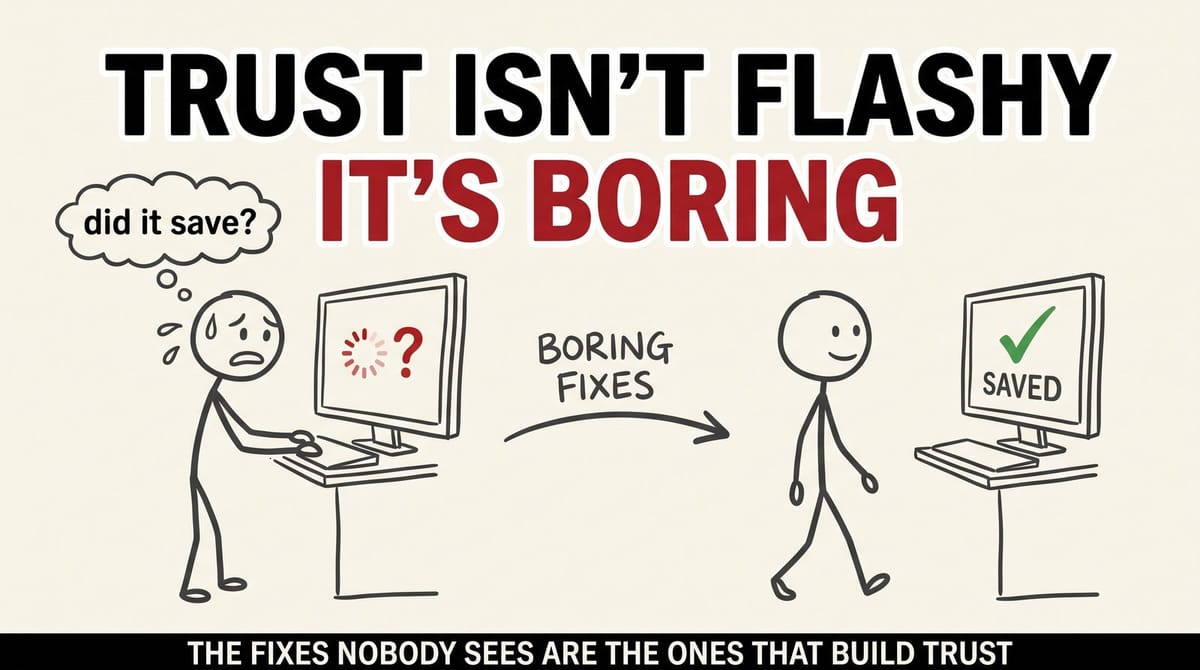
Most healthcare products try to win you over with a dashboard.
Big charts. Smooth animations. A demo that makes everyone in the room nod along. The pitch is always some version of "look how much it can do."
Here is what I have learned building one: nobody using the thing at 2am cares how it looks. They care whether it saved.
That single shift, from "how much can it do" to "can I trust what it just did," changed how our delivery team ran an entire healthcare build. This is the long version of that story, including the framework we used to decide what to work on and the order we fixed things in. If you lead a product team or run an agency, I think the framework travels well beyond healthcare.
The build nobody posts about
For the last few months, our delivery team has been deep in a healthcare tracker. Not a flashy consumer app. A working tool for staff who log real things about real people on their hardest days.
It is more than one screen. There is a 24/7 tracker, sleep logs, vitals, hygiene notes, food and fluid intake. Each module feeds the others. A nurse enters something in one place, and a coordinator three screens away has to trust it without re-checking the source.
That is the whole game in this category. Not features. Trust in the data.
And trust is fragile in a very specific way. It does not break when a button is ugly or a screen is plain. It breaks the first time someone logs a vital, walks away, and later finds out it did not save.
After that happens once, the staff member stops trusting the system. She starts writing things on paper too, just in case. Now you have two systems, one of them is a sticky note, and the expensive software you built is quietly being routed around. The data splinters. The single source of truth you promised becomes one of three sources, and the other two are a notebook and someone's memory.
In a normal app, that is a churn risk. In healthcare, it is a safety risk. The stakes raise the bar on what "good enough" means.
Why trust is the real product
When people talk about healthcare software, they usually talk about compliance, integrations, and feature checklists. Those matter. But they are table stakes, not the thing that makes a product loved or abandoned on the floor of a care facility.
The thing that decides whether staff actually use it is much simpler. Do they believe what the screen tells them?
Belief is not a feature you can build directly. It is a byproduct. It accumulates every time the system does exactly what the user expected, and it drains every time it does something surprising. You do not earn it with a great onboarding flow. You earn it across hundreds of small, unremarkable interactions where nothing went wrong.
Which means the work that builds trust is mostly invisible. It is the absence of bad surprises. And invisible work is the hardest kind to prioritize, because it never demos well and it never makes the update email.
The "did it save?" moment
There is a moment I think about constantly.
It is the half-second where a user finishes entering something and silently wonders, "did that actually go through?"
Every product has that moment. In most software it is a minor annoyance. In healthcare it is the dividing line between a tool people trust and a tool people work around.
Our entire job, for a long stretch, was to delete that half-second.
Make the save reliable. Make the confirmation clear and immediate. Make the same action produce the same result every single time, on a fast connection and a slow one, on the first try and the fiftieth. Do it so consistently that the user stops checking, because they have stopped worrying.
When software gets boring in that way, it has earned something most products never do. It becomes invisible. People stop thinking about the tool and get back to their actual jobs.
That is not a failure to innovate. In a category where trust is the product, that is the innovation.
What we actually fixed
We had a roadmap full of tempting things. More modules. New views. The kind of additions that look great in a sales conversation and a release note.
We put most of them down and picked up the boring pile instead. Three buckets of work, none of which you could ever screenshot.
Reliability first. Several API endpoints were returning the wrong thing in edge cases. Not crashing, which would have been easy to spot. Returning a plausible but wrong answer, which is far more dangerous because it looks fine. We tracked those down and fixed them, then added the checks that would catch them if they came back.
Consistency in actions. Bulk actions behaved one way on Tuesday and a different way on Thursday depending on the state of the data underneath. We made them behave the same way every time. One example sticks with me: a bulk update that looked like it succeeded, returned a cheerful confirmation, and then silently skipped a handful of records. To the staff member, everything was fine. To the resident whose note never made it in, it was not. That is the exact kind of bug that does not crash anything and quietly destroys trust anyway.
Clarity in the flows. We tightened how notes, logs, and reports connect, so a staff member never has to wonder whether something carried through from one screen to the next. We chased down a steady stream of tickets surfacing the small, ugly situations real staff hit that we never saw in a clean test environment.
None of this is exciting. I cannot show you a screenshot of a fixed endpoint. There is no before-and-after slide that makes a reliability fix look impressive. But the care team feels every bit of it, even though they can never see it.
The framework: trust work vs shiny work
The hard part of all this is not the engineering. It is the prioritization. When you have a backlog with fifty items and a stakeholder who wants the new module, how do you justify spending a sprint on bugs nobody outside the building will notice?
We use a simple test. For every item on the roadmap, we ask four questions.
- If we ship this, does it make the user trust the data more, or just see more on the screen? More trust is trust work. More on the screen is often shiny work wearing a useful disguise.
- Who feels it, and when? A fix that a care worker feels on every shift beats a feature a buyer admires once in a demo.
- Does this remove a bad surprise, or add a new surface for one? Every new feature is a new place for trust to break. Sometimes worth it. Worth naming out loud either way.
- If we do nothing here, what workaround are users already running? Existing workarounds are a map of where trust has already broken. Follow that map first.
This is not anti-feature. Some of the time the answer is genuinely "ship the new module," because the new module is what the product is missing. But running the four questions out loud changes the order of the backlog more often than not. It surfaces the quiet, trust-destroying issues that would otherwise lose every prioritization fight to something shinier.
If you have read my piece on why moving a deadline can be braver than hitting it, this is the same muscle. The brave move is usually the honest, unglamorous one that protects the people relying on you, not the one that looks best in a status update.
How we triaged which bugs to fix first
Not all reliability work is equal. We sorted the bug list by one axis above all others: does this break a daily workflow, or does it just annoy us in staging?
A bug that breaks something a care worker does every shift went to the top, even if it was rare, because rare-but-real in healthcare is still someone's missing vital. A bug that was ugly but only showed up in an internal tool, or only in a configuration no real user would hit, went down the list no matter how much it bothered the engineers.
That sounds obvious written down. In practice it is hard, because engineers naturally want to fix the bugs that offend their sense of craft, and those are not always the bugs that hurt users most. Keeping the list ordered by user impact, not by engineering irritation, took deliberate effort every week.
The result was that our limited time went to the fixes with the highest trust payoff per hour, instead of the ones that simply itched the most.
Before and after
Before this stretch of work, the picture looked like a lot of software projects.
| Before | After |
|---|---|
| Product folks tempted to pitch the next shiny module | One clear question gating the roadmap: does this build trust? |
| Support tickets quietly exposing gaps in core flows | Core flows steady, ticket volume down |
| Staff building paper workarounds because they did not trust the data | Staff relying on the system because it behaves the same way every time |
| Unpredictable releases, recurring fires | Fewer urgent fires, more predictable releases |
| Trust eroding one bad surprise at a time | Trust compounding one boring, correct interaction at a time |
Same team. Same codebase. Completely different relationship with the people using it.
Why this is so hard to actually do
If this is so obviously right, why does almost everyone default to shiny work?
Two reasons.
The first is visibility. New features are legible. You can point at them, demo them, put them in an email. Reliability work is the absence of a problem, and you cannot easily point at an absence. It is genuinely harder to get credit for the fire that never happened.
The second is identity. A lot of us, somewhere along the way, decided that "ships impressive new things" is the headline metric of being good at this job. So a sprint spent on bug fixes can feel like a sprint where you did not really do anything, even when it was the most valuable sprint of the quarter.
Naming both of those out loud, with your team and your stakeholders, is most of the battle. When everyone agrees that trust is the product, the boring work stops feeling like a detour and starts feeling like the point.
The hidden cost of skipping this
It is tempting to treat reliability work as optional polish, the thing you get to after the real roadmap is done. In healthcare, that math is backwards, and it is worth spelling out the cost of getting it wrong.
When a care worker stops trusting a screen, she does not file a ticket. She adapts. She keeps a paper log next to the keyboard. She double-enters the important things. She tells the new hire, quietly, "do not fully rely on this part." None of that shows up in your analytics. Your dashboards still say the feature is being used. What they cannot see is that it is being used with a backup, which means it is not really being trusted at all.
That gap between "used" and "trusted" is where healthcare software quietly fails. The product looks adopted. The renewal still happens. And then one day a note does not carry through, a workaround misses a step, and the failure that had been hiding in the workarounds finally surfaces at the worst possible moment.
The cost is not just that one incident. It is everything that compounds before it. Every paper backup is wasted time. Every double-entry is a second chance for a transcription error. Every "do not trust this part" handed to a new hire is institutional knowledge that your software is not dependable. You are paying for all of it, every shift, and none of it appears on an invoice.
Compare that to the cost of the boring work. A sprint spent fixing endpoints and bulk actions is legible, finite, and over when it is over. It feels expensive because you can watch the hours going in. The eroded-trust cost feels cheap only because it is invisible and spread across hundreds of small moments. Add it up and it is far larger.
This is why we treat reliability as a feature with a line on the roadmap, not as cleanup that happens between the real work. Naming it that way changes how it gets funded and how it gets talked about. The fix that prevents a future incident deserves the same respect as the feature that wins a demo, and in this category it usually deserves more.
What you can do this week
You do not need a healthcare build to use any of this. Here is the small version.
Pull up your current roadmap. Go line by line. For each item, run the four questions above, starting with the first one: does this build real trust with the people using the product, or does it mostly look good in a demo? You will feel the answer faster than you expect.
Then do the harder part. Pick one unglamorous reliability win and ship it. The bug that breaks a daily workflow. The inconsistent behavior everyone has learned to tolerate. The thing that makes someone quietly check twice. Ship that.
And then, instead of only posting your launch highlight reel, tell that story too. Normalize the quiet work. It is how you teach a team, and an audience, that trust is worth more than applause.
If you want help doing this
This is the kind of work our delivery team at Chykalophia does on client products every week: finding the trust-breaking issues hiding under a backlog of shiny requests, and fixing the boring things that make software something people actually rely on. If you have a product where staff or customers have quietly started working around the system, that is usually a sign there is trust work waiting to be done. I am happy to talk through it. You can reach me at piotrkrzyzek.com.
The shiny stuff gets the applause. The boring stuff gets the trust.
I know which one I would rather have running the software that tracks someone's vitals at 2am.
What is one boring fix your users would quietly thank you for?
Related reading: Chykalophia case studies and Healthcare websites & HIPAA basics.
Get the next one by email
One practical fix every two weeks for owners of established B2B companies. Websites, conversions and operations, written plainly.

Peter Krzyzek
eter Krzyzek is co-founder and CTO of Chykalophia, the Chicago agency that builds strategy-led websites for established B2B companies, and co-author of Made to Sell.

Comments