Your Client Demo Is a Week of Content Waiting to Happen
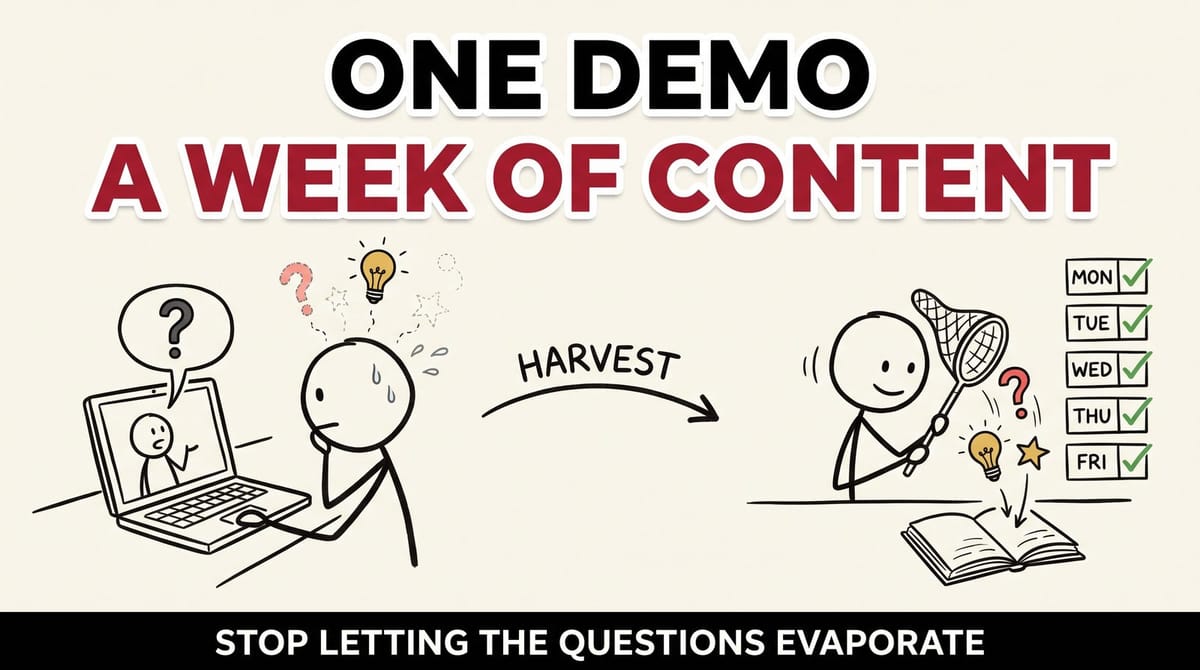
Last week I walked a client through her new site.
Halfway through, she stopped me and asked a question I have answered maybe two hundred times. Something like, "Wait, so if we want to change this later, do we have to call you every single time?"
I gave my usual answer. Clear, calm, a little rehearsed.
And then it hit me.
That question, the one I keep answering in demo after demo, is the exact thing a hundred other people are typing into Google at 11pm. And I was answering it once, in a private call, to an audience of one.
Then I was hanging up and letting the whole thing evaporate.
This post is about the reframe that fixed that, and the exact system I use now to turn a single client demo into a full week of content without inventing a single idea from scratch.
The demo is not just a sales event
A client demo feels like a sales event. You prep, you present, you answer questions, you hope they say yes. Then it is over and you move to the next one.
But a demo is not just a sales event. It is the single richest source of content you will ever sit inside of.
Think about what actually happens in that room.
A real person, with real money on the line, tells you exactly what confuses them. They ask the questions that scare them. They light up at the parts that matter. They push back on the things they do not believe yet. They tell you, in their own words, what would make them say yes and what is making them hesitate.
Companies pay research firms serious money to get one hour of that. Focus groups, user interviews, message testing, win-loss calls. It is a whole industry built on getting real buyers to tell you what they actually think.
You get it for free. Every demo. On a call you were already going to be on.
And most of us throw the entire thing away the second we hang up.
Why the blank page was never the real problem
I used to think content was a separate job. A thing you scheduled. Sit down, stare at a blank page, invent something smart to say, publish it, do it again next week.
That was three years of me producing almost nothing. Blank page, blinking cursor, close the laptop. I tried to force it more times than I want to admit. Results? Zero.
I blamed it on being busy. Then I blamed it on not being a "writer." Then I blamed it on being an introvert who would rather build than broadcast. (I wrote a whole piece about being the founder nobody sees, so trust me, the introvert excuse was real.)
None of those were the actual problem.
The actual problem was that I was trying to create content out of nothing. I sat down with an empty head and demanded that it produce insight on command. Of course the page was blank. I had not collected anything to put on it.
The demo flipped the whole thing.
Once I started treating demos as the source, I was not inventing anything anymore. I was noticing. I was collecting. The writing part got easier because the hard part, the raw material, was already done. It got done during a call I had to run anyway.
Here is the mindset shift in one sentence: you do not have a content creation problem, you have a content collection problem. And the demo is the best collection tool you already own.
What one demo actually contains
Let me get specific, because vague advice is useless. Here is exactly what I pull out of a single client demo now. One call. Five distinct content angles. A week of raw material.
1. The repeat question
The thing three clients in a row have asked. That is not a coincidence. That is your market telling you what to write.
My repeat question is the "do we have to call you every time we want to change something" one. It comes up in some form in almost every demo. That tells me two things. One, it is a real fear people have about working with an agency. Two, my website is clearly not answering it before the call.
If people are confused about the same thing in a paid demo, your website is confusing a hundred people who never booked the call. The repeat question is not just a content idea. It is a leak in your funnel that content can plug.
Write the post that answers it. Then put a version of that answer on your site.
2. The objection
The thing they push back on. "Isn't this overkill for a company our size?" "Why does this cost more than the other quote we got?" "Do we really need all of this?"
Every objection is a post. Not a defensive one. A generous one. "Here is why this matters, especially for a company your size" is a stronger piece of content than anything you would invent from a blank page, because it answers a real hesitation a real buyer just said out loud.
Objections are gold because they are the exact reasons people do not buy. Address them in public, before the call, and you shorten every sales cycle that follows. I made a version of this argument in why most B2B websites are just brochures. The demo tells you which brochure pages to turn into real answers.
3. The moment they light up
The part where their posture changes. They lean in. The tone shifts from polite to interested. Something you said just landed.
That moment is your value story, and most people miss it because they are too busy presenting to notice.
Start watching for it. And the second it happens, make a mental note of what you said in the ten seconds before. That sentence, the one that made them lean in, is your hook. It is the thing that matters most to buyers, discovered live, in real time, instead of guessed at.
4. The thing you had to re-explain
If you said it twice on one call, it is not obvious.
We are cursed with knowledge. The things we understand deeply feel simple to us, so we assume they are simple to everyone. They are not. The moment on a demo where you have to circle back and explain something a second way is a giant flashing sign that says "this is confusing to normal people, write it down."
Every re-explanation is a teaching post. And teaching posts are the ones that build trust, because they show you can make a hard thing simple.
5. Your own explanation
Here is the sneaky one.
The way you described the hard thing, out loud, under pressure, to a real person who needed to understand it? You just wrote copy. Good copy. Clearer than anything you would type, because you were talking to a human instead of performing for an audience.
Record your demos. With permission, obviously. Then pull the transcript. The section where you explained your core offer, your process, your differentiator, that is a first draft you did not know you were writing.
Five things. One call. And you did not have to invent a single one of them.
Why their words beat yours
This is the part that took me too long to understand, and it is the most valuable idea in this whole piece.
The words the client uses are better than the words you would write.
You would write "post-launch content governance." She said "do we have to call you every time." One of those is what people actually search and think and feel. It is not the one you would have written on your own.
When you harvest a demo, you are not just collecting topics. You are collecting the exact language your buyers use when they are confused, in the precise moment they are confused. That language is worth more than any keyword tool, because it is real, specific, and already in your buyer's mouth.
There is a name for this in copywriting: "voice of customer" language. Whole agencies charge for mining it out of reviews and surveys. You are generating it live, every demo, and you can just write it down.
The rule I follow now: write the post using their words, not yours. "Do we have to call you every time" out-performs "understanding your post-launch support model" every single time. Because one of them sounds like a person and the other sounds like a brochure.
A worked example: one demo, five posts, one week
Let me make this concrete with a real week. One website demo produced all of this.
Monday. The repeat question post. Title: "Do we have to call you every time we want to change our site?" A short, direct answer to the most common fear, written in the client's exact words. This is the highest-value post of the five because it plugs a real funnel leak.
Tuesday. The objection post. During the demo, the client asked why the build cost more than a template. So: "Why a custom build costs more than a template, and when it is worth it (and when it is not)." Generous, both-sided, not defensive.
Wednesday. The light-up post. She lit up when I showed how the new site would let her team publish without a developer. So: "The moment a website stops needing you is the moment it starts paying you back." Built around the exact benefit that made her lean in.
Thursday. The re-explain post. I had to explain twice what a staging environment is and why it matters. So: a plain-English teaching post: "What a staging site is, and why launching without one is a bad bet."
Friday. The transcript post. I pulled the two minutes where I explained our whole handoff process and turned it into a post about how we hand off a finished site so the client is never stuck. Lightly edited. Mostly just me, talking, cleaned up.
Five posts. One demo. Zero invented from a blank page. And every one of them is grounded in something a real buyer actually cared about, which means every one of them is more likely to land than something I dreamed up alone.
Take the best of those five and it becomes a Substack piece. Take the sharpest hook and it becomes a LinkedIn post. Take the teaching one and it becomes a short video. One demo can feed every channel you run. I broke down that multiplication in more detail in the marketing problem is usually a pipeline problem.
The only discipline that makes this work
None of this matters if the raw material dies in your memory by dinner.
I have lost more good content to "I will remember that later" than to any blank page. You will not remember it. The specific words, the exact question, the thing that made them lean in, all of it fades within an hour. By the time you sit down to write on Friday, the demo is a blur.
So here is the one habit that makes the whole thing repeatable. The second the demo ends, before the next thing, you spend five minutes dumping it.
Not writing content. Just dumping. Four prompts:
- What did they ask? (Especially anything you have heard before.)
- What confused them, or what did I have to say twice?
- Where did they light up, and what did I say right before?
- What did they push back on?
Five to ten bullet points in a note. In their words, not yours. That is the entire discipline.
I keep one running file. Every demo adds a few lines under that day's date. I do not organize it. I do not polish it. I just dump and close it.
By Friday, I do not have a blank page. I have a list of things real buyers were actually confused about this week, in their own language, ready to be turned into posts. The writing session that used to take two hours of staring now takes forty minutes, because the thinking is already done.
The blank page was never a creativity problem. It was a raw material problem. The demo solves the raw material problem, if you catch it before it evaporates.
The five-minute harvest, step by step
If you want to run this exactly how I run it, here is the whole system. It is almost embarrassingly simple, which is the point. Anything more complicated does not survive a busy week.
Before the demo: open a note. That is the whole prep. One open note titled with the client name and date.
During the demo: run the demo like you always do. Do not turn it into a research session, that changes the energy and clients can feel it. Just glance at the note when something lands, gets a question, or goes quiet, and drop one or two words so you can find it again later. "call every time." "cost vs template." "lit up at publishing." Fragments are fine.
Right after the demo: five minutes, four prompts above. Turn your fragments into full lines while the call is fresh. This is the non-negotiable part. If you skip it, the rest falls apart.
On writing day: open the running file. Pick the strongest three to five lines from the week. Each line is a post. Write the one that has the most heat first.
That is it. No content calendar gymnastics. No brainstorming sessions. No staring. The demos do the hard part. You just have to stop letting them evaporate.
Where this pays off beyond content
The best part of this system is not actually the content. It is what the collecting does to you as an operator.
When you start writing down every repeat question and every objection, you start seeing patterns. The same three fears come up over and over. The same part of your offer keeps confusing people. The same benefit keeps making them lean in.
That is not just a content list. That is a map of exactly where your sales process, your website, and your product are unclear. Content is the output. Clarity about your own business is the byproduct, and it is worth more.
I started this to fill a blank page. What I got was a running, real-time read on what my market actually thinks. That has changed how we write proposals, how we structure our site, and how we open sales calls, not just what we post.
Try this with your next call
You have a call this week. A demo, a walkthrough, a pitch, a discovery call. Something where a real person reacts to your thing in real time.
Do the demo like you always do. But this time, keep a note open.
Every time they ask a question, write it down. Every time they get quiet, write it down. Every time they say "oh, I get it now," write down what you just said.
Then, after, do not close the laptop. Spend five minutes turning that note into five content angles using the four prompts.
You will not need to invent anything. The person on the call already told you what your audience wants to know. You were just letting it evaporate.
The best content you will publish this month is not waiting to be created. It already happened. You were in the room for it.
I run a digital studio, Chykalophia, where we build and support websites for founders and teams who are tired of their site being a brochure that does not sell. If your demos and sales calls are full of the same questions your website should be answering, that is usually a sign the site is working against you. That is the kind of thing we fix. If you want to talk through it, reach out here.
And if you want more posts like this one, on content, GTM, and running a studio without pretending you have it all figured out, the newsletter is where I go deeper every week.
Related reading: LinkedIn for B2B founders, SEO & content marketing and Made to Sell, our book on websites that convert.
Get the next one by email
One practical fix every two weeks for owners of established B2B companies. Websites, conversions and operations, written plainly.

Peter Krzyzek
eter Krzyzek is co-founder and CTO of Chykalophia, the Chicago agency that builds strategy-led websites for established B2B companies, and co-author of Made to Sell.
Comments