
The Tiny Shopify Fields Quietly Deciding Your AOV
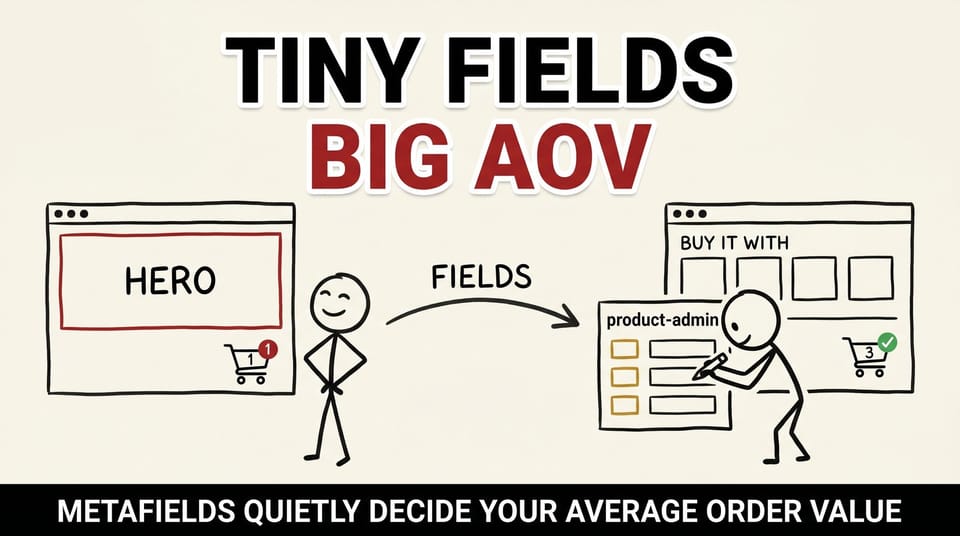
Table of contents
"I think it might be a theme issue, but I'm not sure."
That was the whole support ticket. One line. A founder convinced something on their Shopify store had broken, and reaching for the most visible explanation they could think of: the theme.
We jumped in to look. And here is the part that surprised them: the store was fine. The theme was fine. The product data sitting underneath the whole thing was the problem.
I have seen this pattern enough times now that I want to write it down properly. The thing that looks technical on the surface is almost always a growth story underneath. And in ecommerce, the most underrated growth story is the one hiding in the product admin, in a set of fields most founders have never opened.
Metafields.
Nobody starts a store because they got excited about metafields. But once a store starts to grow, metafields are frequently the difference between a one-product cart and a three-product cart. They quietly decide average order value. They decide whether your recommendations feel like help or noise. And they decide how much of the coming wave of AI personalization will actually work on your store, or just sit on top of a mess.
Let me break the whole thing down the way I wish someone had broken it down for me.
What a metafield actually is, in plain language
Forget the documentation for a second.
A metafield is a custom box of information you can attach to a product, a collection, a customer, or an order. Shopify gives you the standard fields out of the box: title, price, description, images, variants. Metafields are the extra fields you define yourself, for the things Shopify did not assume every store would need.
Think of a standard product as a person with a name tag. The name tag says who they are. Metafields are everything else you might want to know: their allergies, their shoe size, the three friends they always travel with, the thing they pair with everything.
For a coffee brand, a metafield might be "roast level," "tasting notes," or "best paired with." For a furniture store, it might be "assembly required," "room type," or "completes the set." For a supplement company, it might be "stack with," "time of day," or "goal."
On their own, those fields look like tidy housekeeping. The reason they matter is what they make possible downstream, in merchandising. Because once a product knows what it pairs with, your store can do something it could never do before: make an intelligent suggestion.
That is the whole game. Metafields are how a store stops guessing and starts knowing.
The hero section gets the credit. The metafields get the revenue.
Most ecom founders pour weeks into the hero section.
The headline. The big lifestyle photo. The above-the-fold moment they see first every single time they open their own site. It feels like the storefront, so it absorbs almost all of the attention and most of the budget.
I understand the instinct. The hero is visible. It is the thing you can show a friend. It is the part that feels like "the brand."
But here is what the hero section does not do. It does not decide how many items end up in the cart. It does not decide whether the customer adds the matching accessory. It does not teach your store anything about what your customers naturally buy together.
A set of tiny fields buried in the product admin decides all of that. Quietly. Without ever asking for credit.
When I look at a store that has plateaued on average order value, the hero is rarely the problem. The product data almost always is. The store has no structured idea of what goes with what, so every "related products" block is a shrug dressed up as a recommendation.
What that support ticket was really asking
When the merchant wrote "I think it might be a theme issue," they were really asking three questions, without knowing it.
Can a non-technical owner easily surface the right add-on or related product? Not by hand-coding it onto each product page every time. By setting it once, in a structured way, so the theme can render it everywhere automatically.
Does the theme expose metafields in a way that supports the merchandising strategy? A theme that ignores your metafields is fighting your strategy. A theme that reads them is amplifying it.
Are we structuring the data so future AI-driven recommendations have something meaningful to work with? Because the recommendation engine you adopt next year will only be as smart as the data you give it this year.
None of those are theme questions. They are data questions. And data questions are where the real money lives, even when they never show up in a design review.
This is the reframe I want every founder to make. When something feels "technical and broken," ask whether it is actually "structural and unfinished." Most of the time, it is the second thing.
What a couple of good metafield setups actually do
I cannot stand vague advice, so let me be specific about the payoff.
A thoughtful metafield structure makes three concrete things possible.
It turns a one-product cart into a three-product bundle, because the store finally knows which products belong together and can present them at the right moment.
It makes recommendations feel relevant instead of creepy. There is a real difference between "people also bought this" and "this is the exact accessory for the thing currently in your cart." The first is a statistical guess. The second is structured knowledge. Customers can tell which one they are looking at.
It powers "buy it with" sections that make genuine sense to the buyer, instead of showing them a random product from the same collection because that was the only logic the theme had available.
Same store. Same traffic. Same ad spend. Completely different cart.
That is what makes this such a high-return area. You are not buying more visitors. You are getting more value from the visitors you already paid for. For most brands, that is the cheapest revenue available to them, and it is sitting untouched in the product admin.
The uncomfortable truth about AI personalization
There is a lot of noise right now about AI-powered hyper-personalization. Smarter recommendations. Stores that seem to read the customer's mind. Most of it is arriving in 2026 whether your store is ready or not, and the marketing around it is loud.
Here is my honest take.
No amount of AI magic fixes a store where the underlying product data is a mess.
The fancy recommendation engine you are eyeing is only ever as good as the data you feed it. If your products do not know which other products they relate to, the AI is guessing from purchase history and hoping. And buyers can feel a guess. It reads as noise, not help, and noise trains people to ignore the recommendation block entirely.
So I want to retire a bad mental model. Clean product data is not the boring prerequisite you have to slog through before you get to the exciting AI stuff. Clean product data is the exciting AI stuff. Everything downstream depends on it. The model is just an amplifier, and an amplifier turns up whatever you put into it, signal or noise.
The founders who will quietly win the personalization race are not the ones buying the most apps. They are the ones who structured their data now, so that every tool they add later actually has something real to work with. This is the same lesson I keep running into in other parts of the business: the unglamorous foundation decides how much the exciting layer on top is worth.
What this costs you if you ignore it
If your product pages are static, you are likely leaving two things on the table.
The first is obvious. Revenue. Every cart that could have been a bundle and was not. Run the math on even a modest lift. If your average order value is 60 dollars and structured merchandising moves it to 72, that is a 20 percent lift on every single order, with no extra ad spend. Across a year, that number is not small.
The second cost is sneakier, and in some ways more expensive. Insight. When you structure how products relate to each other, you start to learn what your customers naturally buy together. That insight feeds your bundling, your ad creative, your email flows, and your next product line. A static store never teaches you anything. It just processes orders and forgets them.
Metafields are how you teach your store which products belong together. And they are how you build the foundation for real personalization later, instead of bolting an expensive app onto a shaky base and wondering why it underperforms.
The non-technical founder's metafield checklist
You do not need to become a metafields expert. You need to ask sharper questions of the person who already is. Here is the checklist we walk merchants through inside Delivery, written so a non-technical owner can run it.
- List your top ten products by revenue. Open each one. Can you, in plain language, name the products that should appear in its "buy it with" or "related" section? If you can, your store should know that too. If your store does not, that is gap number one.
- Audit your "related products" logic. Ask your dev or ops partner one question: how does the store currently choose related products? If the answer is "same collection" or "the app picks," you are running on a guess, not a strategy.
- Define your pairing rules in human terms first. Before anyone touches the admin, write the merchandising logic in sentences. "Every grinder pairs with these two filters and this cleaning kit." Metafields are just where those sentences get stored.
- Check that your theme actually reads your metafields. A metafield nobody renders is a note nobody reads. Confirm the theme surfaces them on the product page, in the cart, and in any "complete the set" block.
- Name an owner. Metafields rot if nobody maintains them. New products launch without pairings. Someone, a person, not an app, needs to own keeping the structure current.
- Revisit quarterly. Customer behavior shifts. The pairings that made sense last spring may be stale now. Put a recurring 30-minute review on the calendar.
If the honest answer to most of these is a shrug, that is not a failure. That is a found opportunity, and most of your competitors have the exact same shrug. The first brand in a category to treat product data as a strategy usually pulls ahead quietly, before anyone notices why.
The common mistakes that quietly tank recommendations
Most metafield problems are not exotic. They are the same handful of mistakes, repeated across thousands of stores.
The first is treating metafields as a developer toy. Someone technical sets up a beautiful structure, then leaves. Nobody else understands it, so nobody maintains it. Six months later, half the catalog has empty fields and the recommendations have quietly degraded back to random. Metafields are a merchandising tool that happens to live in a technical place. The owner should be whoever owns merchandising, with technical help, not the other way around.
The second is building structure with no strategy behind it. Fields get created because they sounded useful, not because they map to a real decision the store needs to make. You end up with twelve metafields and no clear rule for any of them. Always write the merchandising logic in plain sentences first. The fields are just storage for a decision you already made.
The third is the silent theme mismatch. A merchant fills in every field perfectly, then never checks whether the theme actually displays them. The data is immaculate and invisible. Before you invest hours populating fields, confirm the theme renders them where it matters: the product page, the cart, and any "complete the set" block.
The fourth is set-and-forget. A store sets up pairings once, at launch, and never revisits them. But the catalog grows. New products arrive with no pairings. Bestsellers shift. The structure that fit last year slowly stops matching reality. This is why the quarterly review on the checklist matters more than the initial setup.
None of these require a rebuild to fix. They require an owner, a strategy written in plain language, and a recurring 30 minutes on the calendar.
Where this fits in the bigger picture
I write a lot about the gap between the work that looks impressive and the work that actually moves the number. This is another version of that story. The hero section looks impressive. The metafield structure moves the number.
It also rhymes with something I believe about almost every "technical" problem a founder brings me. The surface complaint is rarely the real issue. "The theme is broken" turns into "our merchandising has no structure." "The site feels slow" turns into "we never decided what mattered." The job is not to fix the symptom. It is to find the structural question underneath it and answer that one.
If you run an ecommerce brand and your product data has never had a serious review, that is the highest-return afternoon you can book this quarter. Not a redesign. Not a new app. A structured look at the boring fields that decide your cart.
Want the checklist and a second set of eyes?
If you want the full metafield review checklist as a working document, or you want our Delivery team to audit your store's product data and merchandising structure directly, that is exactly the kind of work we do. The fastest version is a short audit: we look at your top products, your related-product logic, and how your theme exposes your metafields, then hand you a prioritized list of what to fix first.
Reach out through Chykalophia and mention you read the metafields piece. I will make sure it gets to the right person on the team.
The hero section gets the credit. The metafields get the revenue. Go look at yours.