Designing the End: How to Shut Down a Product Without Burning Trust
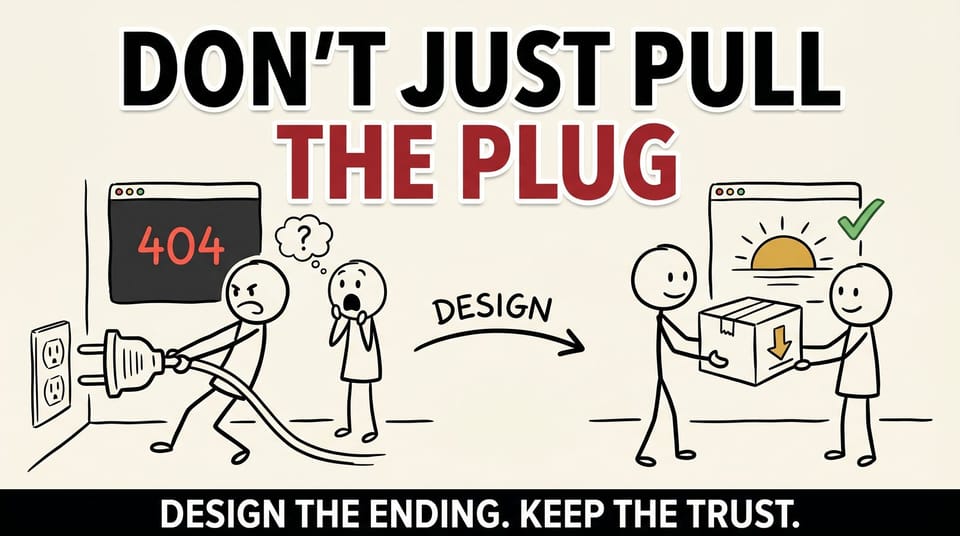
Table of contents
Right now, my team is helping a long-running education brand shut down an online program people genuinely love.
Not pivot it. Not rebrand it. Not "evolve the offering." End it. On purpose, with a date on the calendar.
And the longer I'm inside this project, the more convinced I am that endings are one of the most neglected disciplines in business. There are a thousand playbooks for launching something. Courses, frameworks, entire conferences about go-to-market. For shutting something down, you get a cancellation policy template and a shrug.
So most companies wing it. The site goes dark, the subscriptions stop, one cold email goes out, and the brand quietly absorbs whatever damage follows. Nobody measures the damage, so nobody learns from it.
This post is the playbook I wish someone had handed us before we started. It's what we're actually running, mid-project, with the results we're seeing so far.
The default shutdown, and why it fails
Let me describe the easy path first, because it's genuinely tempting.
The easy path on this project was three steps. Flip off the site. Kill the subscriptions. Send one "we're closing" email. A week of work, maybe two. Invoice, handshake, done.
Here's what that version costs, itemized, because the costs are real even though they never show up on the project budget:
Support chaos. Every customer who discovers the shutdown by hitting a dead login page becomes a support ticket. Multiply by your active user count. Now imagine the tone of those tickets.
Refund disputes. Customers billed after access disappeared don't email politely. They go to their credit card company. Chargebacks on a dying product are pure loss: you pay the fee, lose the dispute, and the payment processor flags the account.
Data panic. People had things in your product. Course progress, files, certificates, history. When it vanishes without an export window, some percentage of those people will be furious, and a smaller percentage will be furious publicly.
Brand scar tissue. This is the expensive one. The team behind this program will build something again. The founders always do. And when they do, the first Google result conversation will include how the last thing ended. "They just disappeared" is a sentence that follows a brand around for a decade.
The easy path isn't actually cheap. It just moves the cost somewhere the project plan doesn't look.
The reframe: a launch in reverse
When this engagement started, the team made one framing decision that changed everything downstream.
Treat the shutdown like a product launch in reverse.
Think about what a real launch involves. Audience segments mapped. A sequenced rollout where each step depends on the last. Copy that's been rewritten eleven times because the first impression matters. Someone watching support channels on launch day. A plan for what happens if something breaks.
Nobody would ship a product by flipping a switch and hoping. But that's exactly how most products die. Switch flipped. Hope deployed.
Running the ending like a reverse launch gave us three concrete workstreams, and I want to walk through each one with enough detail that you could actually copy this.
Workstream 1: Map every touchpoint
The first deliverable wasn't technical at all. It was a list.
Every single place a student touches the product is a place the ending will land. For this program, the map included:
- Login screens and password reset flows
- Billing portal and payment methods on file
- Course access and saved progress
- Downloadable materials and certificates
- Community spaces and discussion threads
- The support inbox and its auto-responders
- Email sequences still running on autopilot
- Social accounts and pinned posts pointing at the program
The list was longer than anyone expected. It always is, and here's why: the leadership team making the shutdown decision stopped logging in as a user years ago. They see the product as a P&L line. The customer sees it as fourteen different surfaces, and every one of those surfaces is about to change.
The exercise we ran: walk the entire customer journey as a current student, screenshot every surface, and ask "what does this person need to know, and when, for this surface to change without shocking them?"
That question generates your communication plan almost automatically. The touchpoint map is the skeleton of everything else.
Workstream 2: Sequence the teardown
Platforms are tangled. Billing talks to the auth system. The auth system talks to the course platform. Email runs through a domain that's also pointed at the website. Backups live in an account someone pays for annually and forgot about.
If you remove things in the wrong order, you don't get a graceful ending. You get a broken product limping toward a deadline, and customers experiencing random failures during the exact window when you most need them to feel taken care of.
I wrote about this same project earlier this year, when a security tool got disconnected one step too early and the site flickered. That incident is what pushed the closure date from March 11 to March 30, and the decision to move that date instead of grinding through it became its own lesson. The full story is here: Move the date
The sequencing principle is simple to state and tedious to execute: tear down in reverse dependency order, and never close a door customers are still using.
In practice, for this program:
- Data exports open before anything closes. Students got a window, with reminders, to download progress, materials, and certificates.
- Billing stops before access stops. Nobody gets charged for a product that's mid-shutdown. This single rule prevents the entire chargeback category.
- Email handoff happens before DNS changes. The brand keeps the ability to reach people after the platform is gone. Cutting your own email lifeline mid-shutdown is the most common self-inflicted wound we see.
- Access closes on the announced date, not before. Trust is binary here. If you said June 30, dark screens on June 28 undo every careful email that came before.
- Archive, then dismantle. Full backups, exported records, and documentation land in the owner's hands before any vendor account gets cancelled.
Every removal got a date, an owner, and a verification that the previous step actually finished. This is the unglamorous middle of the project. It's also where most shutdowns quietly fail, because nobody assigned an owner to "check that the export window actually worked."
Workstream 3: Write copy that honors the community
The default shutdown email reads like it was written by a lawyer holding their nose. "Effective June 30, services will be discontinued. We thank you for your patronage."
The students in this program spent years there. Some of them built friendships, careers, and chunks of their identity around it. Sending those people a terms-of-service update as a goodbye is a small act of brand vandalism.
The closure copy we shipped does four things, in order:
It acknowledges what the program meant. Not in marketing language. In specifics. The years, the community, the work people did there.
It explains the why in plain language. People can handle "this chapter is ending and here's the honest reason." What they can't handle is corporate fog. Fog reads as hiding something, and people fill the gap with the worst version.
It tells people exactly what happens to their stuff. Data, billing, access, certificates, dates for each. Specificity is the difference between an announcement and an alarm.
It points to what comes next. Where to follow the team. What's being built. A forwarding address for the relationship, not just the mail.
One drafting trick that helped: we read every email out loud and asked, "would a person say this to a friend they respect?" Any sentence that failed got rewritten. Legal language survives that test almost never, which tells you something about the default templates.
What it actually bought
Here's what I can report from the middle of the project, with the usual caveat that we're not done.
Fewer panicked support tickets. When people know what's happening and when, they don't flood the inbox asking. The support load during the announcement window came in well under what the team braced for.
Warmer replies to the final emails. People wrote back to say thank you. To a shutdown notice. I've watched launch emails get colder responses than this program's goodbye.
Students asking "what are you building next?" instead of "why did you vanish?" This is the one that matters. The audience of a dying product is asking where to follow the team. That's not a closure. That's a customer list that survives the product it came from, which is arguably the most valuable thing a shutdown can produce.
The real asset
This is the part I'd want every founder and every agency owner to sit with.
The real asset was never the old platform. The code gets archived. The domain eventually lapses. The real asset is the way you handled people on the way out, because that's the trust you carry into whatever you build next.
Designing the end of a digital experience does three durable things:
It protects trust you'll need later. The team behind this program will build again. When they do, thousands of former students will already know how this brand behaves when there's nothing left to sell them. That's a launch advantage you cannot buy.
It prevents expensive cleanup in your stack. Orphaned vendor accounts, zombie subscriptions, unclaimed data, surprise renewals on tools nobody remembers. A sequenced teardown closes these out while the knowledge still exists. An abrupt one leaves a minefield for whoever opens the books in two years.
It gives you a narrative you can reuse. "Here's how we closed our last product" is a story you'll tell in future launches, partner conversations, and investor meetings. The teams that handle endings well get to tell it proudly. Everyone else changes the subject.
You don't get many chances to prove you value relationships more than MRR. A shutdown is one of the only moments where the proof is unambiguous, because there's no revenue left to chase. Everything you do in a closure is pure signal about who you are when there's nothing to gain.
Companies spend fortunes on brand campaigns trying to manufacture that signal. A well-designed ending produces it for free.
The 5-step closure checklist
If you're sunsetting a product, program, or platform, here's the condensed version of what we're running:
- Map the touchpoints. Walk the product as a customer. List every surface the ending will touch, technical and emotional. Screenshot everything.
- Sequence in reverse dependency order. Exports before closures. Billing off before access off. Email secured before DNS moves. Archive before dismantle. Dates and owners on every step.
- Write the comms like a human. Acknowledge what it meant, explain why plainly, spell out what happens to their stuff, and leave a forwarding address.
- Hold the announced dates. Early surprises destroy the trust the whole plan is building. If a date has to move, say so before it lands, not after.
- Capture the audience relationship. The product dies. The list, the goodwill, and the "what's next" attention don't have to. Give people somewhere to follow.
Print it, argue with it, adapt it. The steps are simple. The discipline of actually assigning owners and dates to each one is the part most teams skip.
Who owns the ending?
One structural note, because this is where I see projects stall before they start.
A shutdown has no natural owner. The product manager is already reassigned. Engineering wants to archive the repo and move on. Marketing doesn't want to write a goodbye. Finance just wants the vendor invoices to stop. Everyone has a reason to not be the person holding the checklist, which is exactly how a company ends up with the flip-the-switch version by default.
Our fix on this project was blunt: the closure got a named delivery lead, a real timeline, and standing updates, exactly like a build project would. The moment someone owned the ending, the ending started behaving like a project instead of a chore. Status updates went out. Dates got defended or consciously moved. Questions had a place to go.
If you take one operational thing from this post, take that. Assign the ending to a person, not a department. A shutdown that belongs to everyone belongs to no one, and the customers can tell.
There's a quieter benefit too. The team running this shutdown isn't burned out by it. Closure work usually grinds people down because every day is an apology. When the plan is public and the sequence is holding, the work feels like craftsmanship instead of damage control. The same people who close this program well are going to build the next one, and they'll start it without the residue.
Three questions before you touch a switch
Have we mapped every place this change will emotionally land for customers? Not just technically land. Emotionally. The saved progress, the community threads, the years of history.
Are we sequencing tech and comms together, or just turning things off? If your DNS change and your goodbye email aren't on the same timeline, one of them is going to embarrass the other.
What story do we want customers to tell about how we handled this? Because they will tell one. The only question is whether you wrote it or they did.
If you're staring at a sunset
I don't have endings all figured out. This is the first closure I've helped design this deliberately, and I'm taking notes as the project finishes. But the core idea has already paid for itself.
Most teams obsess over launches. The mature ones design their endings just as carefully.
If you're winding down a product, a program, or a whole platform and you want a second set of eyes on the sequencing, this is exactly the kind of unglamorous work my team does at Chykalophia. The touchpoint map alone usually surfaces three or four landmines before they go off.
And if you've ever been on the receiving end of a shutdown, good or bad, I'd genuinely like to hear what they did. I'm collecting examples, because the field has no literature and somebody should start writing it down.