The Riskiest Part of Shutting Down a Digital Business Is the "Can I Just Cancel This?" Email
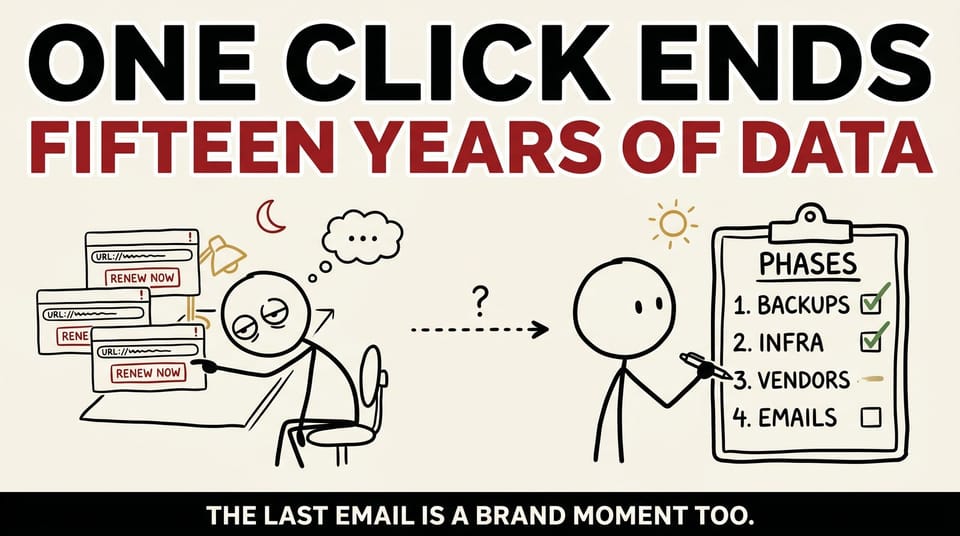
Table of contents
"Am I good to just cancel those things? Anything I need to know before I do that?"
That email came in at 10pm on a Tuesday. It was the kind of email a thoughtful founder writes after she has been awake too long, with too many tabs open, looking at a vendor renewal notice she does not want to deal with. She had run her digital school for fifteen years. She had survived three platform migrations and one ransomware scare. She was not careless.
We were halfway through shutting down her digital footprint.
On paper the work was straightforward. Back up the main site and the courses site. Wind down the security tools. Clean up DNS and the domains. Remove old admin users on AWS. Cancel a stack of subscriptions in the right order. A list any senior technical operator could write on the back of a napkin in five minutes.
In practice, the list does not include the part where the founder is one click away, at 10pm, from breaking something nobody can put back.
Backups were still in flight. The DNS for the new redirect was halfway propagated. We had not finished the AWS audit. Two of the subscriptions in her renewal queue still held data she would need for the next year of tax reporting.
If she cancelled the wrong vendor first, the courses archive could become unrecoverable. If she cancelled the DNS provider before the redirect was confirmed, her course alumni would land on a 404 the next morning. If she cancelled the email service before we exported the customer list, fifteen years of opt-ins would vanish without an audit trail.
This is the part of digital offboarding that nobody puts in the case study.
The risk is not the stack. It is the trusting click.
I have shut down a few digital businesses over the years. Some were quiet retirements. One was an emergency. The work in front of you on day one always looks like a security exercise. Backups. Access controls. Domain transfers. Subscription cancellations.
The work that actually decides whether it goes well is the founder's confidence in what to click next.
A founder who has built something for fifteen years has internalized one bias. Most of the time, when a vendor sends an urgent email, the safe answer is to handle it quickly. Pay the renewal. Confirm the contact info. Click the link to keep the lights on.
In a shutdown, that bias is exactly wrong.
Half the urgent emails are urgent because they are auto-generated by a billing system that does not know the business is closing. Half of them want to pull her back into a relationship she has already decided to leave. A handful of them are legitimately important, and only one or two of those are in the right phase for action this week. None of them care whether the backup is finished yet.
The riskiest moment in a digital shutdown is not when an attacker shows up. It is when a thoughtful, exhausted founder reads a "your subscription expires in 72 hours" email and decides to take initiative.
What a phased plan actually looks like
The thing that kept this client out of trouble was not a security tool. It was a phased plan we wrote on day one and committed to in plain language. Three pages. No security jargon. Every step had an owner and a "do not start this until X is confirmed" gate.
The phases below are the version we ship for digital service businesses. They are not the only way. They are the version that has worked for me across the last five closures.
Phase one: data
Get every site, every course, every customer record, and every transaction history out of the live systems and into something durable.
For most digital businesses this means:
A full file-system backup of every site. WordPress, custom apps, course platforms. Pull a tarball, store it somewhere outside the platform's own backup system.
A database export for each system, with a sanity-check restore on a different host. A backup you have not restored is not a backup. It is a hope.
A customer-record export with full opt-in audit trail. Email list, transaction history, support ticket history, customer-supplied content. This is the data that matters most for trust, taxes, and any future obligation.
A transaction-record export covering every platform the business took payment on. This is the data the accountant will ask for in eighteen months.
No vendor account gets touched until the data is independently verifiable on a system that the closing business owns or controls.
Phase two: infrastructure
Switch DNS to a parked-page provider, or to the new owner if the brand is being acquired. Confirm the redirect works for every legacy URL the closing business still cares about.
Take down the security tools only after the new state is verified for at least a 24-hour window.
If there are SSL certificates with auto-renewal, decide whether to let them lapse or to transfer them. Most closures let them lapse, but the parked-page experience needs to look intentional, not broken.
If there is an active email-sending domain, decide whether to keep DKIM/SPF/DMARC alive for a transition period so that the final "we are closed" message lands in inboxes, not spam folders.
Phase three: vendor accounts
Cancel in a specific order, with one person responsible for confirming each cancellation went through cleanly.
The order matters. You cancel the application-layer vendors first (the ones that depend on the data you have already exported). You cancel the infrastructure-layer vendors last (DNS, registrar, the cloud account itself). In between, you cancel the security and monitoring tools only after their last useful day has passed.
For each cancellation, save the final invoice. Save the cancellation confirmation. Save a screenshot of the account showing "closed" or "cancelled" status. Put all three in a folder labeled by vendor name and date. Future-you, or a future tax accountant, will thank present-you for the audit trail.
Phase four: the human one
Pre-written emails to alumni, partners, and the small number of stakeholders who still care. Each one signed personally. None automated.
A short FAQ on the parked page for the most common questions: how do I get my data, where did my courses go, who do I contact about a refund or an outstanding invoice.
A handful of personal outreach notes from the founder to people who matter. Long-term partners. Top customers. The few people whose ongoing trust is worth more than the time it takes to write a 200-word email.
This phase is the one most shutdown checklists treat as optional. It is the only one the founder will be remembered for.
Translating "scary email" into "phase, not panic"
The other thing that mattered was the small, almost boring, language work.
Every vendor email that looked alarming, we translated. Sucuri sent a renewal nag. We sent her one sentence: "this is a phase two cancellation, scheduled for next Tuesday after the backup verification, no action needed today." The DNS provider sent an unrelated upsell. One sentence: "ignore, not in our plan." AWS sent an account-audit reminder. One sentence: "this is exactly phase two, here is what we will do on Thursday."
Most of these took ninety seconds to write. The compounding effect on the founder's stress level was enormous.
She was not getting better at reading vendor emails. She was getting permission to not read them in isolation. Every alarming inbox notification got plugged into the plan, and the plan told her what to do next.
The single sentence we used most often was a question, not a statement: "what phase is this in, and what is the gate that lets us act on it?" After two weeks, she was writing that sentence herself when a vendor email landed. By the end she did not need me to translate anymore.
This is the part most "shutdown checklists" online get wrong. The checklist itself is the easy part. The hard part is building the habit of routing every incoming nudge through the plan instead of into the founder's late-night decision-making.
What the email at 10pm actually meant
When the founder sent the "am I good to just cancel those things" email at 10pm, it was not a request for permission. It was a request for a frame.
She had three vendor renewals stacked up. She had been awake for sixteen hours. She wanted to clear her inbox. The fastest path felt like cancelling them all and going to bed.
The right path was to write back four sentences:
Two of those are phase three vendors. They are on the cancellation list for Tuesday after we verify the backup restore on Monday. The other is a phase one data vendor that we cannot cancel until we have a verified export, which is scheduled for Wednesday. None of them require action tonight. Go to sleep.
She did. She wrote back the next morning with a thank-you. She never asked another "can I just cancel" question for the rest of the closure.
That four-sentence response is the work. Not the security stack. Not the cancellation order. The fact that, at 10pm on a Tuesday, the founder had a person to ask and a plan to ask against.
Offboarding as a brand moment
Here is the part I did not expect to find when I started this work.
Most of what we read about customer experience in service businesses is about onboarding. The welcome flow. The first thirty days. The lifecycle email sequence. Every vendor in the space is selling onboarding automation right now.
Almost nothing is written about closing the door on the way out.
But the founder remembers her last interaction with you longer than her first.
The way you handle the closure is the version of you she will tell her network about when somebody asks "who do you trust on the technical side?" Even when she is not coming back as a customer, she is now your highest-leverage referral source for the next twenty years of her career.
A panicked, fragmented shutdown produces a founder who is privately relieved you are no longer in her life. A thoughtful, phased shutdown produces a founder who introduces you to the next three people she meets. The difference between those two outcomes is, in my experience, almost entirely a function of how many "is this safe to click" moments the founder had to absorb alone.
In a year when every vendor is selling AI-powered onboarding flows, the quiet differentiator is how carefully you handle the offboarding.
The connection to pipeline
I have written a lot recently about pipeline for B2B service firms. The argument I keep making is that most $5M-$20M B2B service firms do not have a marketing problem. They have a pipeline problem, and the pipeline problem is usually a website that is not doing the work for them.
Most B2B service firms don't have a marketing problem. They have a pipeline problem.
Offboarding lives inside that same conversation, just on the other end. The website is the front door. The shutdown is the back door. Both are pipeline-relevant, because both are trust-creating or trust-destroying moments. A site that does not pull its weight loses you the trust of a prospect before they ever talk to your sales team. A shutdown that breaks things loses you the trust of a customer at the precise moment when they were about to become a referral source for the next decade of your work.
Trust does not just compound from the start. It also compounds backwards from the end.
What a shutdown playbook costs to build
The first phased shutdown plan we wrote took about four hours of senior time, spread over a week, plus another six hours of execution time as each phase came due. The second one took half that. The third one we now have as a template.
The template lives in a Google Doc. It has four sections, matching the four phases above. Each section has a checklist of typical tasks for a small digital business, with blanks where the specific vendors get filled in. The bottom of the doc has the standing "translate this email" language we use to plug new vendor pings into the plan.
The thing that takes the longest is not the template. It is the conversation in the kickoff meeting where we map every vendor in the closing business to a phase, and where we identify the two or three vendors whose data dependencies cross phase boundaries. Those are the cancellations you can get wrong. The rest is mechanical.
If you are a service provider running this work for clients, the template plus the kickoff meeting will repay itself the first time you avoid a 10pm "I cancelled the wrong thing" call.
If you are a founder running it yourself, the template is still worth half a day of your time on a Sunday afternoon. Future-you will thank present-you.
What I want you to do today
If you provide any kind of digital service to a small business, ask yourself three questions before the next closure email shows up in your inbox.
Do you have a non-guessy, written-down playbook for how to shut a property down without breaking anything?
Does that playbook have a real person, not a tool, owning each phase?
When the founder gets a scary vendor email in the middle of phase two, who translates it for her in one sentence so she does not have to decide alone?
If the honest answer to any of those is "no" or "I think so," your next strategy session is not about a new funnel. It is about what your last email looks like.
If you are inside a service firm and the closure-work falls to you, the same questions apply. The playbook is not in the security training. It is not in the customer-success handbook. It is the one operator-level document most agencies and most internal teams have not written down yet.
The firms that write it down keep the founder's trust through the closure and out the other side. The firms that do not, lose it in one wrong click.
A small ask
If this resonated, two things would help.
First, share it with one founder you know who is either thinking about a shutdown, in the middle of one, or has recently survived one. The "I wish I had read this six months ago" reaction is the most common feedback I get on this piece.
Second, if you have run a digital shutdown yourself, tell me what you would add to the playbook. Every closure I have run has produced one new line item I did not have before. I want yours too.
The series this piece sits inside is about the boring stuff. Pipeline conversations every B2B services founder needs to be having with their website, their operations, and their relationships. Most of it is unglamorous. All of it compounds.
Trust does too. From both ends.