The Partial Launch That Saved a Full Website Rebuild
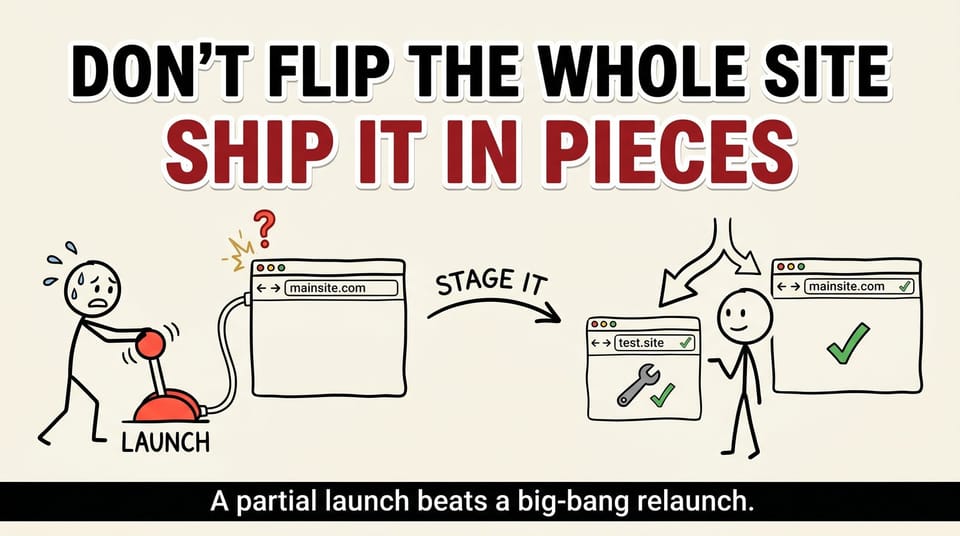
Table of contents
Everyone loves a launch day.
The "our new site is live" post. The homepage screenshot. The confetti in the comments. The little dopamine hit of pushing something into the world and telling everyone you did it.
I used to love them too. Then I watched enough of them go sideways to learn something quieter.
The best website launches I have been part of were the ones nobody announced. No fanfare. No held breath. Just a new site that quietly started working, because by the time it went live, all the scary parts had already been tested somewhere safe.
This is the story of one of those, and the playbook you can copy.
The setup: a live asset and a new build waiting to ship
A while back, our team was brought in to QA a new website experience for a client before a full rebuild went live.
The situation was the one a lot of growing companies find themselves in. There was a live production site doing real work. Real traffic, real search rankings, real leads coming through the door every single day. And there was a new build, a fresh brand and a new layout, sitting on staging and waiting to ship.
The obvious plan was the one almost everyone reaches for. Finish the rebuild. Pick a launch day. Flip the domain. Announce it to the world.
We did not do that.
Instead, we pushed a partial version of the new site live on a separate domain first. A clean playground that was not the client's main URL. Social posts and ad campaigns pointed there. Meanwhile, search traffic and existing customers kept landing on the stable site that already worked.
Same company. Two surfaces. One safe and being tested in the open, one proven and left alone.
It sounds almost too simple to matter. It mattered enormously.
Why your main domain is not just a website
To understand why the second domain is worth the trouble, you have to stop thinking of your website as a website.
Your main domain is an asset. Specifically, it is several assets stacked on top of each other:
- Search equity. Years of rankings, backlinks, and crawled history that you cannot rebuild quickly if you break it.
- Conversion plumbing. The forms, the tracking, the integrations, the analytics that actually turn visitors into leads and tell you what is working.
- Trust. Returning customers who already know where the button is and expect it to behave.
When you flip that domain to a brand new build, you are betting all three survive the switch at the same moment. New templates, new URLs, new code, new tracking, all going live at once on the property that feeds your business.
Most of the time it works. The times it does not are expensive, and they are public. A redirect map with a hole in it quietly tanks rankings for a month before anyone notices. A form that submits to nowhere costs you leads you will never know you lost. A layout that breaks on the one device half your audience uses turns your shiny new homepage into a bounce machine.
A partial launch on a second domain changes the bet. Instead of putting everything at risk in one moment, you move the risk somewhere it cannot hurt you.
The move: a partial launch on a safe domain
Here is the shape of it.
You stand up the new experience, or a meaningful slice of it, on a domain that is not your money-making URL. A subdomain works. An alternate domain works. A dedicated campaign microsite works. The only requirement is that nothing on it is load-bearing for your current revenue or your current SEO.
Then you point forgiving traffic at it. Campaign clicks. Social visitors. Email recipients. These are people who arrived on purpose, from a source you control, and who are far more forgiving of a rough edge than someone who searched for your brand and expects perfection.
Your search traffic and your existing customers never see the test surface. They keep landing on the proven site, which keeps doing its job while you experiment next door.
You are not launching. You are rehearsing the launch in front of a small, friendly audience, with real data, before the real thing.
What we actually watched: the QA that mattered
The QA was not a checklist someone skimmed at the end of the project. It was the entire point of the partial launch.
A staging environment lies to you. Every input is fake, every tester is on the team, and everyone is gentle with the thing they built. Real traffic does not lie. It does weird things in weird orders on devices you did not plan for, and that is exactly what you want to see before the stakes are high.
So we watched the things that only break when a stranger touches them:
- Forms under real load. Did they submit, route, and notify correctly when actual prospects filled them out, not just when one team member entered a polite test record.
- Animation and scroll behavior on real devices. The buttery animation on a designer's monitor can stutter badly on a three-year-old phone. Real traffic shows you which.
- Layout across real screen sizes. Not the three breakpoints in the design file. The long tail of widths and zoom levels that humans actually use.
- Accessibility and interaction edge cases. The bugs that never appear until someone tabs through in the wrong order, or uses a screen reader, or clicks the thing you assumed nobody would click.
Every bug we found on the test domain was a bug we did not ship to the main one. Every rough edge a campaign visitor hit was one a returning customer or a search visitor never had to experience.
That is the whole trade. You let a low-stakes audience meet the messy version so that your highest-stakes audience only ever meets the clean one.
Big bang versus boring: where the risk really lives
This is a small move with a big idea behind it.
The instinct on a redesign is the big bang. One date, one switch, one announcement, one held breath. It feels decisive and it photographs well. It also concentrates every bit of your risk into a single moment, which is the worst possible place to keep it.
The boring version spreads the risk out across time. Ship a partial version somewhere safe. Route low-stakes traffic to it. Measure what happens. Fix what breaks. Then, when the new build has actually earned it, flip the main domain with almost nothing left to chance.
I wrote a while back about how moving a deadline can be braver than grinding through one. This is the same muscle. It is risk-managed delivery instead of heroics. Both come from the same belief: that the job is to protect the client, the team, and the outcome, not to produce a dramatic moment you can post about.
When your website is a primary sales asset, boring is not a compromise. Boring is the professional choice.
The partial-launch playbook
If you want to copy the pattern, here is the sequence we run.
- Pick the safe surface. Choose a subdomain, an alternate domain, or a campaign microsite. The test: if it went down for an hour, would it cost you revenue or rankings? If yes, it is not safe enough.
- Decide what slice ships first. You rarely need the whole new site to learn something. The homepage, the top landing page, and the primary form are usually enough to surface the bugs that matter.
- Route forgiving traffic. Send campaign and social visitors to the safe surface. Leave search and direct traffic on the proven site untouched.
- Instrument everything. Before a single visitor arrives, make sure analytics, form tracking, and error logging all work on the test surface. Untracked traffic teaches you nothing.
- Watch real behavior for a real window. Give it long enough to collect honest data across devices and sources. A day is noise. A couple of weeks is signal.
- Fix, then flip. Resolve what real traffic surfaced. Only then plan the main-domain switch, with a clean redirect map and a rollback ready.
None of these steps are clever. All of them are the difference between a launch you sweat through and one you barely notice.
How to choose your safe surface
The most common question here is which kind of safe surface to use, and the honest answer is that it depends on what you are trying to learn.
A subdomain (like new.yoursite.com) is the easiest to stand up and shares some context with your main site. It is great for testing experience and conversion, less ideal if you want a fully clean SEO separation.
An alternate domain gives you the cleanest separation. Nothing you do there touches your main domain's search equity, which makes it the safest playground for aggressive changes. The tradeoff is a little more setup and the need to handle the eventual consolidation carefully.
A campaign microsite is perfect when you only need to test a slice, like a new landing experience for a specific offer, rather than a whole site.
For a high-stakes rebuild where protecting the main domain's SEO is the priority, the alternate domain is usually worth the extra setup.
What to measure before you flip the main domain
A partial launch is only useful if you actually watch the right things. Pick three to five behaviors that map to your business and track them on the test surface against your current baseline:
- Form completion rate. The clearest signal that the new experience converts at least as well as the old one.
- Scroll depth and engagement. Are people getting to the parts of the page that matter, or bailing at the new hero.
- Load time on real devices. Especially mobile, where a heavy redesign quietly punishes you.
- Bounce or exit rate on the key pages, compared to the proven site.
- Conversion on the primary action, whatever yours is.
If the new experience matches or beats the old one on the metrics that matter, you flip with confidence. If it does not, you just saved yourself from launching a downgrade on your most important property.
Handling the eventual domain switch
The partial launch does not replace the main-domain switch. It de-risks it. When the time comes to flip:
- Build the redirect map first, page by page, and test it before you need it.
- Preserve the URL structure where you can, and redirect cleanly where you cannot.
- Keep tracking and analytics continuous across the switch so you can see the impact immediately.
- Have a rollback plan, and make sure the whole team knows the trigger for using it.
Because you already tested the experience on real traffic, the switch becomes a plumbing exercise rather than a leap of faith. That is the entire goal: turn launch day into the least interesting day of the project.
When a partial launch is the wrong call
Honesty matters more than a clean framework, so here is the caveat.
A partial launch is not free. You are running two surfaces for a while, which means two things to maintain, a bit more coordination, and the discipline to actually watch the data instead of just admiring the new design. For a tiny brochure site with little traffic and almost no SEO at stake, the big bang might genuinely be cheaper and simpler.
But the equation flips fast. The bigger the website, the more traffic it carries, and the more your business depends on it, the more that coordination cost is worth paying. A few weeks of running two surfaces is far cheaper than one bad afternoon of a broken relaunch on the domain that feeds you.
How to explain this to a nervous client
There is a human side to all of this that the framework misses, and it is usually the part that decides whether the staged approach actually happens.
Clients and stakeholders are emotionally attached to launch day. They have told their board, their team, and sometimes their customers that the new site is coming. When you propose shipping it in pieces on a domain nobody will see, the first reaction is often disappointment. It can sound like you are slowing down, or hedging, or quietly admitting the build is not ready.
So you have to reframe it before you propose it.
The line I use is simple: we are not delaying the launch, we are protecting it. The new site still goes live on the real domain on a real date. The staged version just means that by the time it does, every scary part has already been tested on real traffic, and there is almost nothing left that can embarrass us in public.
Then I make the risk concrete. I ask what it would cost the business if the new site launched and the contact form silently stopped working for three days. Or if rankings dipped for a month because a redirect was missed. Those numbers are almost always larger than the cost of running two surfaces for a couple of weeks. Once a client can see the downside in dollars instead of in vibes, the staged plan stops feeling slow and starts feeling responsible.
The goal is to make the boring choice feel like the confident one, because it is.
What you can do this week
If you have a redesign brewing, sit with three questions before you pick a launch day.
Where could you ship a partial version first? Somewhere that is not the URL paying your bills.
What traffic could you route there without risking core revenue or SEO? Campaign and social clicks are usually the safest place to start.
What three to five behaviors would you measure before flipping the main domain? Pick the ones that matter for your business, and watch them on real traffic before the stakes get high.
Get those answers, and launch day stops being one terrifying click. It becomes a series of small, reversible moves you can actually stand behind.
The launches worth bragging about are loud. The launches worth copying are quiet.
If you are planning a rebuild and want a partner who treats your domain like the sales asset it is, that is the kind of work we do at Chykalophia. Careful QA, staged rollouts, and relaunches that protect your traffic instead of gambling with it.
What is one redesign you could ship in pieces instead of all at once?