Before You Blame Your Ads, Blame Your Measurement Story
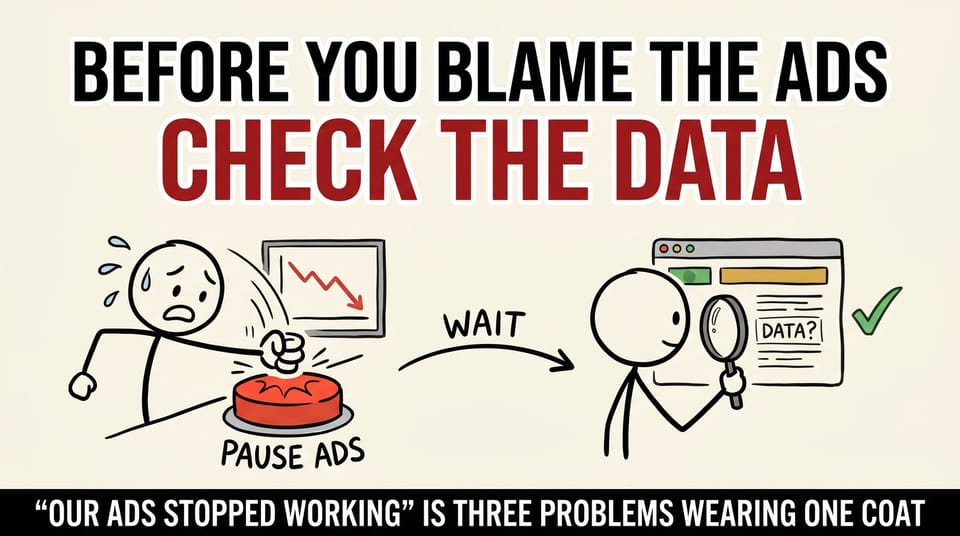
Table of contents
When ad performance tanks, the easiest thing in the world is to blame the channel.
Google Ads is broken. Meta changed the algorithm again. LinkedIn is a money pit. The platform is rigged. Pause it, move the budget, go find something that feels safer.
I understand the instinct completely. Watching return on ad spend slide in real time is a specific, stomach-dropping kind of stress, especially when there is a board, a partner, or a client watching the same dashboard you are. The pressure to do something, anything, becomes enormous.
But the easy explanation is usually the wrong one. And acting on the wrong explanation is one of the most expensive habits in marketing.
This is a piece about the boring, unglamorous discipline that prevents that mistake: a measurement story you actually trust, and a repeatable triage you run before you touch a single dollar of budget.
The question that saved a budget
Let me start with a real moment, because the principle only matters when you see it in action.
A client of ours watched their Google Ads return on investment drop. It was not a dramatic crash. It was worse in a way, because it was a soft, nagging dip. Conversions looked thin. The dashboard did not match what their gut was telling them about the actual pipeline and the conversations their sales team was having.
The room got quiet, the way rooms do when numbers go the wrong direction and nobody wants to be the first to say it. Someone floated the obvious move: turn the campaigns off and stop the bleeding.
But the person leading the account asked a different question first.
"Is something broken in our tag or measurement setup?"
That is not a heroic question. It does not feel like leadership. It is not a growth hack you can put in a carousel. It is the disciplined, slightly tedious thing that separates real signal from noise. And it saved them from killing a channel that, on inspection, was performing fine.
The data was the problem. Not the ads. A measurement issue had made a healthy channel look like a failing one, and the proposed fix, pausing the campaign, would have thrown away working spend while leaving the actual problem untouched.
"Our ads stopped working" is three problems wearing one coat
Here is the core mistake, and almost everyone makes it.
Teams take three completely separate problems and blend them into one vague, anxious feeling: "our ads stopped working." Once that sentence is in the room, it drives decisions. And because it is imprecise, the decisions it drives are usually wrong.
Unbundle it and you get three distinct issues, each with a different owner, a different diagnosis, and a different fix.
1. Tracking integrity
Is the data even real?
This is the layer people skip, and it is the layer that wrecks the most decisions. A broken tag. A conversion event that stopped firing after a site deploy. A deduplication problem double-counting or under-counting. A consent banner that started blocking your pixel after a privacy update. An attribution window that changed under you when the platform pushed an update.
Any one of these can make a perfectly healthy campaign look dead on the dashboard. And if you act on a dashboard that is lying to you, every downstream decision inherits the lie.
2. Channel performance
Assuming the data is real, is the campaign actually underperforming?
This is the layer most people jump straight to. Audiences fatigue. Creative goes stale. Competitors raise their bids and change your auction dynamics. Your campaign structure, which made sense six months ago, drifts out of alignment with how people actually move through your funnel today.
Real channel problems live here. They are solvable. But you can only diagnose them once you have ruled out layer one, because a tracking problem masquerades perfectly as a performance problem.
3. Offer and landing page fit
Does the page still match what people clicked for?
You can buy exactly the right traffic, with clean tracking and a healthy campaign, and still watch conversions die at the door. If the landing page no longer matches the intent behind the click, the whole chain breaks at the last step.
An offer that converted in January might be quietly mismatched with the keywords you are bidding on in June. A landing page that got edited by three different people over two quarters might no longer say what the ad promised. The traffic is fine. The destination drifted.
Why bundling them is so expensive
When you collapse these three into "our ads stopped working," you make a predictable set of costly mistakes:
- You kill channels that were performing, because a tracking glitch made them look dead.
- You scale campaigns on broken data, pouring more budget into a signal you cannot trust.
- You let one bad week rewrite a strategy that was working perfectly well a month ago.
The shift I want for you is from reactive budget swings to a repeatable diagnostic you can run every single time the numbers dip. Not a heroic intervention. A checklist.
The calm triage, layer by layer
When a client's numbers slide, we do not touch budgets first. We walk through the three layers in a deliberate order, because the order is the whole point.
Layer one: validate the measurement
Could the drop plausibly be a reporting issue rather than a performance issue?
Check the tag. Check that conversion events are still firing and firing once. Check attribution windows and whether they changed. Check whether a recent site change, a new consent management setup, or a platform update quietly broke something. Compare platform-reported conversions against a source you trust, like actual closed deals in your CRM or revenue in your billing system.
If the data is lying, nothing downstream matters. You fix the measurement, let clean data accumulate, and only then judge performance. Acting before this step is like adjusting a recipe based on a thermometer you have not checked.
Layer two: review campaigns and audiences
Once you trust the data, ask whether you are still talking to the right people with the right structure.
Has the audience fatigued? Is frequency too high? Did a competitor enter the auction and change your cost dynamics? Is the campaign structure still matched to how buyers actually move, or is it a relic of a funnel that has since evolved? This is where genuine channel optimization happens, and it is productive work, as long as you have earned the right to do it by clearing layer one.
Layer three: audit offers and landing pages
Finally, stress-test the destination.
Does the landing page still match the intent you are buying? Does the offer still land with this audience, in this market, at this moment? Walk the path a real visitor walks: click the ad, hit the page, and ask honestly whether the page delivers on the promise that earned the click. Mismatches here are common and quietly devastating, because everything upstream looks fine.
Measurement first, then channel, then offer. Build your diagnosis from the foundation up, not the roof down.
The three-question habit
The single most useful habit I can hand you is small enough to fit on an index card.
When performance drops, write down three measurement questions before you change a single dollar of spend.
- Could this be a reporting issue, not a performance issue?
- Are we still talking to the right people with the right structure?
- Do the landing pages still match the intent we are buying?
Confirm, or fix, the story your data is actually telling. Then, and only then, decide what to change.
This feels almost too simple to be worth writing down. That is exactly why it works. The discipline is not in the cleverness of the questions. It is in asking them before you panic, every time, so that a single soft week never gets the power to redefine a strategy.
A 72-hour version for when you actually have to move fast
Sometimes you do not have the luxury of a calm week. Spend is high, the dip is real-looking, and someone needs an answer in days. Here is a compressed version that still respects the order of operations.
Day one: validate tracking and attribution. Spend the first day proving or disproving the data. Reconcile platform conversions against your CRM or revenue system. Confirm tags fire, events dedupe correctly, and nothing broke in a recent deploy or consent change. By end of day one, you should be able to say "the data is trustworthy" or "the data is broken, and here is where." Most false alarms end here.
Day two: evaluate campaigns, audiences, and spend distribution. With trustworthy data, look at where the money is going and who it is reaching. Identify fatigued audiences, stale creative, and structural drift. Make targeted adjustments rather than blunt pauses. The goal is precision, not panic.
Day three: stress-test offers and landing pages. Walk the full path from ad to conversion. Find the mismatch between what you promised and what the page delivers. Fix the most obvious gap and let it run.
Three days of structure beats three minutes of panic every time. The point of the timeline is not speed for its own sake. It is to give pressure a place to go that is not the pause button.
Why AI raises the stakes instead of lowering them
You might assume automation makes all of this obsolete. It does the opposite. It makes a trustworthy measurement layer more important than it has ever been.
AI tools now make it trivial to launch new campaigns, auto-generate creative variations, and hand optimization over to the algorithm. That is genuinely useful, and I use these tools myself. But there is a catch that never makes it onto the sales page.
If your measurement layer is shaky, you are feeding bad data into very confident systems.
Algorithmic optimization does exactly what you tell it to. If your conversion signal is broken or misattributed, the algorithm will optimize toward the wrong outcome, scale it aggressively, and report back with total confidence. The machine does not know the data is wrong. It simply trusts the signal. And then you trust the machine. The error compounds at the speed of automation, which is to say, fast.
In a landscape obsessed with AI-driven personalization and predictive analytics, the least glamorous advantage in marketing is a measurement story you actually trust. Not a flashier tool. Not a bigger budget. A clean signal that both you and your algorithms can rely on.
The false signals that fool everyone
Most measurement panics trace back to a short list of usual suspects. Knowing them turns a vague "something is off" into a fast, specific check.
A deploy that broke a conversion event. The most common one by far. A developer ships a site update, a button changes, a thank-you page moves, and the tracking that depended on the old structure silently stops firing. Conversions appear to crater overnight. The ads never changed. The instrumentation did.
A consent or privacy change. A new cookie banner, an updated consent management platform, or a browser-level privacy shift can start blocking pixel fires for a chunk of your audience. Reported conversions drop. Actual conversions did not. You are simply seeing less of the truth.
An attribution window or model change. Platforms quietly adjust how they credit conversions. A shift from a longer to a shorter window, or from one attribution model to another, can make week-over-week numbers look like a collapse when nothing about real performance moved.
Double-counting that suddenly stops, or starts. Deduplication issues cut both ways. A campaign that looked artificially strong because of double-counted conversions can appear to "drop" the moment someone fixes the dedupe. The fix was correct. The panic was not.
Seasonality mistaken for decay. Sometimes the data is perfectly accurate and the dip is real, but it is a known seasonal pattern, not a broken channel. Without a documented baseline, every normal trough looks like an emergency.
Walk a suspicious drop against this list before you reach for the budget controls. More often than not, one of these is the culprit, and the fix is an hour of instrumentation work rather than a panicked strategy overhaul.
What this looks like as an operating habit
The teams that handle performance dips well are not smarter or luckier. They have simply made measurement validation a default reflex instead of a crisis response.
They reconcile platform data against revenue on a regular cadence, not just when something looks wrong. They document what "healthy" looks like for each channel, so a dip is measured against a known baseline rather than a vibe. They keep a short, written diagnostic, the kind of thing in this article, so that under pressure they follow a process instead of an impulse.
None of this is exciting. None of it will go viral. It is the marketing equivalent of flossing. But it is the difference between a team that calmly diagnoses a problem and a team that lurches from budget swing to budget swing, killing good channels and scaling broken ones, always reacting, never quite trusting their own numbers.
What to do this week
You do not need a crisis to start. Pick one channel that matters to you and ask a single honest question.
Do I actually trust the numbers this channel reports? If someone called me right now and asked "is this real," could I answer with confidence, or would I have to go check?
If the answer is "I would have to check," that is your work for the week. Validate the measurement now, on a quiet Tuesday, before you ever need to make a decision under pressure. The calm version of this diagnostic is worth ten of the panicked version.
I do not have every channel perfectly instrumented. Nobody does. But I would much rather know exactly where my data is shaky than discover it the hard way, mid-panic, with a finger hovering over the pause button.
The next time your numbers slide, resist the easy story. The channel is rarely the villain. The villain is almost always a measurement story you quietly stopped trusting and never went back to fix.
If your team is making budget decisions on data you are not sure you can trust, that is exactly the kind of problem we help untangle at Chykalophia. Sometimes the highest-leverage fix is not a new campaign. It is finally trusting your own numbers.