
The Setting That Was Quietly Burying Her Best Work
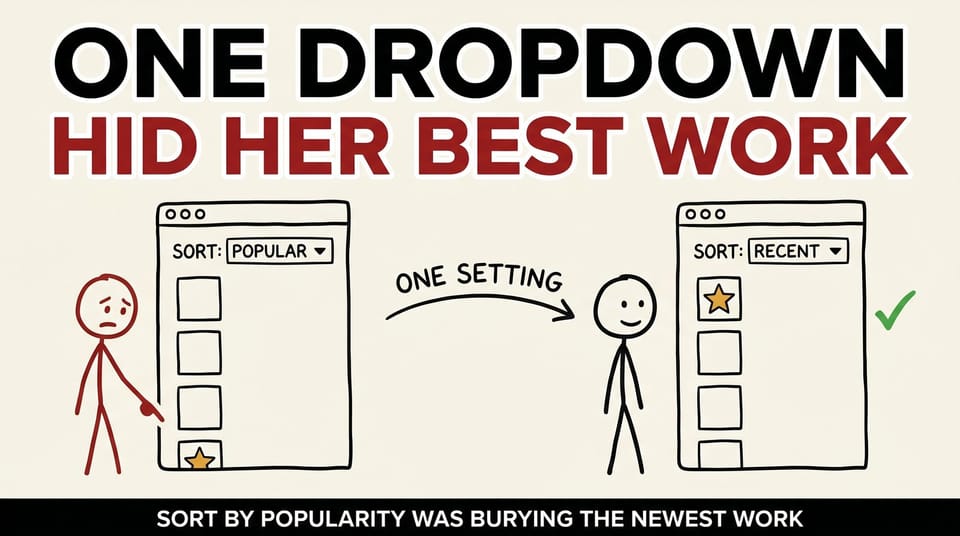
Table of contents
A bridal brand we support had a problem they could not see.
Their newest gowns, the ones the founder was most excited about, the ones she wanted to build her next season around, were almost impossible to find on their own website.
Not because of a bug. Not because of a broken page. Not because the photography was bad or the descriptions were thin.
Because of a dropdown.
I want to walk through this one carefully, because it is one of the clearest examples I have seen of how a tiny, invisible default can quietly work against everything a founder is trying to do. And because the lesson scales far past bridal gowns. If you sell anything online, product or service, you almost certainly have a version of this running right now.
Sort by: Popularity
Here is what was actually happening.
Every category page on the site defaulted to "Sort by: Popularity." That sounds reasonable. Show shoppers the crowd favorites first. Most ecommerce platforms ship with some version of this turned on, and most founders never touch it. It feels like a safe, sensible default.
But stop and think about what "popularity" actually measures.
It measures accumulated signal. Views. Clicks. Add-to-carts. Orders. All of those build up over time. So popularity, as a sort, is really a proxy for age. A gown that has been live for three years has had three years to collect that signal. A gown that launched last month has had a few weeks.
The math only ever goes one way. Older pieces sit at the top of every category page, every single time, while newer designs get pushed down to where almost nobody scrolls.
There is a well-documented pattern in ecommerce behavior here. The products in the first row or two of a category page get the overwhelming majority of clicks. Visibility drops off a cliff as you go down the page, and most shoppers never change the default sort at all. They take the page as it is given to them.
So the founder was in a quiet, losing loop. She poured her energy into new work. The website surfaced the old work. The new gowns got fewer views, which meant less "popularity" signal, which meant they stayed buried, which meant even fewer views. The default was not neutral. It was actively compounding against the exact inventory she was betting her season on.
That is the part that stays with me. Nobody made a bad decision here. There was no meeting where someone chose to hide the new gowns. There was no negligence. The default simply did its job, year after year, and the default happened to be pointed in the wrong direction for this business at this moment.
One support ticket, two backstage fixes
This whole thing surfaced from a single support ticket.
The founder was heading into maternity leave. Before she stepped away, she wanted two things handled, and she described them in fairly plain terms.
First, she wanted more control over how her collections showed up on the site. She had a feeling, not a diagnosis, that her new pieces were not getting a fair shot. She could not name the mechanism. She just sensed that the work she was most proud of was not landing the way it should.
Second, she wanted confidence that customer support would keep running cleanly while she was out. Specifically, she wanted replies to keep a visible thread and to copy in the right people automatically, so that conversations did not get dropped or stranded in one person's inbox while she was unavailable.
Two requests. Both backstage. Neither one is what most people would call strategy. And yet both of them, handled well, changed how the business performed and how it felt to run.
We walked her through both.
Fix one: the sort order
On sorting, the fix was almost embarrassingly simple. We showed her where in the platform settings to change the category default from "Most Popular" to "Most Recent."
That one change flipped the entire dynamic. Now the newest gowns rise to the top of the category pages on their own, automatically, without anyone touching the site again. The work she is most excited about is the first thing a shopper sees. New inventory finally gets the front-row visibility it needs to start building its own signal.
We talked through the tradeoff honestly, because there is one. "Most Recent" is not universally correct. For some stores, especially ones with deep evergreen catalogs and steady bestsellers, popularity-first is genuinely the right call. The point is not that recency always wins. The point is that the default should match what the business is trying to do right now. She was in a launch-new-work season. Her sort order was stuck in a reward-old-work configuration. We aligned the two.
Fix two: support hygiene
On support, we tuned how replies and CCs behave so that every conversation keeps its full history and automatically includes the right team members.
This sounds even less glamorous than a sort order, and it matters just as much. When a founder is the single point of contact, everything routes through one inbox and one brain. The moment she steps away, threads fragment. Someone replies without the history. The wrong person gets left off. A customer has to re-explain their situation to a second team member who has no context. The brand starts to feel disorganized at exactly the moment the founder is least able to catch it.
We set things up so the thread stays intact and the right people stay in the loop by default, even when the founder is not the one forwarding every email. She got to leave without wondering whether support would quietly come apart while she was gone.
That was the whole engagement. One ticket. Two settings. No redesign, no campaign, no new platform, no big budget.
Why the small stuff is not actually small
On paper, none of this is impressive. You cannot put "changed a sort order and cleaned up email CCs" on a case study slide and expect a standing ovation. It does not photograph well. It does not make a good conference talk.
In practice, here is what those two changes actually did.
They gave fresh inventory a real shot at discovery. The gowns the founder was betting on stopped losing, by default, to gowns from three years ago. New work finally got placed where it could be seen, clicked, and start earning its own momentum.
They cut the mental load on someone in a major life season. Maternity leave is not a small thing to plan around. Removing the low-grade anxiety of "will support fall apart while I am out" is worth more than it looks on a spreadsheet. Founder bandwidth is a real business asset, and we just protected a chunk of it.
They made the brand feel more responsive and organized, both to customers and to the founder's own team. Clean threads, the right people included, fast and coherent replies. That is what customers remember. That is what makes a brand feel trustworthy.
None of that shows up in one flashy metric. All of it compounds quietly in the right direction.
The compounding cost nobody measures
Here is what makes this kind of problem so dangerous: it never announces itself. There is no error message for "your best product is sorted into oblivion." There is no alert that fires when a support thread fragments. The cost is real, but it is invisible, and invisible costs are the ones that survive the longest.
Think about the loop the bridal brand was stuck in. New gown launches. It lands at the bottom of the page because it has no popularity signal yet. Few shoppers scroll far enough to see it. With few views, it earns almost no clicks or orders. With no clicks or orders, it never builds the popularity signal that would lift it. So it stays buried. The next new gown launches into the same trap.
Every season, the founder was effectively starting her newest work from behind, then wondering why it never caught on. She might reasonably conclude the designs were not resonating. She might pull back on the exact work that was actually her best. The hidden default does not just cost you the sales you can see. It distorts the conclusions you draw about your own product, which is far more expensive over time.
The support side has the same shape. A fragmented thread does not produce a complaint most of the time. The customer just quietly feels like the brand is a little disorganized, a little slow, a little harder to deal with than they expected. They do not write in to tell you. They just become a touch less likely to buy again, or to refer a friend. You never see the lost order, so you never trace it back to a CC rule.
This is why I push so hard on auditing the boring layer. The loud problems get fixed because they hurt visibly. The quiet ones persist precisely because they do not, and they tax everything you build on top of them.
Demand generation is bigger than your campaigns
Here is the broader point I keep making to the founders we work with.
We tend to think about demand generation as the loud, visible stuff. Ads. Funnels. Launches. Email sequences. Influencer partnerships. The things with budgets and dashboards attached.
But a huge amount of whether your best work actually gets seen comes down to the quiet stuff that has no dashboard.
The defaults your platform enforces when nobody is looking. The way your support threads make a customer feel seen, or make them feel dropped. The tiny backstage choices that either amplify the work you are proud of or bury it under a setting you forgot existed.
You can run the best campaign of your life, spend real money driving traffic, write copy you are proud of, and still lose. Because the page that traffic lands on is sorted to hide your newest, most relevant work behind three-year-old inventory.
This is the sequencing mistake I see constantly. Founders reach for the big, expensive lever first. More ad spend. A new channel. A rebrand. When the cheaper, faster, more reliable win is sitting in a settings panel they have not opened in two years.
Get the small UX and ops details right first. Then every bigger thing you do has a better surface to land on.
The invisible-defaults audit
Because this pattern is so common, we run a quick audit with clients to surface these "invisible" defaults before spending a dollar on campaigns. You can run a lighter version of it yourself this week. Here is the checklist.
1. Look at every category and collection page the way a customer sees it. Open an incognito window. Do not log in as admin. What is the default sort on each page? Write it down. Do not assume you know. The default is often something nobody chose on purpose.
2. Ask whether each default matches your current priority. If you are pushing new offers and your store sorts by all-time popularity, the answer is no. If you are clearing old inventory, popularity-first might be exactly right. The test is alignment with this season, not some universal best practice.
3. Check what shows up in the first two rows. That is where most clicks go. Is the work you most want to sell actually there? Or is it three scrolls down?
4. Check your search and filter defaults too. Sort order is the obvious one, but default filters, default price ranges, and "featured" flags do the same quiet work. A "featured" collection that has not been updated in a year is its own version of this problem.
5. Open a support thread and trace it. Reply to a real customer email and watch what happens. Does the history stay attached? Do the right people get included automatically, or does it depend on one person remembering to CC them? Imagine that person is out for a month. Does the system still hold?
6. Find the settings nobody owns. The most dangerous defaults are the ones with no owner. Sort order, email routing, notification rules, fulfillment defaults. Assign an owner to each. Unowned settings drift, and drift always costs you eventually.
You can get through most of this in an afternoon. Almost no founder does, because none of it ever feels urgent. It just quietly costs you, week after week, in work that never gets seen and customers who feel dropped.
Three questions to ask before the week is out
If you do nothing else, sit with these three.
One. What are my product or content listings actually sorted by? Go look at the live page, not the strategy doc in your head.
Two. Do those defaults match what I am trying to sell right now? Be honest about whether your store is configured for the season you are actually in.
Three. Would my customers describe our support emails as easy to follow? Or do threads split, fork, and get lost the moment more than one person is involved?
The part worth remembering
The founder did not need a new strategy. She needed the strategy she already had to stop fighting itself.
That is true more often than any of us want to admit. The work is good. The offer is good. The thing burying it is a setting, a default, a backstage habit nobody questioned. The problem is not a lack of effort or a lack of ideas. It is a quiet misalignment between what you are trying to do and what your systems are quietly doing on your behalf.
When you get those small details right, you are not doing busywork. You are clearing the path so the bigger work can finally be seen.
If you want help finding the invisible defaults on your own site, or you want the full version of the audit we run with clients, that is exactly the kind of work we do at Chykalophia. Reach out and we will take a look.
The new work was never the problem. The setting burying it was. And settings are the easiest thing in the world to fix, once you know to look.