Your Founder's LinkedIn Feed Is a Better Landing Page Than Your Homepage
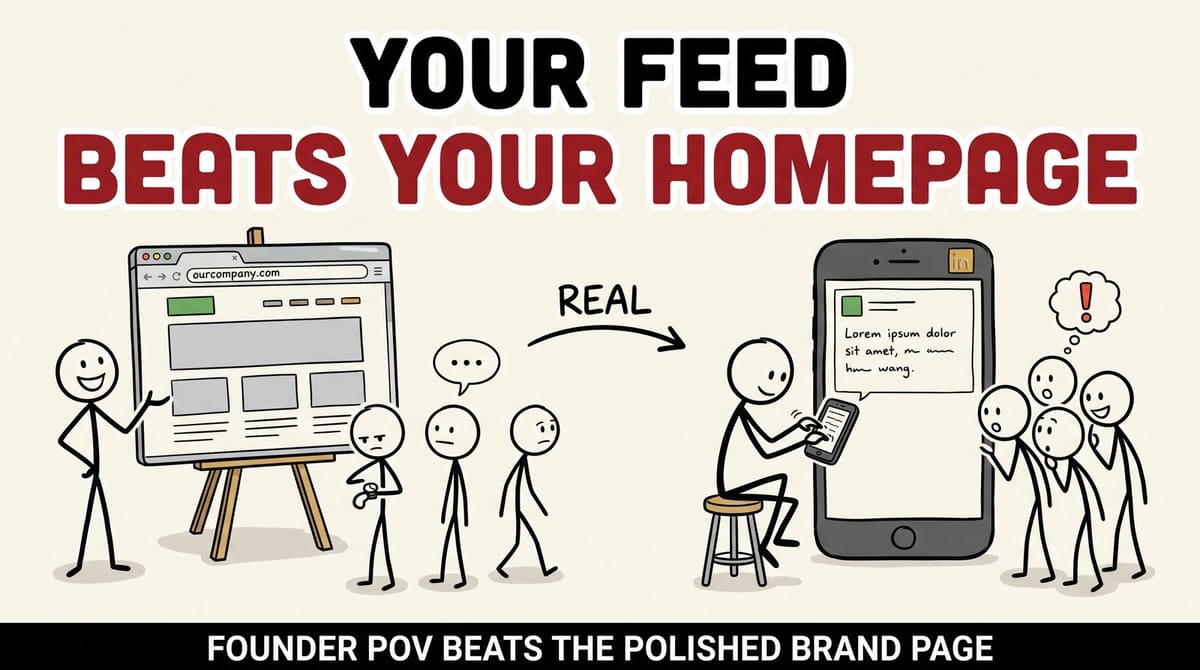
Our best-performing "campaign" last quarter wasn't a campaign.
It was a founder rant on LinkedIn. Written in fifteen minutes, between two client calls. No designer. No creative brief. No funnel sitting behind it waiting to catch the traffic.
And it pulled in more real conversations than the polished assets we spent weeks building.
I want to be precise about what "real conversations" means, because the word gets abused. I do not mean likes. I do not mean impressions. I mean people who showed up to a sales call already half-sold, who quoted the post back to me, who had decided we think the way they think before we ever talked price.
That is the whole game in B2B services. And we keep stumbling into it sideways, through posts that took an afternoon, while the expensive stuff sits quietly converting almost nobody.
Here's what actually happened, and what I think it means for anyone running an agency or a service business.
We build the polished stuff for a living
Inside our delivery team, we ship classic marketing work all day. New websites. UX overhauls. Decks, data visualizations, owner manuals. Maintenance, performance fixes, SEO clean-up. The whole catalog.
This is the work clients pay us for, and it matters. A slow, confusing website costs real money. We have watched a small UX change move a real revenue number, and we have the receipts to prove that fixing this stuff works. I am not here to tell you craft does not count. It counts enormously.
So you would think the thing that earns us the most new trust would be a beautifully optimized "Our Services" page.
It isn't. Not even close.
The services page does its job. It tells people what we sell and lets them self-select out if we are not a fit. But nobody has ever finished reading our services page and felt like they knew us. They felt informed. Informed and trusting are two different states, and only one of them signs a contract.
Most B2B websites have the same problem. They are brochures. They describe. They do not convince, and they definitely do not connect. I have written about that specific failure before in why most B2B websites are brochures, and the short version is this: a page that only describes you is competing on polish, and polish is the cheapest thing in the market right now.
The posts that actually move people
The content that keeps sparking the most excitement, internally and with prospects, isn't the big polished assets.
It's the raw founder POV pieces.
The five questions founders kept asking us on stage in 2025. The honest list of things we're retiring in 2026. The story about walking away from a $30k project because the fit was wrong, even though we needed the revenue that quarter.
None of those took a week to make. Most took one coffee and one sitting.
But they do three things the services page structurally cannot do.
They name the quiet fears we hear in delivery every single week. The fear of overpaying. The fear of hiring a vendor who disappears after the kickoff call. The fear of building something nobody on the team can maintain. When you name a fear out loud, the reader feels seen, and feeling seen is the front door to trust.
They show how we actually operate when nobody is watching. Not the values page version. The real version, including the parts that cost us money in the short term.
And they read like a hallway conversation, not a brand slogan. That register is the entire point. People do not refer brands to their friends. They refer people.
And here's the kicker. Prospects bring these posts into calls.
"I read your thing about not overbuilding." That is how a sales call opened last month. We were already three layers deep into trust before I said a word about what we do or what it costs. The post did the qualifying. The call just confirmed it.
A nurture sequence cannot manufacture that. A founder being honest in public can.
Why the feed beats the homepage
Here is the structural reason, and once you see it you cannot unsee it.
Your homepage is built to survive a committee. It has been through legal. Through a brand review. Through three rounds of "can we soften this." Every person who touches it has an incentive to remove risk, because risk is what gets people in trouble internally.
By the time it ships, it sounds like every other firm's homepage. Safe. Polished. Forgettable. It has been optimized so carefully that all the edges have been sanded off, and the edges were the exact thing a buyer was looking for.
Your founder's feed has no committee. It can say the specific, slightly risky thing that a real person actually believes. And specific plus slightly risky is precisely what a buyer scans for when they are trying to decide if you are the real deal or just good at slides.
Let me put the two side by side, because the contrast is the argument.
| Your homepage | Your founder feed | |
|---|---|---|
| Who approved it | Legal, brand, a committee | One person, hitting publish |
| What it sounds like | Every other firm | A specific human |
| What it does | Describes the offer | Reveals the judgment |
| Risk tolerance | Near zero | Whatever you can stomach |
| What the buyer feels | Informed | Like they know you |
| Best job | Closing a warm lead | Earning the click and the trust |
This is not an argument to kill your homepage. The homepage still closes the deal. When a warm buyer is ready to act, they need a clear, credible page to land on, and if that page is a mess you will lose them. Both things are true at once.
The mistake almost everyone makes is one of allocation. We pour the entire budget into the page nobody emotionally trusts and ignore the feed everybody actually reads. That is not a strategy. That is a habit left over from when websites were the only owned surface we had.
The trend underneath it
This is not just happening in our little corner of the market. Buyers have quietly changed how they evaluate a firm long before they ever fill out a form.
They read the people, not the brand. On LinkedIn, content from a named human routinely outperforms the same message from a company page. The logo reads as marketing. The person reads as a referral. Same words, completely different reception.
Part of this is simple platform mechanics. Networks favor people over pages because people are what keep humans scrolling. But the deeper part is about how trust actually forms in a high-consideration purchase.
When a buyer is deciding whether to hand you real money and real risk, they are not hunting for the most polished sentence. They are hunting for evidence that there is a competent, honest human on the other end who has done this before and will tell them the truth when the project gets hard. Every project gets hard. They know it. They are trying to find out, in advance, how you behave when it does.
A founder post is that evidence. A homepage is a promise. People trust evidence more than promises, every time, in every market I have ever sold into.
Find your next five posts
If you run an agency or a service business, you already own the raw material. You just have not written it down yet. Here are the three questions I would start with.
1. What are the three questions prospects keep asking you in private that they never ask on stage or in an RFP?
These are gold, because the private questions are the real ones. "How do I know you will not disappear after the deposit?" "What happens if the project goes sideways?" "Is this price normal?" If they are asking you privately, a thousand other buyers are asking it silently and never getting an answer. Answer it in public and you become the person who finally said the quiet part.
2. What did you stop doing this year that still looks smart on paper?
Retiring something respectable is a flex of judgment, and judgment is what buyers are actually shopping for. We retired a few "best practice" things this year that were quietly making client work worse. Writing that down does more for our credibility than any award badge in the footer.
3. Where did you walk away from revenue because it didn't feel right long-term?
Nothing signals integrity like turning down money. The $30k project we walked away from became a post, and that post has out-earned the project we declined several times over, in trust if not yet in invoices. When you show a prospect you will tell them no, you make your yes worth far more.
Those are not just anecdotes. They are your next three to five posts. Each one names a real decision. Each one shows your judgment in motion. And judgment is the thing buyers are trying to buy when they hire a partner instead of a vendor.
The repurposing engine
Here is the part most people miss. A good founder post is not a one-time spend. It is a source file.
Once a post earns real engagement, you have proof that the message lands. That is your signal to push it everywhere else. We run roughly this loop, and it is the same loop I described in the pipeline over campaigns piece.
First, the post proves the angle on LinkedIn. Real comments, real DMs, prospects quoting it. That is your market telling you the message works, for free, before you invest another dollar.
Second, the winners become a longer piece. A Substack essay or a blog post that gives the idea room to breathe and adds the framework underneath the story. That is the article you are reading right now. It started as a one-line observation in a team channel.
Third, the proven language becomes site copy. The exact sentence that made a prospect say "yes, that is exactly my problem" belongs on your homepage, in your proposal, in your pitch deck. You are not guessing at messaging anymore. You are promoting language the market already validated.
Fourth, the story becomes sales enablement. We pull founder posts directly into decks and owner manuals, because a real story closes a room better than a feature list ever has.
So the rant you wrote in fifteen minutes does not just earn a few calls. It becomes the research that fixes your homepage, sharpens your deck, and pre-qualifies your pipeline. That is the opposite of how most teams treat social content, which is as disposable confetti.
How to actually start this week
Reading this and nodding is the trap. The whole idea dies in the gap between "good point" and "published." So here is the smallest version that works.
Before you plan your next campaign, block one morning. Just one. Put it on the calendar like a client meeting, because it is more valuable than most of them.
Write a post that does three things. Names a real founder fear. Shows one way you handle it differently. Ends with a clear, human takeaway.
No carousel. No complex funnel. No designer in the loop. Just you, talking the way you talk after a client call, when the guard is down and you are being honest about what actually happened.
A simple structure that works almost every time:
- Open with a specific scene or a real line someone said. Not the topic. The moment.
- Name the fear or the tension underneath it.
- Show how you handled it, including the cost.
- Pull out the one takeaway the reader can use.
- End with a question that invites the comment, not a pitch.
If you want a worked example of taking the unglamorous, true thing and turning it into a post that pulls, the boring stuff outreach piece walks through exactly that move.
But I'm not a writer, and what if it flops
I know the objections, because I have all of them.
"I am not a writer." You do not need to be. You need to be honest and specific. The posts that work are not well-written in the literary sense. They are true in the uncomfortable sense. Write it the way you would say it to one trusted peer over a beer, then publish that.
"I do not have time." You have time for the polished asset that converts nobody. Trade one of those mornings. The post is cheaper to make and it works harder.
"What if it flops?" Some will. That is fine. A post that flops cost you an hour. A campaign that flops cost you a quarter. The downside is not symmetrical, and the upside on the winners is enormous. You are running cheap experiments in public, and the market is grading them for free.
I will be honest, this still feels uncomfortable every single time. Hitting publish on something that sounds like me, and not like a brand, is harder than approving a beautiful asset. The asset has a committee to hide behind. The post is just you, in public, saying what you believe. That exposure is exactly why it works, and exactly why most of your competitors will not do it.
One honest founder post can pre-qualify leads better than three new nurture workflows. I have watched it happen in our own pipeline, more than once. Someone reads the post, decides we think the way they think, and arrives at the call already trusting us. That is not avoidance of "real marketing." That is the most efficient marketing we do.
Where this leaves you
The next time someone on your team says "we need a campaign," ask a smaller question first. What does the founder actually believe about this problem that no competitor would dare put on a homepage? Start there. The campaign can come later, built on the language the post already proved.
If you want help turning your raw founder POV into a homepage that finally closes and a content engine that feeds it, that is a lot of what we do at Chykalophia. We are biased, obviously. But the bias comes from watching this work, over and over, including on our own pipeline.
Block the morning. Write the uncomfortable one. Let the polished page do the closing, and let your feed do the thing it was always better at.
What's the one post you have been scared to write?
Related reading: LinkedIn for B2B founders, SEO & content marketing and Made to Sell, our book on websites that convert.
Get the next one by email
One practical fix every two weeks for owners of established B2B companies. Websites, conversions and operations, written plainly.

Peter Krzyzek
eter Krzyzek is co-founder and CTO of Chykalophia, the Chicago agency that builds strategy-led websites for established B2B companies, and co-author of Made to Sell.
Comments