AI Is Now Your Buyer's Intern. Is Your Website Clear Enough to Pass the 20-Second Test?
Updated
Last month I did a small experiment that I cannot stop thinking about.
I opened ChatGPT, pasted a long-standing client's homepage URL into the chat, and asked it one question.
"Based on this page, what does this company actually do, and who do they help?"
The answer came back in one calm, polished, beige paragraph. Nothing factually wrong. Nothing memorable. The kind of summary you would scroll past in a search result and forget about ten seconds later.
That client had been on the same homepage for five years. They had won awards in their category. They had a clear specialty their existing clients raved about. None of it came through.
That paragraph is what an AI agent is going to feed your next buyer when they ask, "find me three agencies who can actually fix our website" or "who is the best B2B firm for mission-driven nonprofits in the Midwest."
If your homepage gives a vague answer to a specific question, the AI gives a vague answer to the buyer. And the buyer never shows up.
That was the moment something clicked, and the redesign brief I had been writing rewrote itself.
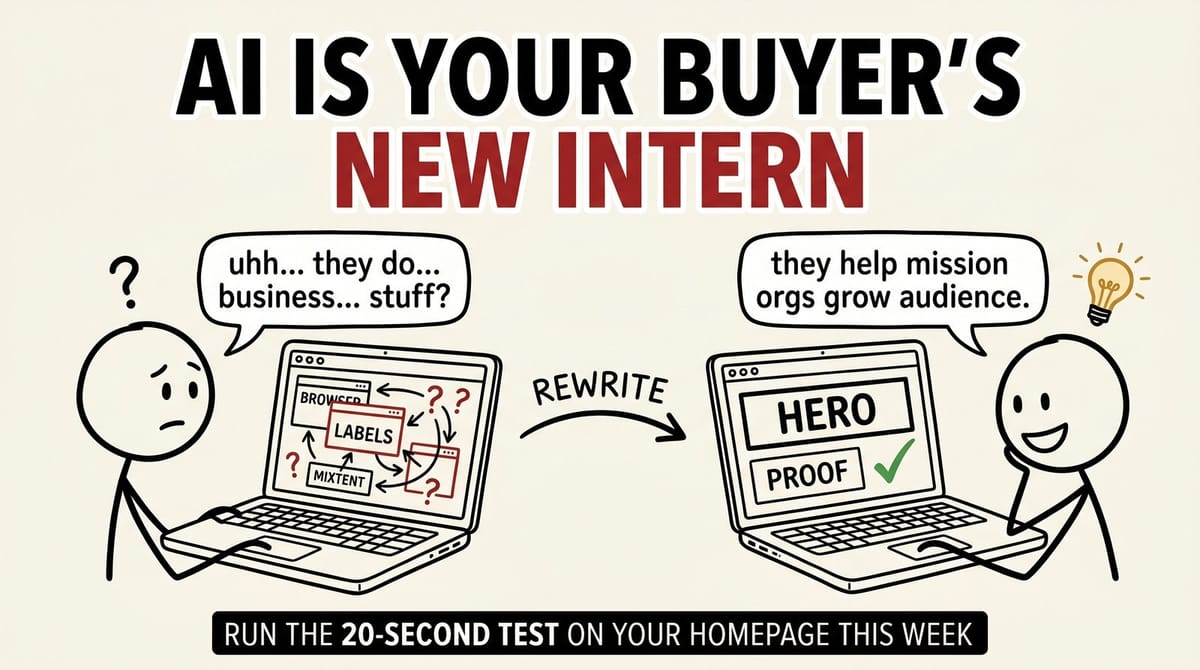
Your buyer hired a new intern. You have not introduced yourself yet.
The way B2B buying journeys started a year ago looked like this. A trigger event. A google search. A list of tabs. A vendor list assembled from a blend of reputation, referrals, and whoever had run the cleanest ads.
The way more and more of them start today looks like this. A trigger event. A prompt. An AI agent returns three names. The human takes a look, picks one or two to actually visit, and the conversation begins from there.
The buyer is still the buyer. The decision still belongs to a person. But the first draft of the shortlist is being assembled by something that reads your site differently than a human does.
It does not get charmed by your hero photography. It does not give you credit for the work you have been doing for five years that does not show up in your copy. It does not assume you are good at the thing you do not actually claim.
It reads the words on the page. It checks whether your words match the buyer's question. If they do not, you are quietly removed from the shortlist before any human at your prospect ever sees your site.
The rejection is silent. You will never get a "thanks but no thanks" email. You just get fewer of the right inbound calls, and you wonder where the pipeline went.
The junk-drawer site we just rebuilt
The project that started this whole thread was for a mission-driven client we have worked with for years. Their site had not been touched in any structural way in about five years.
When we got into the work, the pattern was familiar.
Every team had added their own pages over time. Marketing added campaign landing pages. Programs added service descriptions. HR added a careers section. Communications added blog categories and event archives. Each contribution made sense in isolation. Stacked together, they made a junk drawer.
Three problems jumped out fast.
The homepage promised everything to everyone. Six service lines, three audience tracks, two CTAs in the hero, and a marquee of partner logos that looked impressive but said nothing about fit.
The actual specialty was buried three clicks deep. The thing they were genuinely better at than anyone in their region required a buyer to click "What We Do," then choose a vague subcategory, then scroll past the section everyone scrolls past.
The copy was written from the org chart, not from the buyer's question. The page categories matched the company's internal departments. The buyer does not care about your departments. The buyer cares about their problem.
We did the obvious work first. We mapped the buyer journey. We listed the top five questions a real buyer asks before reaching out, and we asked whether the site answered those questions in fewer than three clicks.
It did not. Not even close.
But the question that changed the project was the one I added at the end of the audit doc.
"If an AI agent read only this homepage and one case study, what would it actually conclude about this organization?"
I tried it. The answer was almost insulting in how generic it was.
That answer was the brief.
The three rules we rebuilt the site around
We did not need a new visual system. The brand was fine. The photography was fine. The colors were fine.
What needed to change was the words on the pages, and the structure underneath those words.
We agreed on three rules. We held to them through every page on the site, including the ones it hurt to cut.
Rule 1: One promise per page. Backed with proof.
If a page is trying to say three things, an AI agent will summarize it as zero. Multi-promise pages give the model nothing to anchor on.
Every page got one promise it made to the buyer. Said clearly in the hero. Backed with a case, a number, or a specific example below it.
The discipline was uncomfortable. The team would draft a page, and on the second pass the hero would already be saying two things. "We help mission-driven organizations grow audience AND deepen impact." Fine words. Two promises. Cut to one.
If we could not find a real proof point for the promise we wanted to make, the promise had to change. We were not allowed to put a claim on a page if we could not show evidence of it on the same page.
This sounds obvious until you try it on your own site. Almost no B2B homepage I have audited in the last two years follows this rule. Almost all of them claim multiple outcomes in the hero with no proof attached.
Rule 2: Buyer language, not org-chart language.
We pulled the last 18 months of sales call transcripts and ran a careful sweep through them. We were not looking for clever quotes. We were looking for the exact phrases their best-fit clients used when describing their own problem.
Sometimes the phrases were embarrassingly plain.
"Our site looks dated."
"People do not know what we do."
"We are getting the wrong inbound."
"Our team keeps fighting about the homepage."
Then we rewrote the headlines and intros to mirror those phrases. Not because it sounds clever, but because the buyer's actual words are also the AI agent's actual search terms. When the buyer says "our site looks dated" and your hero says "Modernize Your Digital Presence," the AI has to translate, and the translation costs you signal.
When the hero says "We help organizations whose websites have quietly drifted into a junk drawer," the AI does not have to translate. It just summarizes.
Rule 3: Collapse overlapping pages into one pillar per offering.
The old site had six pages that, charitably, did the same job. Each one was a slightly different angle on the same service. Each had been added by a different team at a different time. Each was getting a sliver of traffic and converting almost nobody.
We collapsed them into one pillar page per offering, with the supporting detail underneath as anchored sections. Fewer pages. Deeper signal per page. Clearer answer to the buyer's question.
The work was unglamorous. It was a lot of writing, then cutting, then rewriting. The team kept asking, "are we sure we want to delete this?" Almost every time, the answer was yes.
The objection people raise to this approach is usually about SEO. "We will lose ranking on those pages." In practice, we have not seen that play out. The pages that ranked for high-intent terms were two of the six. The other four were ranking for nothing useful and were splitting the signal of the two that were working. Collapsing the six into one pillar concentrated the authority, not diluted it.
The 20-second test
After we shipped, I went back to the experiment that started the project.
I pasted the new homepage URL into ChatGPT and asked the same question I asked five months earlier.
"Based on this page, what does this company actually do, and who do they help?"
The answer came back in one paragraph that I could have written myself. Specific industry. Specific outcome. Specific buyer profile. Exactly the position the client had been quietly occupying for years without anyone outside the company being able to articulate it.
We did not change what the company did. We changed what the page said. The summary changed because the source changed.
That is the test I want you to run on your own site this week.
Open ChatGPT or Claude. Paste your homepage URL. Ask, "based on this page, what does this company do, and who are they for?"
Read the answer like a skeptical buyer would read it. Not like the founder who wrote the page. Like someone who has 11 tabs open and 90 seconds to decide which two are worth a phone call.
If the answer is generic, vague, or wrong, your buyer's intern just filed you in the wrong folder. The rejection is silent. You will not get an email. You will get fewer of the right inbound calls and you will wonder why.
Why this is harder than it sounds
The reason most homepages fail this test is not laziness. It is identity.
Your homepage is usually the most-edited, most-fought-over page in the company. Every department wants a sentence. Every founder has a favorite phrase. Every consultant who walked through in 2022 left a mark.
So the page ends up trying to honor every voice in the room. Which means it speaks in a voice that belongs to nobody and lands with nothing.
Stripping back to one promise per page feels like loss. You feel like you are abandoning the things you cut. In practice, you are protecting the things that stayed.
I have watched founders defend a sentence in a hero section for 40 minutes in a workshop. The sentence was a favorite of theirs from three years ago, the last time they did a brand exercise. The sentence had not landed for a buyer in those three years. They knew it. They still wanted to keep it.
The work of an outside team is partly to absorb the discomfort of the cut. We are not invested in the sentence. We can see what the buyer sees. We can hold the rule.
If you are doing this work internally without that outside pressure, the discipline has to come from the rule itself. Write the three rules on a sticky note. Put them on the wall of the room where the rewrite happens. When someone wants to add a second promise to a page, point at the sticky note and ask which of the two promises has the proof point.
The four-question audit we now run before any redesign
The thing that changed the project was a question I added at the end of an audit doc. Now it is the audit doc. We run these four questions on every site before we touch the design.
You can run them on your own site this week without us.
1. If an AI agent read only this page, what would it say we do?
Test it. Actually paste the URL into ChatGPT or Claude. Read the summary out loud. If you are uncomfortable reading it to a prospect on a sales call, the page is failing.
2. Does that answer match what our best-fit clients ask for on sales calls?
Pull the last 10 sales calls you closed and the last 10 you lost. What words did the buyers use to describe their own problem? Is your hero copy in those words, or is it in your words?
3. Is there one clear promise on this page, or is the page trying to honor every internal voice?
Count the promises in the hero. If you find more than one, you have a problem. Pick the promise with the strongest proof point. Cut the others or move them to deeper pages where they belong.
4. Is there proof on this page that a buyer would actually believe?
Logos are weak proof. Testimonials with vague language are weak proof. Specific outcomes with named companies are strong proof. Specific numbers tied to a recognizable problem are strong proof. If your only proof is "trusted by industry leaders," upgrade it or remove the promise the proof is supposed to support.
If any of those four answers is uncomfortable, that page is the rewrite list.
The unglamorous work in the middle
The middle of this work is not exciting. It is a lot of writing. A lot of cutting. A lot of conversations where someone in the room wants to keep a sentence the buyer will never read.
You do not need a redesign to do this. You do not need a new brand. You need a week of disciplined writing on the hero section of your homepage and one core offer page, with the four questions on the wall and someone in the room whose job is to enforce the rules.
We have done this with clients in three weeks. We have done it in six months when the political work took longer than the writing work. The political work always takes longer than the writing work.
The work is worth it because the cost of the alternative is silent. You will not see a chart showing you the deals the AI agent did not surface. You will just see a thinner pipeline and not know why.
What good looks like
We are watching the data come back on the rebuilt site over the next quarter. Early signal is clear.
Inbound conversations are starting in a different place. Buyers are quoting the new hero line back to us on sales calls. The first 30 seconds of a discovery call is no longer "tell us what you do." It is "we saw on your site that you specialize in X, and that is exactly our problem." That is the conversation you want to have.
The AI summary is now the same summary the sales team has been trying to get out of their own marketing for years. The marketing site is finally selling the same company the sales team is selling.
That is what good looks like.
If you want to go deeper
The follow-up version of this work, the one we are running for clients now, includes three things this post did not cover.
The first is structured data and schema markup that gives AI agents an even cleaner signal about who you serve and what you offer. Worth doing once the words on the page are right. Not worth doing if the words are wrong, because schema cannot fix vague copy.
The second is the buyer-language transcript sweep. The full method we use to pull the right phrases out of sales call recordings without drowning in transcript noise.
The third is the "one promise per page" review template we now run with clients as a 90-minute workshop. It is the format that has made the hardest cuts go down easiest.
If any of that is useful to you and your team, we are happy to walk through the audit together. Reply to this post or reach out via piotrkrzyzek.com. The audit itself is free. We are interested in the conversation, not the upsell.
Your buyer's intern is already reading your site today. The question is whether what it reports back is the version of your company you actually want on the shortlist.
If you want to compare notes after you run the 20-second test, I would love to hear what your homepage said back to you.
Related reading: AI Search and B2B Discovery: How to Get Named by AI, How ChatGPT, Perplexity and Google's AI Overviews choose what to cite, Structured data (schema) explained for business owners and Writing content AI assistants can quote.
Common questions
How do AI assistants decide which companies to recommend to buyers?
An AI agent reads the words on your page and checks whether they match the buyer's question. It is not charmed by hero photography and does not assume you are good at something you do not claim. If your words do not match the question, you are removed from the shortlist before any human sees your site.
How do I check what ChatGPT thinks my company does?
Open ChatGPT or Claude, paste your homepage URL and ask, "based on this page, what does this company do, and who are they for?" Read the answer like a skeptical buyer with 11 tabs open and 90 seconds to decide. If the summary is generic, vague or wrong, that page belongs on your rewrite list.
Will I lose SEO rankings if I merge overlapping service pages?
In the rebuild described, six pages covering the same service were collapsed into one pillar page with supporting sections underneath. Only two of the six ranked for high-intent terms, and the other four were splitting their signal. The feared ranking loss did not happen, and merging concentrated authority instead of diluting it.
What counts as strong proof on a B2B website?
Logos and testimonials with vague language are weak proof. Specific outcomes with named companies, and specific numbers tied to a recognizable problem, are strong proof. If your only proof is "trusted by industry leaders," either upgrade it or remove the promise that proof is supposed to support.
Get the next one by email
One practical fix every two weeks for owners of established B2B companies. Websites, conversions and operations, written plainly.

Peter Krzyzek
eter Krzyzek is co-founder and CTO of Chykalophia, the Chicago agency that builds strategy-led websites for established B2B companies, and co-author of Made to Sell.
Comments