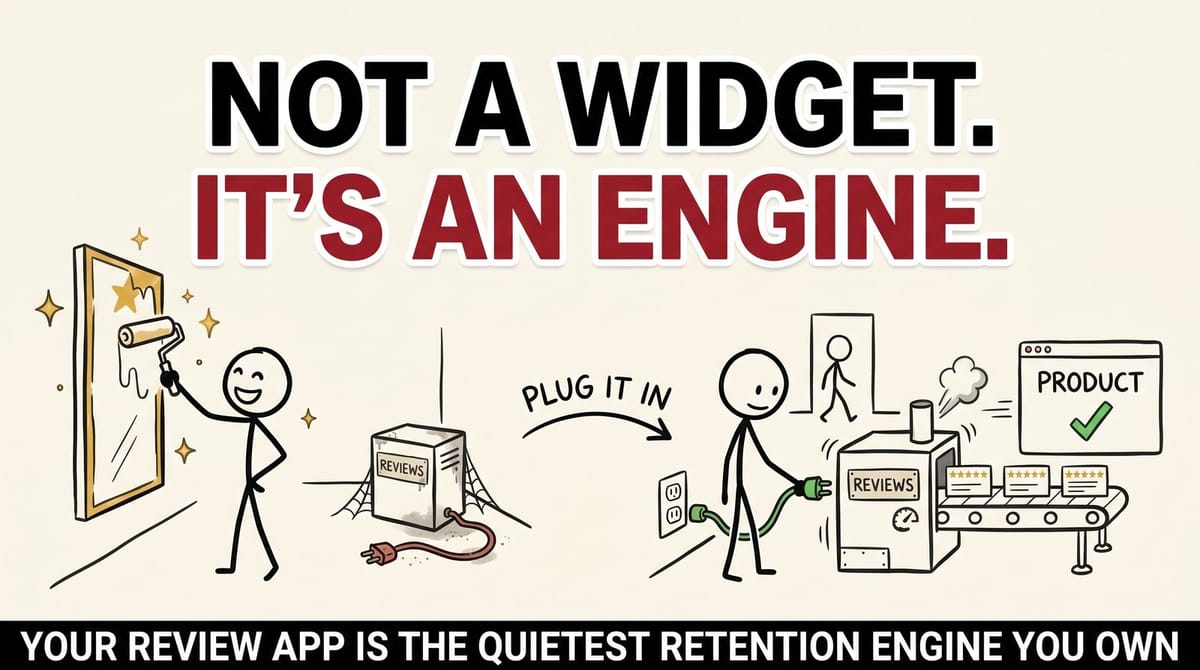
Your Review App Isn't a Widget. It's a Retention Engine.
Last week in Delivery, we pulled apart the tech stack of a Shopify haircare brand we work with.
The team had done all the fun work. New product photography. A cleaner homepage. A full email flow rebuild. The kind of work that feels like progress because you can watch it move on the screen.
Then I asked about reviews.
Long pause.
The review app had been installed since 2021. Technically on. Practically asleep in the corner.
It was collecting almost nothing. The handful of reviews it did have showed up in a random order, so a brand-new visitor researching a $40 hair serum was reading feedback from someone who bought a completely different product two years ago.
Nobody on the team owned it. Nobody could tell me the last time anyone had looked at it. It was a box that got checked during the original build and never thought about again.
This is the most common pattern I see in stores that are doing fine but want to do better. The flashy levers get all the attention. The boring infrastructure that actually compounds gets installed once and forgotten. The review app is almost always the clearest example.
So let me make the case for the most ignored app in your stack.
A review app is not a star-rating widget
We treat reviews like decoration. A little row of gold stars under the "Add to Cart" button. Nice to have. Social proof. Cool.
That framing is exactly why the app sits there idling.
A review app, set up properly, is the quietest retention engine you own. It runs in the background after the sale, in the exact window where most stores stop paying attention. It asks the right customer for feedback at the right moment. It feeds that proof back onto the pages where the next buyer is making up their mind. And it hands your marketing team the actual words your customers use, for free.
None of that is flashy. All of it compounds.
Think about what a review app actually touches. It sits at the seam between a sale you already made and a sale you have not made yet. The customer who just got their order is your warmest audience on earth. The visitor reading that customer's words three weeks later is your most skeptical. A review app, working properly, is the bridge between those two people. It turns a finished transaction into ammunition for the next one.
The store owner who treats reviews as a widget gets a dusty star rating. The one who treats reviews as infrastructure gets a machine that makes every future visit convert a little better than the last one.
Same app. Completely different outcome.
How the engine was actually broken
When we audited the haircare store's stack, the review app was technically installed, but three things were quietly wrong. If you recognize your own store in any of these, you are not behind. You are normal. Almost everyone is here.
It wasn't tied to key moments in the journey. The request to leave a review was not timed to anything. It was not connected to the difference between a first order and a fifth order. A loyal repeat buyer and a nervous first-timer got treated identically, which means neither got treated well.
It wasn't feeding back into product pages or email. Reviews came in, landed in the app's database, and stayed there. The product pages showed a generic, stale slice of them. The email flows did not pull customer language at all. The proof existed, but it never traveled to where decisions get made.
It was invisible to leadership. Nobody owned it as a growth lever, so nobody measured it, so it never came up in a meeting, so it never got better. The ad account had an owner. The email calendar had an owner. The single highest-trust asset in the store, the voice of actual customers, had no owner at all.
Notice that none of those are technical failures. The app worked. The integration was fine. The failure was one of attention and ownership, which is the kind of failure that hides in plain sight for years.
What we changed (and what we didn't)
Here is the part I like, because it is so unglamorous.
We did not buy anything new. The app was already there. We did not rebuild the store. We just stopped treating reviews like a plugin and started treating them like part of the plumbing.
Three changes.
One: we tied the request to a real moment. Not a blast to everyone on a Tuesday afternoon. A request that fires 3 to 5 days after delivery, when the product is fresh in someone's hands and the experience is still warm. First-time buyers got one message and one ask. Repeat buyers got a different, shorter one, because you do not talk to a regular the way you talk to a stranger. The timing did most of the work before we touched anything else.
Two: we made reviews feed back into the store. The right reviews on the right product pages. Recent proof, from buyers who actually bought that specific item, shown to the high-intent visitor who is one nervous click away from leaving. We stopped showing a random wall of old feedback and started showing relevant feedback in the exact spot where doubt usually wins. We also opened the tap into email, so the flows could pull real quotes instead of marketing guesses.
Three: we gave it an owner. One person on the team is now responsible for review quality and coverage, the same way someone owns the ad account. They watch the request open rate. They watch which products have thin coverage. They flag the reviews worth pulling into ads. Because the thing nobody owns is the thing that quietly rots, and accountability is cheaper than any tool you could buy.
That is the whole intervention. No new vendor. No big budget line. Timing, placement, and accountability on an app the store was already paying for every month.
| Before (review app as a widget) | After (review app as infrastructure) |
|---|---|
| Request sent whenever, to everyone | Request timed 3 to 5 days post-delivery, segmented |
| Random old reviews on every page | Relevant, recent reviews on the matching product page |
| Reviews trapped in the app | Customer language flowing into pages, ads, and email |
| Owned by nobody | Owned by one accountable person |
| Invisible to leadership | A tracked growth lever with real numbers |
Nothing went viral. That was the point.
I want to be honest about what happened next, because it is not a dramatic story.
There was no screenshot-worthy spike. No "we tripled revenue in a weekend" headline. If you were staring at the dashboard waiting for fireworks, you would have been bored.
What happened was slower and better.
Reviews started landing within days of delivery instead of weeks, or never. High-intent visitors finally saw proof from people like them. The marketing team pulled real customer language straight into ads, landing pages, and email, instead of guessing at what to say in the next campaign.
And the conversion story got a little stronger on every single visit, because the proof kept stacking up.
This is the thing about compounding assets. They are unsatisfying to watch day to day and undeniable over a quarter. A review engine does not give you a hero moment. It gives you a slightly better baseline that keeps climbing, quietly, while you go do the loud work somewhere else.
Think about the math for a second. If your product page converts at two percent, and relevant, recent proof nudges it to two and a half, that half a point does not feel like anything on the day it happens. Spread across every visitor for the next year, it is a different business. The review engine is one of the few assets in your store that gets more valuable the longer it runs, because every new customer adds another piece of proof for the next one. You are not buying a spike. You are buying a slope.
I have written before about how the boring, honest version of leadership usually beats the heroic one, and how small post-purchase touches quietly compound into lifetime value. Reviews sit right at the center of both ideas. They are boring, they run after the sale, and they make the store clearer on every single visit.
That is the kind of growth nobody posts about. It is also the kind that holds, because it is not a trick or a hack. It is a system doing its job in the background, every day, whether or not anyone is watching.
It is worth being precise about who benefits, because it is not only the next shopper. The store owner gets a calmer marketing function, because the team stops inventing claims and starts repeating the ones customers already make. Support gets fewer "does this actually work" emails, because the answer is sitting right there on the page in a real buyer's words. The product team gets an early warning system, because a run of lukewarm reviews on one item is the cheapest research you will ever buy. One input, four or five downstream payoffs. That is exactly why treating reviews as a single checkbox during the build is such an expensive mistake. You are not turning on a star rating. You are turning on a feedback loop that touches half the store.
The 10-minute audit you can run today
You do not need us for this part. If you sell online, you can audit your own quiet retention engine this afternoon. Three questions, and an honest answer to each.
1. Do you know your review request send time and your open rate?
If you cannot answer that, your timing is almost certainly wrong, and timing is most of the game. The sweet spot for most physical products is a few days after delivery, not the moment of purchase and not three weeks later. Go find the actual send trigger and the actual open rate. If you cannot find them, that is your answer.
2. Can you show different reviews to first-time visitors versus returning buyers?
A first-time visitor needs reassurance that the product is real and works. A returning buyer needs a reason to try the next thing. If everyone sees the same undifferentiated wall of reviews, you are spending your best proof on the wrong people at the wrong moment.
3. Is anyone on your team explicitly responsible for review quality and coverage?
Not "we all kind of keep an eye on it." One name. If the honest answer is "not really," that is your starting point, and it is the cheapest fix on this list. Ownership costs nothing and changes everything.
If you came up unsure on more than one of those, your quietest retention engine is idling in the corner with the keys still in it.
It does not need a redesign. It needs someone to turn it on, point it at the right moment, and let it run.
Why this keeps happening
It is worth asking why a lever this obvious gets ignored this often. It is not laziness. It is incentives.
The fun work is visible. A new homepage gets compliments. A redesigned product page gets a Slack thread of thumbs-up. You can screenshot it. You can show it to a partner. It feels like building.
The review engine produces no screenshot. It produces a number that moves slowly and a customer who came back without telling you why. Nobody high-fives you for a well-timed review request. So in a hundred small decisions about where attention goes, reviews lose every time, to things that photograph better.
The leaders who win the long game are the ones who can tell the difference between work that looks like progress and work that compounds into it. Usually it is both, but when you have to choose where the next hour goes, bet on the boring asset that keeps paying.
There is also a simpler reason reviews get skipped: asking for them feels needy. Founders worry that a follow-up message is an imposition, one more email in an already crowded inbox. In practice it is the opposite. A customer who just had a good experience often wants to say so, and giving them an easy, well-timed way to do it is a small kindness, not a burden. The stores that ask well, at the right moment, in a human voice, get more reviews and warmer ones. The fear of being annoying is what keeps the engine switched off, and it costs you the one asset no ad budget can buy: proof from someone with nothing to sell.
What we do, if you want help
Most of the time you can run the 10-minute audit and fix the obvious things yourself. Start there. Genuinely.
If you get into it and realize the review engine is one of several quiet leaks across the store, that is the work my team does in Delivery. We audit the full post-purchase and conversion stack, find the assets that are installed but idling, and turn them back on with timing, placement, and an owner. Not a redesign you do not need. The boring fixes that move the number.
If that sounds useful, you can see how we approach this kind of work and reach out. And if you just want the checklist, keep reading.
The 3-step checklist
Here is the simple version we use in Delivery to turn a sleepy review app into a real revenue lever.
- Time it. Set the review request to fire 3 to 5 days after delivery, and segment first-time buyers from repeat buyers. Two messages, not one.
- Place it. Put recent, relevant reviews on the matching product page, and open the tap so your email flows can pull real customer quotes.
- Own it. Give one person responsibility for review quality, coverage, and the open-rate number. Put it on a dashboard a human looks at.
That is it. No new vendor required. The fun work will always get the attention. The boring infrastructure gets the results. After enough years of watching both, I will take the boring every time.
What is the most ignored app in your stack right now? Go open it up. You might be sitting on an engine you forgot you owned.
Related reading: Your 30-minute conversion self-audit, Trust signals: reviews, logos, guarantees and where they go and the Conversion Leak Scorecard.
Get the next one by email
One practical fix every two weeks for owners of established B2B companies. Websites, conversions and operations, written plainly.

Peter Krzyzek
eter Krzyzek is co-founder and CTO of Chykalophia, the Chicago agency that builds strategy-led websites for established B2B companies, and co-author of Made to Sell.
Comments