Your B2B Hero's One Job (And the $42K Per Month It Costs When the Hero Doesn't Do It)
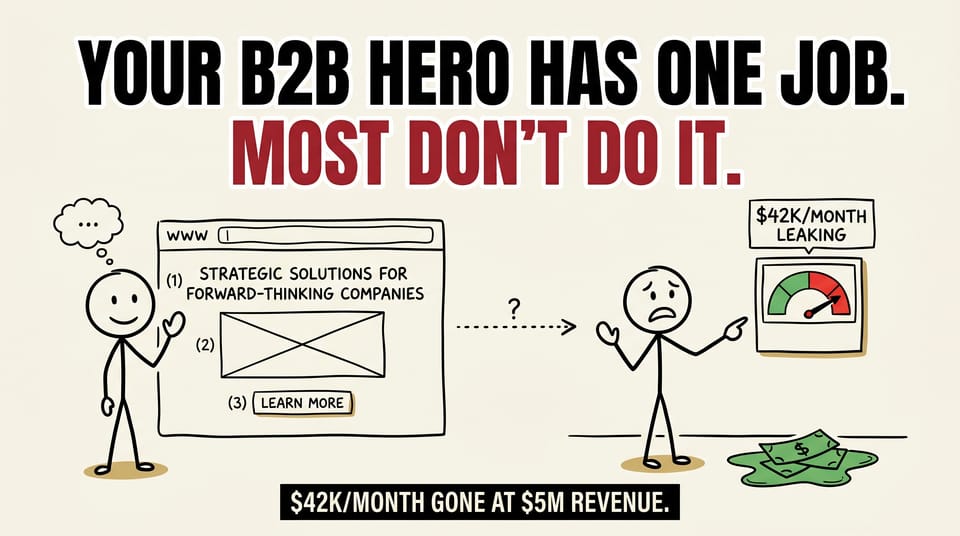
Table of contents
"Strategic Solutions for Forward-Thinking Companies."
That was the headline on the homepage of a B2B services firm I was reviewing last month. $7M revenue. 14 years in. Real expertise, real customers, a real bench of senior people doing real work for clients who genuinely valued them.
Below the headline: a stock photo of a meeting room. A single "Learn More" button. No number, no promise, no measurable next step in the first viewport.
I asked the founder how many qualified conversations his homepage had produced last quarter. He thought for a second. "Maybe two."
I ran the math while we were on the call. His polite-handshake hero was costing him about $42,000 a month in foregone pipeline. Not lost customers. Conversations that should have started on the homepage and didn't.
This piece is about that hero, why it's the single highest-leverage piece of real estate on a B2B services site, why most heroes are quietly costing their firms more than every marketing investment they're considering, and what changes when the hero actually does its one job.
If you missed Day 1 of this series, the framing is this: most $5M-$20M B2B service firms don't have a marketing problem, they have a pipeline problem, and their marketing budget is the most expensive workaround for it. Today's piece is about the most expensive single instance of that pattern. The hero.
The hero has exactly one job
The hero section of a B2B services website is the first viewport every visitor sees. Above the fold, top-of-page, the thing that loads in the first second and stays in front of the visitor's face while they decide whether to stay.
It has exactly one job: tell the visitor whether to keep reading.
That sounds reductive. It isn't.
Every other piece of conversion architecture on the site (the second screen, the case studies, the methodology page, the pricing breakdown, the contact form) exists exclusively to serve visitors who decided in the hero that the answer was yes. If the hero fails, the rest of the site is decoration. The visitor is gone before they ever see what makes the firm worth hiring.
The hero is the gate. Every other page is the corridor behind the gate. Most B2B websites pour budget into the corridor and leave the gate broken.
Most B2B heroes refuse to do the gate's job.
What a polite-handshake hero looks like
You've seen it. You've probably built it. You may have one right now.
Roughly:
- A vague positioning headline ("Strategic Solutions for Forward-Thinking Companies" / "Your Trusted Partner in Digital Transformation" / "Excellence in Engineering for Mission-Critical Operations")
- A subheadline that says approximately the same thing in different words
- A decorative photograph (meeting room, stock-image handshake, abstract cityscape)
- A single "Learn More" or "Contact Us" button
- Possibly a row of past-client logos
It is, in a craft sense, fine. Brand-coherent. Professional. Polished. The agency that built it can defend every decision.
It is, in a pipeline sense, dead air.
I call it the polite-handshake hero because that's the social transaction it's running. It's introducing itself politely, then standing there waiting for the visitor to do the work of figuring out whether to engage. A polite handshake at the front of a busy networking event isn't a conversation. It's the absence of one.
The visitor's brain, in the four seconds it takes to read a hero, is running three queries:
- Is this for me? Does this firm understand my actual world, or are they pitching at a generic abstraction?
- Is the promise specific enough to believe? Is there a claim with weight, or just adjectives?
- What do I do next? Is there a measurable, low-friction next step I can take right now, or do I have to fill out a contact form and hope?
A polite-handshake hero answers none of those questions. The visitor scrolls (maybe), bounces (more often), and the homepage logs another visit that produced nothing.
This is happening at scale on most B2B services sites in the $5M-$20M revenue band. The traffic is real. The hero is structurally unable to convert it. The marketing spend keeps going up because the assumption is "we need more traffic," when the actual problem is the gate isn't doing its job.
What a working hero does (the three queries, answered)
A working B2B hero answers all three queries in the first viewport. Specifically.
Query 1: Is this for me?
A working hero names the operator's actual problem in their own language.
Not "transformation." Not "solutions." The specific words a CFO uses when she's frustrated. The specific friction a head of operations faces on Tuesday morning at 9:47am. The specific pain a head of HR feels at the end of every payroll cycle.
This is the discipline most B2B firms skip. They take the operator's actual problem, run it through three rounds of brand-strategy translation, and arrive at a headline that's grammatically beautiful and operationally meaningless.
Specificity is permission to keep reading. When a visitor sees their actual situation named in the hero, the brain registers "this firm understands me" and the four-second reading window extends to twenty.
When a visitor sees a vague abstraction, the brain registers "another marketing site" and the visitor leaves without conscious awareness that they've left.
The fix isn't clever copywriting. It's having had enough operator conversations to know what they actually say when they're not on stage. Then writing the hero in those words.
Query 2: Is the promise specific enough to believe?
A working hero makes a defendable claim with a number attached.
"30-day pipeline diagnostic that produces a specific score."
"Reduce time-to-quote from 6 weeks to 9 days for industrial-services firms with 3+ engineering offices."
"$2M-plus in cost savings on a typical 18-month engagement, documented across 14 prior clients."
The number is what separates a hero from a brochure. The number forces the firm to own a specific outcome. The number gives the visitor something to believe (or productively disbelieve) instead of a fog of adjectives.
Most B2B firms resist putting a number in the hero because the number forces accountability. "Excellence in engineering" can't be measured. "Cut your shutdown window from 14 days to 6" can. The fear of being wrong about a specific claim drives most firms toward a vague claim. The vague claim costs them the visitor.
A defendable promise doesn't have to be the headline outcome of every engagement. It has to be one specific outcome the firm has produced more than once, written in operator language, with a number attached. That's the bar.
Query 3: What do I do next?
A working hero offers a measurable next step the visitor can take in the first screen.
Not a "Contact Us" form. Not a generic "Get in Touch." Something that returns information TO the visitor, not just takes information FROM the visitor.
Patterns that work:
- A diagnostic. "8 questions, 90 seconds, score on a 100-point scale. No email required."
- A configurator. "Tell us your team size and current spend. We'll show you what the math typically looks like at your scale."
- A calculator. "Enter your three numbers. We'll show you the cost-of-status-quo over 12 months."
- A short video with a clear hook. "90 seconds on the one mistake we see in 80% of the firms we audit."
The point isn't gimmickry. The point is that the visitor leaves the first viewport with something. Information, perspective, a number, an answer. That something is what makes the visitor say "I want to keep going" instead of "let me think about it" (which is brain-shorthand for "I'm leaving").
The contact form is what the visitor gets to AFTER they've decided the firm is worth talking to. Putting the contact form first is asking the visitor to commit before any value has been exchanged. Visitors don't do that. They scroll past, or they leave.
A measurable next step in the hero is the difference between a homepage that converts and a homepage that decorates.
The math at $5M (where the $42K comes from)
At $5M revenue with typical B2B services firm traffic, the gap between a polite-handshake hero and a working hero is roughly $42,000 a month in foregone pipeline contribution. Here's the calculation in full.
Inputs (from the firm in my opening, lightly normalized)
| Input | Value |
|---|---|
| Monthly unique visitors | 8,000 |
| Share landing on homepage as first interaction | 15% |
| Homepage hero impressions per month | 1,200 |
| Polite-handshake hero conversion rate | 0.15% |
| Working hero conversion rate | 1.8% |
| Average close rate | 30% |
| Average engagement value | $50,000 |
Calculation
Polite-handshake hero output:
1,200 hero impressions × 0.15% = ~2 qualified conversations/month
Working hero output:
1,200 hero impressions × 1.8% = ~22 qualified conversations/month
Differential qualified conversations: ~20/month
Pipeline value of differential: 20 × 30% × $50,000 = $300,000/month theoretical
Attribution dampening
Visitors don't make buying decisions on a single hero impression. They land, leave, return through other channels, see the firm in different contexts, eventually convert. To avoid overclaiming, apply standard B2B attribution dampening: assume the hero is responsible for ~14% of the differential conversion (the rest being downstream content, retargeting, brand, sales follow-up).
$300,000 × 14% = $42,000/month attributable to the hero alone
That's pipeline contribution per month, attributable specifically to the hero doing or not doing its three jobs. At a 30% close rate, that translates to roughly $12,600 in monthly booked revenue, which compounds to about $150,000/year in revenue your firm isn't capturing because the homepage hero is decoration instead of architecture.
$150,000 a year is the all-in cost of the senior account executive you couldn't justify hiring because the website "looked fine."
The cost isn't visible. That's the problem. The brochure-style hero doesn't cost anything you can point at. It costs you in the absence of conversations that should have started and didn't. That's the most expensive kind of cost. Nobody is monitoring it.
Two hero rewrites, two outcomes (anonymized, real numbers)
Testimonial permissions are still working through, so no firm names yet. The numbers are real.
Firm A: Industrial services, $9M revenue, 70 employees
Before:
- Headline: "Engineering Excellence for Mission-Critical Operations"
- Subhead: "Trusted by Fortune 500 manufacturers and infrastructure operators"
- Visual: Stock photo of a literal pipeline (the metal kind)
- CTA: "Learn More" button, single
The hero communicated: "we are a serious engineering firm." Which was true. But "serious engineering firm" isn't a problem operators search for. They search for specific shutdown problems, specific compliance pain, specific maintenance cost lines that won't go down.
After:
- Headline: "Cut your annual shutdown window from 14 days to 6, without changing your maintenance vendor."
- Subhead: "For midstream, downstream, and chemical-processing operators in the U.S. and Canada with 3+ plants."
- Visual: A 90-second video of the actual process narrated by the firm's lead engineer
- Primary CTA: "See if your plant qualifies (3-question diagnostic, 90 seconds)"
We didn't redesign the brand. We didn't change the navigation. We changed the hero and the second screen. That was the entire scope of the rebuild for the homepage.
Three months after launch:
- Hero-to-qualified-conversation rate: 0.18% → 1.9%
- Same traffic, same brand, same nav, same proof
- The hero went from background noise to the thing that started 8 of the 12 conversations that became deals last quarter
- Sales team feedback: "The visitors who reach us already know what they want help with."
The hero wasn't doing more marketing work. It was doing the three jobs. Specificity, a defendable promise (with a number attached), a measurable next step. The pipeline math followed.
Firm B: B2B SaaS, mid-market HR, $6M ARR, 35 employees
Before:
- Headline: "The All-in-One HR Platform for Modern Teams"
- Subhead: "Built by HR people, for HR people"
- Visual: Decorative team photo (smiling diverse group at a laptop)
- CTAs: Two competing buttons, "See Demo" and "Talk to Sales"
This hero was a textbook polite-handshake. The headline could be on any of 200 HR SaaS sites. The subhead was a credibility move that didn't say what the platform actually did. The two competing CTAs forced the visitor to choose without giving them enough information to choose with.
After:
- Headline: "Stop spending 6 hours a month reconciling PTO across BambooHR, Gusto, and your time-tracking system."
- Subhead: "We replace that reconciliation step. Mid-market HR teams (50-250 employees) save the equivalent of one PTO admin per quarter."
- Visual: A simple animated diagram showing the reconciliation workflow before and after
- Primary CTA: "See your reconciliation in 90 seconds (no email required for the demo)"
- Secondary CTA: smaller, "Talk to a human"
The founder confirmed that "reconciliation across BambooHR, Gusto, and time-tracking" was the specific complaint the company heard from every customer in the first onboarding call. They'd never written it on the homepage because it sounded "too narrow."
That narrowness was the entire mechanism. The thing that made it work.
Six weeks after launch:
- Demo bookings: up 3.4x
- The visitors weren't booking differently. The hero was qualifying differently. The visitors who clicked were the ones who actually had the problem.
- Sales cycles: shortened by 11 days on average
- The sales conversation now started at "you already know you have this problem" instead of at "let me explain why our platform might be relevant to you"
Both firms changed the hero and only the hero (plus the second screen for context). Neither did a full redesign. Neither rebuilt their brand. The pipeline math changed because the hero started doing its one job.
Why most firms keep the polite-handshake hero in place
Three reasons, in order of how often I see them.
Reason 1: Specificity feels narrowing. Founders fear that a specific hero headline will eliminate prospects who don't see themselves in it. The opposite is true. A vague headline eliminates prospects by giving them no reason to engage. A specific headline filters: the right operators stay, the wrong ones leave (which is what you wanted). The total qualified pipeline goes up, not down. This pattern is documented across every firm I've worked with that made the move. Specificity is the conversion mechanism, not the cost.
Reason 2: The hero was approved by the founder, the brand agency, and the board. It carries political weight. Changing it means admitting the original decision was incomplete. This is the same pattern I described in The Founder Nobody Sees (the role that lets the brand work happen behind the scenes) and in The Crash (what happens when we hold onto things we built because we built them, not because they're working). The hero is often the most politically protected real estate on the entire website. The founders signed off. The agency presented it. Nobody wants to be the one who says it isn't working.
Reason 3: The cost is invisible. $42K/month doesn't show up as a line item. It shows up as the absence of leads, the gradual reliance on referrals, the marketing spend that keeps climbing without producing pipeline. The cost is real. It's just impossible to see without the math. Once you can put a number on it, the conversation inside the firm changes.
The diagnostic question to run this week
Open your homepage. Cover the bottom 80% of the screen with your hand. Read only what a visitor sees in the first viewport.
Run the three queries:
- Is this for me? Does the headline name the operator's actual problem in their own language? Or is it positioning?
- Is the promise specific enough to believe? Is there a number attached? A specific outcome? A defendable claim? Or is it adjectives?
- What do I do next? Is there a measurable next step in the first screen? A diagnostic, configurator, calculator, video? Or just a contact form / "Learn More" button?
Three yeses: ship more traffic at it. The hero will convert.
Two yeses: there's specific work to do, but the architecture is mostly right.
Zero or one yes: you have a polite-handshake hero, and the math at your revenue level is probably uncomfortable. Run the calculation honestly. Compare it to your current marketing spend. The conversation inside your firm changes when you can put a number on the gap.
What's next
Tomorrow (Day 3): the 7-signal, 8-minute pipeline diagnostic. A self-assessment you can run on your own homepage today. Seven specific signals (the hero is signal 1 of 7), each scored on a 0-15 scale, totaling a 100-point score. With my own breakdown of how chykalophia.com scored when I ran it on us. Spoiler: we got a 38. I'll publish the full scoring with what's broken and what we're fixing.
Day 4: three rebuilds, three receipts. Anonymized case studies of B2B service firms whose websites went from cost-center to pipeline-source. Real numbers, real time-to-impact, real specificity (testimonial permissions still working through, names withheld).
Day 5: the personal one. The emotional cost of admitting your own site isn't pulling its weight. Why most founders avoid running the diagnostic on themselves. Why the ones who do tend to find the conversation freeing instead of painful.
If you want a thirty-minute walkthrough of your specific hero against the three queries, no pitch, just an honest read, I do a small number of these every quarter. Easier to spend half an hour than to spend another year wondering why marketing investments aren't producing pipeline.
If you read Day 1 and the pattern landed, today's hero piece is where the math gets concrete. The hero is the most expensive single instance of the brochure-vs-pipeline-mechanism gap. Fixing it isn't the only conversation you need to have with your website, but it's the highest-leverage one to have first.
Tomorrow: the 7-signal, 8-minute pipeline diagnostic. I ran it on my own site and we got a 38. The breakdown is uncomfortable and useful. Both at the same time.
What does your homepage hero actually ask the visitor to do? An honest answer, not a vibe.