The First 7 Days: The Most Underrated System in Any B2B Services Firm
Updated
She'd fired three agencies in two years.
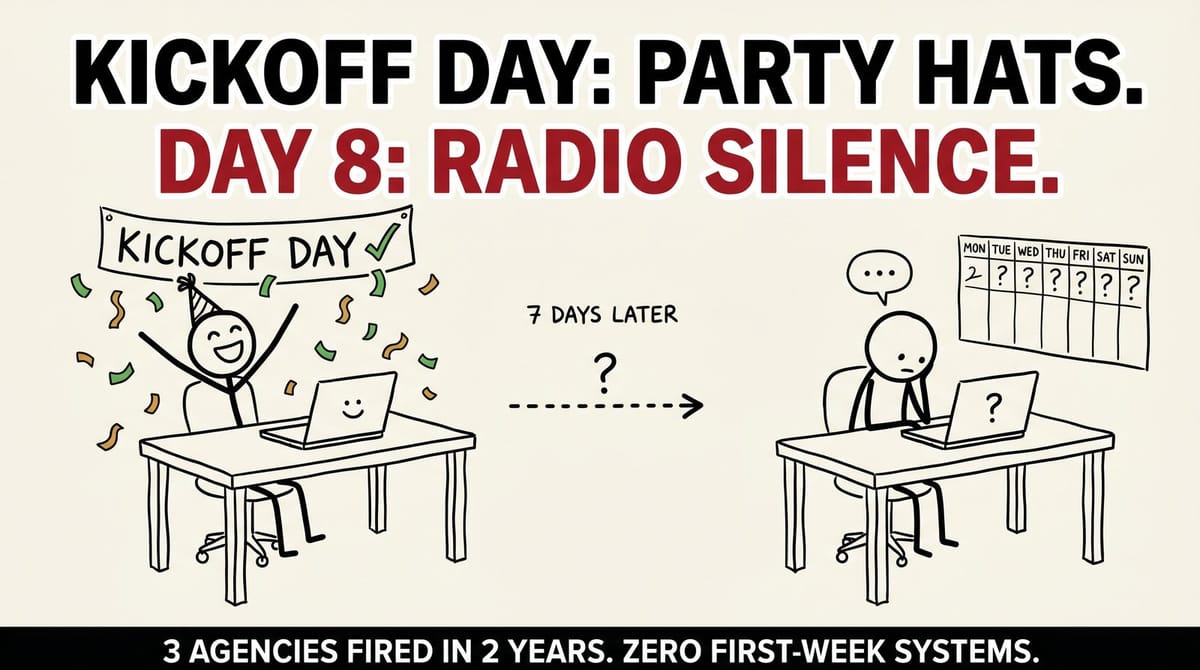
When I asked her what went wrong each time, she didn't talk about the work. She talked about the first week.
Agency one sent a Calendly link the morning after she signed, then went radio silent for 11 days.
Agency two ran a kickoff deck with someone else's logo still on slide 4. She caught it. The PM apologized, blamed a template, and moved on. She did not move on.
Agency three onboarded her into Asana, then stopped using it themselves by week three. By month two she was the only person updating the board.
"They all sold us a kickoff call," she said. "Nobody sold us week one."
That sentence has been rattling around my head since.
The pattern, named
Every agency has a sales motion. Almost none have a first-7-days motion.
The sales motion is rehearsed. There's a deck, a discovery framework, a proposal template, a pricing structure, a contract. The senior partner shows up to close. Everyone is on their best behavior.
Then the contract gets signed and the firm pivots back to whatever it was doing before. The new client gets handed off to whoever has capacity. The kickoff happens. The kickoff feels great because the senior partner is still in the room.
Then the senior partner leaves. The account manager you've never met inherits the relationship. The internal Slack channel that promised to be a hub gets used twice and then never again. The Calendly link sits in your inbox.
Week one happens to you. It isn't designed.
I've seen this play out at maybe forty B2B services firms across the last fifteen years. The shape is almost always identical. The firm has a working sales motion (because revenue depends on it) and an improvised first-7-days motion (because no single client failure has ever felt expensive enough to fix it, and the cumulative damage is invisible until renewal season).
The damage is also delayed. The client whose week one feels chaotic does not usually quit in week two. They go quiet. They stop forwarding the engagement to their internal stakeholders. They stop sending the referral they would have sent. They stop responding within an hour to your account manager's outreach. The decision to not renew is made in week one. The conversation that confirms it happens nine months later. By then it feels like a thousand small things; in fact it was one big thing the firm never named.
This is closely related to the broader pattern I wrote about earlier this month, where founders confuse a marketing budget for a pipeline strategy. Different surface, same root: the firm has decided that the visible motion gets the budget, and the invisible motion gets the leftover. See: You Don't Have a Marketing Problem. You Have a Pipeline Problem.
What "designed week one" actually means
This month in our own delivery operation, we rebuilt the way a new client walks into our world.
It is not glamorous work. It is the opposite of glamorous. It is project templates, naming conventions, auto-tagging, and pre-loaded checklists. It looks, on the inside, like an extremely boring set of administrative decisions.
To the client, it looks like this.
Within an hour of contract signature, they get a short Loom from their account manager. Named, with a face. Plain English. Three things: "Here is what happens today, here is who you'll meet this week, here is where everything will live."
A shared delivery folder gets provisioned automatically. It has every workspace and checklist the engagement requires, pre-loaded. The client doesn't have to ask where anything is. They get one link. The link works.
Calendar invites for week one go out the same day. Consistent title format. Right attendees, right durations, right meeting links. No "we'll send a calendar invite later this week" sentences in any email anywhere.
A first 7-days agenda lands in their inbox by end of day. Stage, owner, expected output. No agency jargon. No promises of "alignment" or "strategic partnership." Just: on Tuesday, this person will send you that. On Thursday, we'll do the discovery interview. By Friday, here is the artifact you'll have.
To the team, it looks like this.
A Client Delivery Folder template spins up the second the contract gets signed. We use ClickUp; the trigger is a status change on the sales deal. The folder includes the standard lists (Discovery, Strategy, Design, Build, QA, Launch) with the right statuses already configured.
Every internal task on that account auto-tags itself with the client name and the account manager. We can answer "what's open on the FinCore engagement this week" from a single view, with zero manual effort.
Pre-loaded checklists for handoff, design review, content review, QA, and the "don't drop this" steps. These checklists are not aspirational. They are the actual list of things that have hurt a previous client when they got missed. We treat the checklists as a running diary of every embarrassing thing we have ever done in week one, and every new client benefits from the prior fix.
Our team never has to guess where anything lives. They never need to ask another team member where the latest version of the brief is. They never need to figure out the right meeting structure. The structure is the template.
The work itself hasn't gotten more impressive. The packaging around the work has. The client experience in the first 7 days went from "we'll figure it out" to "these people have done this before."
Why this is a marketing decision
Designing your internal delivery system is a marketing decision. It is not back-office hygiene.
Marketing is the set of promises you make. Delivery is the set of promises you keep. The first 7 days is where the gap between the two is either invisible to the client (you kept it tight) or screamingly obvious (you didn't).
The founder I quoted at the top had been sold by three different agencies on three different versions of the same promise. Each one delivered the same shape of failure. Not the work failing. The structure around the work failing. By the third one, her trust in the category was almost gone.
If you are competing for that founder's fourth-agency contract, you do not win on a better deck. You win on a better week one.
This is also where most agency expansion math quietly breaks. Renewals get decided in week one. Cross-sell opportunities get decided in week one. The referral that the founder either does or does not send to her peer six months from now gets decided in week one. The QBR is the post-mortem, not the decision point.
Most agencies are running a strategy where they spend heavily on a six-stage sales process and almost nothing on the first 168 hours that decide whether the entire engagement will be remembered as competent or chaotic. The math is upside down. The fix is also one of the cheapest interventions available to a services firm, because it is structure, not headcount.
The "don't drop this" checklist, in plain language
Here is the actual category list we pre-load on every new client folder. None of these are clever. All of them have a story behind them. Most of those stories are about something that went sideways once and shouldn't again.
Day 0: Signature to first contact.
- Loom from account manager landed in inbox within one business hour.
- Delivery folder provisioned and link sent.
- First 7 days agenda sent.
- Calendar invites for week one issued, with confirmed attendees.
Day 1: Internal kickoff.
- Account team meets internally before the client kickoff. Roles confirmed. Risks named. Lead account manager assigns themselves the first three checklist items.
- Pre-read sent to client team for the kickoff.
Day 2-3: Kickoff call.
- Kickoff deck reviewed by a second team member before the call. (This is the agency-two slide-4-logo rule. Never again.)
- Kickoff call has a stated outcome on the agenda, not just "introductions."
- 24-hour follow-up email goes out by end of business the same day.
Day 4-5: Discovery + first artifact.
- Discovery interviews scheduled with the right operators on the client side.
- First tangible artifact lands in the client's inbox by Friday of week one. This can be a notes summary, a draft brief, a documented decision log. The point is that the client has touched something they did not have on Monday.
Day 6-7: Status, structure, predictability.
- Status update format established. The client knows when to expect updates and what they will contain.
- Communication channels confirmed. (No "should we use Slack or email" debate three weeks in.)
- A 30-day forward look documented so the client can see beyond week one.
This list is alive. We add to it every time something goes sideways in a way we want to remember.
What to do this week if you don't have one
Take 30 minutes. Pretend a new client signed today. Walk through the first 7 days from their inbox.
Specifically.
What does the day 1 confirmation email contain? Is there one? Or does the new client get the contract back countersigned and then silence until someone remembers to reach out?
When does the first human voice or face from your team land in their world after signature? In hours, not days. A Loom is fine. A welcome email is the bare minimum. A "we'll get scheduled next week" message is a failure mode.
What does the calendar look like for week one? Who shows up, in what order, for what purpose, with what expected output? If you cannot answer this without opening five different documents, the client is going to feel that ambiguity.
Where do they go to find the project the moment they need to find it? Is there one link? Is the link populated, or do they land on an empty workspace and feel embarrassed for both of you?
What is on the wall (the shared space, the Slack channel, the doc) that signals "you are in a system that has been here before"? Templates with stale content from a prior client are worse than nothing. An empty workspace with intention is fine. A populated workspace that obviously belongs to them is the goal.
If the answer to any of those is "we'll figure it out when the time comes," you have a kickoff. You don't have a week one.
What this is really about
I'm not writing this from the position of someone who has solved it. I am writing this from the position of someone who has been on the receiving end of bad week-one experiences as a paying customer, and who runs an agency that has not always been clean on this either. We have been the agency with the wrong logo on slide 4. We have been the agency where the account manager went radio silent for a few days because three other things were on fire. I am not above this.
What I am doing is taking the first 7 days seriously enough to put a template, a checklist, and an owner against every step of it. Not because it makes my team look polished. Because it is the part of the engagement where trust is either built or quietly drained.
Most agencies underinvest in this. Then they wonder why retention is fragile, why expansion is hard, why the renewal conversation feels uphill. The renewal conversation gets decided in week one. Not in the QBR.
There is a deeper personal pattern that runs underneath this one for me. I grew up watching my parents try to do every piece of their business themselves and lose it because the structure couldn't carry the weight. I have written about that elsewhere. See: The Crash: What Watching My Parents Lose Everything Taught Me About Delegation, Letting Go, and the Real Cost of Doing It All Yourself. Putting templates and checklists against your week one is, in a smaller way, the same lesson. You cannot deliver a calm first 7 days as a heroic individual effort. You deliver it because the system carries the weight when no single human can.
A short note on tooling
I deliberately have not named our specific tooling stack in detail above, because the lesson is not "use ClickUp." The lesson is "have a trigger and a template."
The trigger is the moment in your sales pipeline where the deal moves from "won" to "in delivery." That moment should produce a deterministic artifact: a folder, a list, a workspace, with the right structure and the right people attached, without anyone on the team having to think about it.
The template is what gets created at that moment. The template has been updated over time by your team to encode every failure mode you do not want to repeat.
We use ClickUp because that's what our team runs on. The same shape works in Asana, Notion, Linear, Monday, or a shared Google Drive with a clear folder structure and a short SOP doc. The tool matters less than the rule: every new client triggers the same structure, and the structure carries forward every lesson the team has paid for already.
If you have a tool and no template, you have a tool. The template is the asset.
If you want help running this on your own delivery operation
I do this work with B2B services firms. Specifically: walking through your current first 7 days as a client would experience it, identifying the gaps, and putting structure against them. The artifact at the end is a documented first-7-days playbook your team can actually run. Not a slide deck. A working checklist tied to the tooling you already use, with named owners and explicit triggers.
The engagement is short. It is usually one working session with the founder or COO, one shadow session where I sit with the account team and walk through a recent new-client onboarding, and one synthesis pass where I deliver back the playbook with the gaps marked and the fixes proposed.
If that is the conversation you want to have, send me a note and we'll start with a short call to look at how your week one actually runs today.
What I want you to leave with
One question.
If a new client signed today, what would their first 7 days actually feel like?
If you do not know the answer, that is the answer.
The good news: nothing here requires headcount, new tooling, or a redesign. Thirty minutes of operator attention this week, applied to the steps above, is enough to get a working draft of a first-7-days playbook. Most firms never invest those 30 minutes, which is precisely why the firm that does invest them ends up keeping clients longer, getting referred more, and not being the third or fourth agency someone has fired this year.
That's the conversation I wanted to start with this post.
Related reading: Writing SOPs your team will actually follow and How to map a process before you fix it.
Common questions
What should happen in the first week after a client signs with an agency?
Within an hour, a short Loom from the account manager covering what happens today, who the client will meet and where everything lives. The same day, a working shared folder link, week-one calendar invites and a 7-day agenda with stage, owner and expected output. By Friday, the client should have a first tangible artifact such as a notes summary or draft brief.
Why do agency clients not renew their contracts?
The decision is often made in a chaotic first week and only confirmed months later. Clients rarely quit in week two. They go quiet, stop sharing the engagement internally, stop sending referrals and respond more slowly. One founder quoted in the article fired three agencies over first-week failures, not over the work itself.
How do I build a client onboarding checklist for my agency?
Organize it by day: signature to first contact on day 0, internal kickoff on day 1, the kickoff call on days 2 to 3, discovery and a first artifact on days 4 to 5, and status updates and communication channels on days 6 to 7. Add an item every time something goes wrong that you want to remember.
What tool should I use to automate client onboarding?
My team uses ClickUp, where a status change on the won sales deal creates the client folder. But the lesson is to have a trigger and a template, not a specific tool. The same setup works in Asana, Notion, Linear, Monday or a shared Google Drive with a clear folder structure and a short SOP doc.
Get the next one by email
One practical fix every two weeks for owners of established B2B companies. Websites, conversions and operations, written plainly.

Peter Krzyzek
eter Krzyzek is co-founder and CTO of Chykalophia, the Chicago agency that builds strategy-led websites for established B2B companies, and co-author of Made to Sell.
Comments