The 7-Signal, 8-Minute Pipeline Diagnostic for Your B2B Homepage (With My Own 38/100 Score)
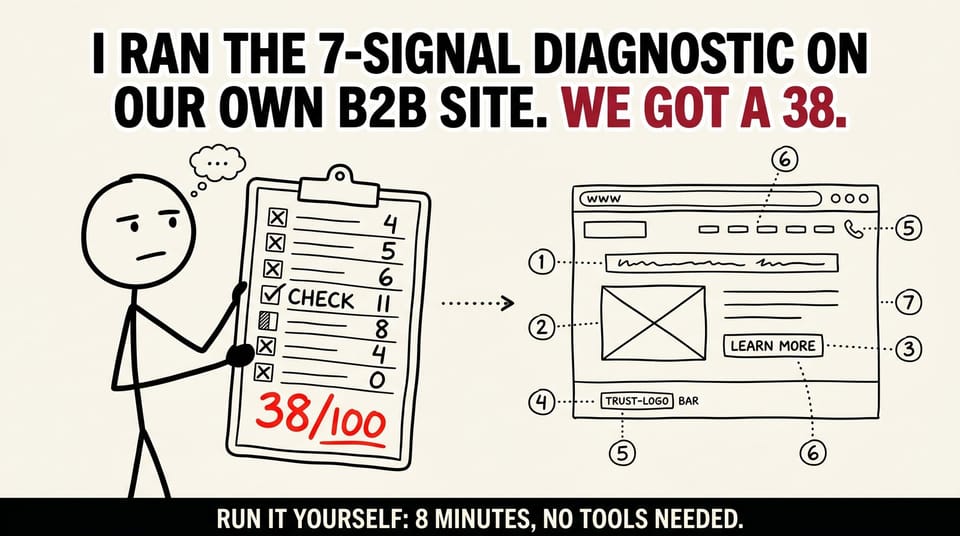
Table of contents
I ran the diagnostic on our own website last Sunday morning.
Chykalophia. The agency I co-founded. The site I personally signed off on. The site I've used to make the case to other founders that a homepage that doesn't pull pipeline weight is the most expensive operating cost on their P&L.
We scored a 38 out of 100.
Seven signals. Fifteen points each. Eight minutes total. The kind of self-assessment any B2B services founder can run on their homepage in the time it takes to drink half a coffee.
I knew before I started that it wouldn't be a 90. I didn't expect it to be a 38.
This piece is the diagnostic itself, the scoring rubric, the breakdown of where Chykalophia lost the points, and a usable model for what to do with the score whatever it turns out to be. If you've been quietly suspecting your homepage isn't pulling its weight, this is the cheapest way to confirm it.
Why I built it
For the last few months I've been telling clients on diagnostic calls that their site isn't doing the pipeline work they think it is. I'd run analytics with them on the call, point at the gap between visitor count and qualified conversation count, and the conversation would shift.
The pattern is the one I named in Day 1 of this series: most $5M-$20M B2B service firms have a pipeline problem, not a marketing problem, and the homepage is the most expensive instance of it. The hero alone, as I covered in Day 2, runs at about $42K/month in foregone pipeline at $5M revenue when it doesn't do the three jobs a hero exists to do.
But I was carrying around the score in my head. I'd say "your hero is doing about 30% of the job," and I'd mean something specific by that, but the founder couldn't run it on their own homepage in the four days between my call and their next leadership meeting. Without a way for the founder to score the gap themselves, the diagnostic stayed mine. They couldn't make the case to their team or their board without me standing next to them.
So I sat down and wrote it up. Seven signals, with pass / partial / fail criteria. Each signal scored 0-15. Total out of about 100. Designed to take 8 minutes (about 70 seconds per signal). No tools. No signup. No outside expert needed.
Then, before I sent it to anyone, I scored ours.
How to use this article
You can read it through, then go score your homepage. That works. What works better: open your homepage in another tab and score each signal as you read its criteria. The whole exercise takes 8 minutes if you stay disciplined. The point of the time constraint is that you're scoring at the resolution your visitor experiences the homepage, not at the resolution of an audit.
Be honest. The diagnostic is for you, not for your team or your designer. There's no prize for a score that flatters the work.
Have a pen and paper or a notes file open. Total at the end.
The seven signals (full criteria)
Each signal is a thing a working B2B homepage does in the first viewport, or in the case of mobile, in the first thumb-scroll. Each one is binary enough that you can call it pass / partial / fail in 70 seconds without overthinking.
Signal 1: Hero specificity (0-15)
The question: Does the hero name the visitor's actual problem in their language?
Pass (11-15): The hero headline contains a specific problem, friction, or outcome the operator would say out loud when they're frustrated. "Stop spending 6 hours a month reconciling PTO across three systems" is pass. So is "Cut your shutdown window from 14 days to 6 without changing your maintenance vendor." The line you'd hear a CFO use when she's venting is the language you want.
Partial (5-10): The hero is on-topic but generic, or names the category without naming the friction. "HR software for growing teams" is partial. Better than nothing, but it doesn't earn the next four seconds.
Fail (0-4): "Strategic Solutions for Forward-Thinking Companies." "Engineering Excellence for Mission-Critical Operations." "Transforming the Way Modern Businesses Operate." These are dead-air heroes. They sound like brochures because they are.
Why it matters: The hero answers query 1 of three queries the visitor's brain runs in the first four seconds (Is this for me? Is the promise believable? What do I do next?). Specificity is permission to keep reading. Without specificity, the visitor's brain says "this is generic," and the bounce is functionally cognitive before it shows up as analytics.
Signal 2: Outcome promise with a number (0-15)
The question: Does the hero contain a specific defendable number?
Pass (11-15): Time saved, percentage moved, dollars recovered, days reduced. A specific outcome attached to a quantified delta. "30-day pipeline diagnostic." "$2M+ savings on a typical 18-month engagement." "Reduce time-to-quote from 6 weeks to 9 days." The number is the difference between a hero and a brochure.
Partial (5-10): A claim is made but the number is vague ("dramatic improvements," "significant ROI") or the number is on the page but below the fold. The visitor in the first viewport sees a promise without proof.
Fail (0-4): No outcome claim, or "Trusted by hundreds of customers" / "Industry-leading" claims that have no defendable specificity.
Why it matters: B2B operators are professional skeptics. A specific number reads as a defendable claim that the firm has thought about. A vague claim reads as marketing. Sandra (the buyer in our profile) trusts numbers more than she trusts adjectives. Always.
Signal 3: CTA discoverability (0-15)
The question: Is there one clear primary CTA in the first viewport, distinct from secondary actions?
Pass (11-15): One primary CTA that the eye lands on within 1.5 seconds. Visually dominant. Secondary CTAs (if present) are clearly subordinated by color, weight, or position. The visitor's next step is unambiguous.
Partial (5-10): A primary CTA exists but is competing with one or two equal-weight secondary actions. The visitor has to choose, and the friction shows up in click rate.
Fail (0-4): Four CTAs of equal visual weight, or no CTA in the first viewport at all. The visitor's brain has to do the work of figuring out what's primary, and most won't.
Why it matters: This signal answers the third query the visitor's brain runs ("what do I do next?"). A working hero gives them a measurable action. A failing hero asks them to scroll and hope.
Signal 4: Trust signals visibility (0-15)
The question: Are trust signals specific, named, and in the first viewport?
Pass (11-15): Three named client logos at thumbnail size, or a specific outcome quote with the operator's name and title. Trust signals are first-viewport, not buried. The visitor sees proof before they have to look for it.
Partial (5-10): Trust signals are present but generic ("Trusted by hundreds of companies"), or specific but below the fold so the visitor never sees them in their first impression.
Fail (0-4): No trust signals in the first viewport, or trust signals so vague they read as filler ("Industry leaders trust us").
Why it matters: B2B trust is built on specificity. "Trusted by industry leaders" is the absence of trust because it tells you nothing about who. Three named logos earn more credibility in 1.5 seconds than 200 words of testimonial copy below the fold.
Signal 5: Mobile experience (0-15)
The question: Has the homepage actually been used on a phone, not just responsive-tested?
Pass (11-15): The homepage is fluent on a phone. Hero text is readable without zoom. Primary CTA is thumbable in the lower 60% of the screen. Page loads in under 2 seconds on 4G. Anyone has tested it on an actual phone in the last 30 days.
Partial (5-10): The site is technically responsive (passes Lighthouse mobile audit) but obviously hasn't been used on a phone. Hero text wraps awkwardly. CTA is in the upper third where the thumb can't reach. Small interactions feel built-for-mouse.
Fail (0-4): Visibly broken on mobile, or the desktop experience squished onto a smaller screen with no mobile-specific consideration.
Why it matters: 60%+ of B2B traffic is now mobile. The behavior pattern is "scout on mobile, convert on desktop" but the scouting is still where the buy/no-buy decision often gets made. A homepage that fails the mobile scout is filtering out half its qualified visitors before they ever sit at a desktop.
Signal 6: Visitor routing (0-15)
The question: Are there 3-4 distinct paths for different operator types, or one undifferentiated funnel?
Pass (11-15): The homepage routes visitors by operator type within the first scroll. A CFO can self-identify and click into a path written for her. A head of operations can do the same. A CTO can find his lane. Three named paths with one click each.
Partial (5-10): The site has paths, but they're behind a "Solutions" or "Industries" mega-menu, or they require interpretation. The visitor can find their path but it costs cognitive load.
Fail (0-4): One funnel for everyone. No operator-routing visible above the fold. The visitor has to extrapolate whether the firm serves them.
Why it matters: B2B services firms typically sell to 2-4 distinct operator types, and the language each type responds to is different. A site that funnels everyone through "schedule a discovery call" is treating prospects as undifferentiated leads, and the conversion rates show it. Self-routing in the hero region is the highest-leverage way to qualify visitors before sales gets the inquiry.
Signal 7: Value prop legibility (0-15)
The question: Can a peer founder reading the homepage cold for 10 seconds answer "what does this firm do" without help?
Pass (11-15): Anyone outside the firm's industry can summarize what the firm does after 10 seconds on the homepage. Specifically. "They help mid-market HR teams reconcile multiple systems" is pass. The legibility test is the closest thing to a lie detector for B2B copy.
Partial (5-10): A peer founder gets a vague sense ("they do something with software," "they help businesses") but can't name the specific operator problem the firm solves.
Fail (0-4): A peer founder shrugs after 10 seconds. They can't summarize because the homepage doesn't deliver one in that timeframe.
Why it matters: Most B2B homepages fail this test catastrophically and the founder has no idea, because the founder is too close to the work to read the homepage cold. This signal is the easiest one to lie to yourself about and the most expensive to leave broken. Run the test with someone outside your industry. Time it.
Scoring bands and what to do with each
Total your seven scores. The number is out of 105 maximum, but treat it as ~100 because precision below the percentage point doesn't matter at this resolution.
70-100: Optimization band. Your homepage is structurally sound for pipeline. The signals are working. The work to do is incremental: tighten the highest-leverage signal another 2-3 points, A/B test the hero copy, refine the visitor routing. You're not in rebuild territory.
50-70: Surgical-fix band. The architecture is mostly right but you're losing points on execution. Identify the two signals you're failing the most on, ship the smallest change that would move them, retest in 30 days. You don't need a rebuild. You need surgical fixes.
30-50: Structural-gap band (where Chykalophia landed at 38). The gap is structural. Several signals are failing or partial in ways that compound on each other. The homepage is contributing well below what the traffic should produce. The conversation inside the firm is no longer "what's the next optimization" but "are we willing to address the architecture?"
Under 30: Functionally-absent band. The website is doing zero or near-zero pipeline work. Whatever marketing is being routed to it is being absorbed without conversion. The conversation is whether the homepage should be doing pipeline work at all, or whether it's been ceded as a brand-only artifact. (Both are valid stances. The cost of either has to be eyes-open.)
Where Chykalophia lost the points
A 38 lives in the structural-gap band. I'm asking founders to be honest with themselves about their score, and I'd feel like a hypocrite without showing my own work. Here's the breakdown.
Signal 1 (Hero specificity): 4. Our hero leans into our story (a husband-and-wife agency building for B2B operators) but doesn't name the visitor's actual problem in their language. The visitor lands on chykalophia.com and learns about us before they learn whether we can help them. The hero is brand-coherent and operator-vague. Fail.
Signal 2 (Outcome promise with a number): 5. We have outcomes named on the site, but not in the hero with a defendable number. Partial.
Signal 3 (CTA discoverability): 6. Two CTAs in the first viewport, both fighting for the same visual weight. The visitor has to choose, and the choice friction reads in our analytics. Partial trending fail.
Signal 4 (Trust signals visibility): 11. We pass this one. Named clients, specific outcome callouts, actual logos visible above the fold. The trust block is doing work.
Signal 5 (Mobile experience): 8. Responsive-tested. I opened our site on my phone last Sunday and caught two things I would not have caught at the desktop breakpoint: the primary CTA was in the upper-third where my thumb couldn't reach without re-grip, and the hero subhead wrapped awkwardly between two columns of text. Partial.
Signal 6 (Visitor routing): 4. We have one path, with sub-paths buried in navigation. Different operators don't have a clear self-route from the homepage. The CFO and the marketing director are funneled into the same first interaction. Fail.
Signal 7 (Value prop legibility): 0. I asked my brother to look at the homepage for 10 seconds and tell me what we do. He said "design something." That's the result the diagnostic is built to surface, and it surfaced for me.
Total: 38.
The pattern is the one I see in most $5M-$20M B2B service firm sites: the signals we passed (trust, partial mobile) were the ones that were easy to get right. The signals we failed (hero specificity, value prop, visitor routing) were the ones that pay back the most. Easy work tends to get done. The work that produces pipeline lift tends to get deferred because it requires harder decisions about positioning, audience, and language.
That's what makes it structural. The fix isn't a feature update. It's a positioning decision.
What I'm doing about our 38
I'm not going to redesign the site this week. The structural-gap fix isn't a redesign anyway. It's a re-positioning, then a hero rewrite, then a routing rebuild.
What I am doing: writing the operator-language hero copy first, before any design treatment. The hero copy is the thing that fails the diagnostic, and you can't fix it with a better photo or a tighter CTA. You fix it by knowing exactly which operator you're writing to and what specific friction they have in their day. That's positioning work. It's slower than a redesign sprint and it pays back longer.
I'll publish the rewrite in a future piece, with the before-and-after score on the diagnostic.
Common scoring mistakes (read before you score)
Three things founders typically get wrong when self-scoring:
1. They score the homepage they intended, not the homepage that exists. The homepage in your head, with the rationale you remember from the original brief, is not what the visitor sees. Score what's on screen at the URL, in the first viewport, in 10 seconds. The intent doesn't count.
2. They score the hero generously because they wrote it. This is the single most common scoring error. The hero you wrote 18 months ago when you re-positioned the firm felt sharp at the time. Today, after the firm has evolved, the same hero may have drifted into generic. Score it as a stranger would, not as the author would.
3. They skip Signal 7 because it requires asking someone. Don't skip it. Signal 7 is the lie-detector. If you can't get a peer founder to take 30 seconds to read your homepage cold, score it conservatively (default to partial at most), but don't default to pass because the test is inconvenient.
What to do with your number
The score is a starting move, not an ending. A 38 is not a verdict on the firm. It's a number that lets you have a more honest conversation about where the website fits in pipeline mechanics.
The conversation that follows the score is where the value is. If the leadership team can look at a 38 and say "that's structurally consistent with what our pipeline data shows," the diagnostic has done its job. The next step (do we redesign, do we rewrite the hero, do we change the visitor routing, do we accept the homepage is a brand artifact and route pipeline elsewhere) is a strategic call, not a checklist call.
What I'd discourage: defaulting to a redesign because the score was uncomfortable. Most $5M+ B2B service firms with structural-gap scores don't need a redesign. They need positioning work that the website can then express. The homepage is an output of positioning, not a substitute for it.
Tomorrow: the receipts
This is Day 3 of a five-day series. Tomorrow is the receipts post: three anonymized B2B service firms whose sites went from cost-center to pipeline-source. The actual conversion numbers, the timeline (how long it took), and the specific signal-level changes we shipped. Real math. No logos yet (testimonial permissions still working through), but the numbers are real.
If you scored 30-50 on the diagnostic, the receipts post will give you a usable model for what the move from a 38 to a 70 actually looks like in months and dollars.
Day 5 (Saturday) is the personal close: the emotional cost of admitting your homepage isn't pulling its weight, and why the founders who run the diagnostic anyway are the ones who actually fix the gap. That one's not for everyone. If you're in the structural-gap band and you've been quiet about it, it might be the most useful piece in the series.
Run it on your site this week
The whole point is that you don't need me, and you don't need an agency, to score your homepage. The seven signals are above. The pass/partial/fail criteria are above. Eight minutes. No tools. Score it honestly.
Whatever the number, post it. I went first with our 38. The conversation a number forces inside the firm is more valuable than the score itself.
What would your homepage score if you ran the seven signals right now?
This is part of a 5-day series for B2B service firm founders. Read Day 1: You Don't Have a Marketing Problem. You Have a Pipeline Problem. and Day 2: Your B2B Hero's One Job (And the $42K/Month It Costs When the Hero Doesn't Do It).
If you'd rather have someone else run the diagnostic on your site (with the same scoring rubric, plus the back-of-the-napkin pipeline math at your revenue level), I do a 30-minute version on calls with B2B service firm founders. No deck, no proposal, just the score and the conversation it forces. Reach out through Chykalophia if that's useful.