What "Foundational SEO" Actually Means: A Plain-English Guide for B2B Service Firm Founders
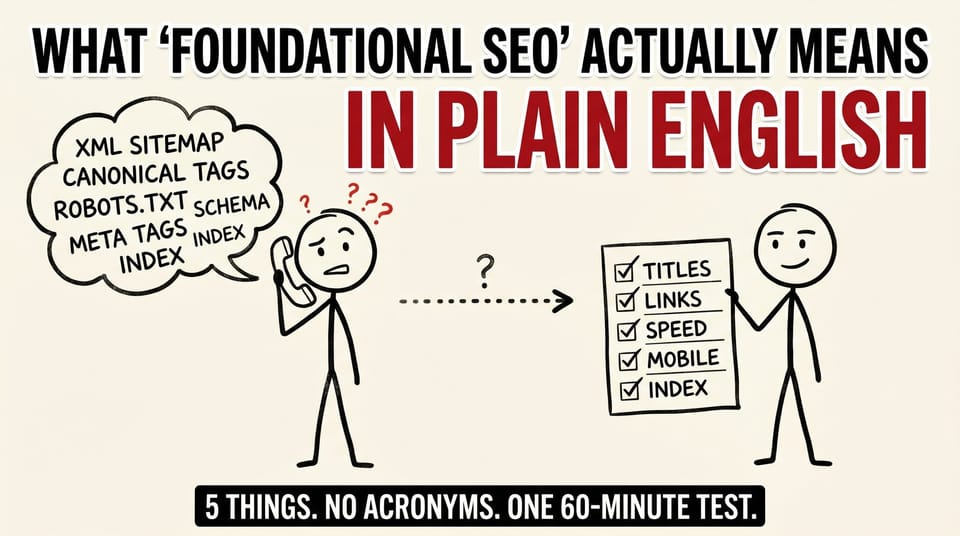
Table of contents
"Can you actually explain what 'foundational SEO' covers? I keep hearing the term and I cannot tell what I'm buying."
That was the question a client emailed me on Saturday morning.
She runs a B2B services firm. She has been sold "foundational SEO" by two different agencies in three years. The first one disappeared mid-project. The second left her with a strategy deck and a five-figure bill she still cannot explain to her board.
By the time the question landed in my inbox, "foundational SEO" had become, for her, a vague label for things she was paying for and could not describe in language her CFO would respect.
So I sat with my coffee and wrote her a long reply. This is the expanded version of that reply, with the examples and the questions I would ask any agency proposing "foundational SEO" for a B2B service firm.
The honest definition
Foundational means the floor that everything else stands on. Not advanced. Not aggressive. The floor.
If you build the floor right, future SEO work has somewhere to land. If you skip the floor and start with content production or link-building or whatever the agency wants to upsell next, you are stacking new effort on top of structural debt.
That is the whole concept. It is not magic. It is not gated behind acronyms. It is five things, and any agency selling you "foundational SEO" should be able to walk you through all five without making you feel like you should have studied harder.
I am going to walk through the five the way I walked through them with her. Each one has the plain-English version, what good looks like, what bad looks like, and one question to ask any agency proposing this scope of work.
1. The site is technically findable
Plain English: Search engines have to be able to read your site before they can rank any of it. That means the address structure is clean, the pages load fast, the mobile version is a real version (not a squeezed desktop), and nothing in the code or hosting setup is blocking the crawler.
What good looks like: URLs that read like English sentences (/services/fractional-finance instead of /page?id=4729). A homepage that loads in under two seconds on a mid-tier phone over a 4G connection. A robots.txt file that gives the search engine the right access. A sitemap that lists every page that should be indexed and excludes pages that should not. A site that responds with the right HTTP status code for missing pages (404), permanent redirects (301), and live pages (200) without surprises.
What bad looks like: URLs full of question marks and tracking parameters. Pages that take six seconds to render because someone loaded a 4MB hero image as the first paint. Mobile menus that are unclickable on a real thumb. A blocked robots.txt that nobody remembers configuring. A sitemap that includes the staging environment.
The question to ask: "Can you walk me through our site's current technical health using a tool I can see, and show me what you would change in the first 30 days?"
A real answer points to PageSpeed Insights, Search Console, or a site crawl from a tool like Screaming Frog, with a list of changes ranked by impact. A jargon-coated answer should make you nervous.
2. The pages explain themselves
Plain English: Each page has a title that says what the page is about, headings that reflect the actual structure of the page, a meta description that makes sense as a Google snippet, and schema markup where it actually earns its keep. The page is talking to two readers at the same time: the human who lands on it, and the search engine deciding whether to send the human there in the first place.
What good looks like: A title that describes the offer in the buyer's words. An H1 that matches the title's intent. H2s that map the page sections. A meta description that reads like the first paragraph of a brochure, not a string of keywords. Schema markup for things that are searchable: services, articles, FAQs, the company itself.
What bad looks like: A title that says "Home | Acme Consulting" on every internal page. An H1 used as a design element instead of an information hierarchy. A meta description that is either missing, auto-generated from random page text, or stuffed with the words "leading provider of innovative solutions." Schema markup that nobody can explain.
The question to ask: "Can you show me the current title tag, meta description, and H1 for our top five revenue pages, and explain why each one says what it says?"
A real answer is a spreadsheet. A vague answer is the warning sign.
3. The content matches the questions your buyers actually ask
Plain English: Keyword research grounded in the words your buyers really use, not the words you wish they used.
This is the one most agencies hide behind. Real keyword research is talking to your salespeople, reading your support tickets, scrolling your buyers' Slack groups and Reddit threads, and pulling Search Console data to see what actually drove qualified traffic last quarter. It is not running your service description through a keyword volume tool and picking the top five.
What good looks like: A keyword document that reads like buyer dialogue. "How to know when to hire a fractional CFO" beats "outsourced finance leadership solutions" every time, because the first one is what a founder actually types into Google at 11pm on a Sunday and the second one is what every consulting firm in the country has on their about page. The good document also lists the terms your buyers DO NOT use, with a one-line note about why they are off limits.
What bad looks like: A keyword report from a tool, sorted by search volume, with no filter for whether your buyers actually use those terms. A list of "long-tail" phrases that nobody has ever spoken out loud. The phrase "industry-leading" anywhere.
The question to ask: "How did you build this keyword list? Walk me through three sources you used that aren't a keyword tool."
A real answer mentions sales calls, Search Console, support tickets, founder communities, customer interviews, or competitor content gap analysis. An answer that is just "we used Ahrefs and Semrush" is incomplete.
4. Internal links route attention sensibly
Plain English: No orphan pages. No dead ends. The pages that matter most to your business should be three clicks from anywhere on the site. Pages that explain related ideas should link to each other. Pages that ask the visitor to take action should be reachable from anywhere a buyer might enter the site.
What good looks like: A homepage that links to the five most-revenue-impacting pages. A blog post on "should I hire a fractional CFO" that links to the fractional CFO services page using the words "fractional CFO services" as the link text. A services page that links back to a relevant case study. A site that, mapped as a graph, has no isolated nodes and no pages that take six clicks to reach.
What bad looks like: A blog with seventy posts and no internal links between them. A services page that exists in the navigation and is linked from nowhere else. A "back to top" button as the only navigation aid on long pages. A site map nobody has looked at since launch.
The question to ask: "Show me the five most internally linked pages on our site today and the five least linked. Are those the right pages to be at the top and bottom?"
A real answer needs a crawl. The follow-up conversation about which pages should change places is the actual strategy work.
5. Measurement is wired up
Plain English: Google Analytics 4. Search Console. A small dashboard that shows, at minimum: where traffic is coming from, what people are doing once they arrive, and which queries are bringing them in. Conversion events for the actions that actually matter to your business (form fills, calls booked, asset downloads), not "scrolled past 50% of the page."
What good looks like: A working GA4 install with conversion events that map to real pipeline. Search Console connected and reporting weekly. A dashboard that any non-technical leader can read in two minutes and walk away knowing whether the site moved or stalled. Quarterly review meetings where the numbers actually drive the next round of work.
What bad looks like: Universal Analytics still installed and producing data nobody can use. GA4 installed but with no conversion events configured. Search Console set up by an agency that left two years ago. A dashboard that shows page views as the headline metric. Nobody can answer the question "did the site move pipeline last month?" without three days of guesswork.
The question to ask: "What conversion events are configured today, and how do they map to our pipeline?"
This is the question most agencies fumble. If they cannot map conversion events to pipeline contribution per visitor, they are not measuring SEO. They are measuring activity.
What "foundational" does NOT mean
Just as important as what foundational SEO covers is what it does not.
Foundational does not mean publishing two blog posts a month. That is content marketing, which is a different scope of work, even though it touches SEO. Foundational does not mean buying backlinks. That is link-building, which is not foundational and is rarely the right next move for a $5M-$20M B2B service firm. Foundational does not mean a one-time technical audit handed to your developer to fix. An audit without execution is a $4K document.
If an agency is selling you "foundational SEO" and the deliverables list includes 12 blog posts and 15 backlinks, you are not being sold a floor. You are being sold a content retainer with SEO as the wrapper.
The reply she sent back
"I am on board with this. Thank you for explaining. I am going to forward this question to the SEO firm we have been talking to and see what comes back."
That is the part of the email I want to talk about.
The lesson is for the buyer
The lesson is not for me. It is for her. And it is for any founder reading this who has been quietly paying for "foundational SEO" without being able to explain to her own board what foundational means.
Most agencies I have watched over fifteen years of building B2B websites don't sell "foundational SEO" with bad intent. They sell it because the term is convenient. It is broad enough to mean a hundred different scopes of work and narrow enough to sound like a real deliverable. That is a useful term for a sales conversation. It is not useful for a buyer trying to figure out what she is going to get.
The fix is not to learn more SEO jargon. The fix is to refuse jargon. If your agency cannot describe foundational SEO without four acronyms in a row, that IS the warning sign. Foundational means the floor every other tactic stands on. Anyone selling you that floor owes you a description in plain English.
How to evaluate any SEO proposal in 60 minutes
If you are looking at a proposal right now, run this five-question test. It takes about an hour. Schedule the agency for a video call. Open a shared screen. Ask each question, watch the answer, and keep notes.
- Show me, on our actual site, the technical issues you'd fix in the first 30 days. Real answer: a crawl report or PageSpeed export, with a ranked list. Bad answer: vague mention of "site speed and mobile optimization."
- Pull up our top five revenue pages and tell me what their title and meta description should change to. Real answer: specific suggestions with reasoning. Bad answer: "we'll do an audit and get back to you."
- Show me three keywords our buyers actually search for and how you found them. Real answer: sources that go beyond a tool, things like sales calls, Search Console, founder communities, customer interviews. Bad answer: a long list of search-volume-sorted terms with no buyer reasoning.
- Map out, on paper, what our internal linking looks like today. Real answer: a sketch or a tool-generated graph. Bad answer: "internal linking is one of the things we'll address."
- What conversion events do you configure, and how do they map to pipeline contribution per visitor? Real answer: a clear measurement plan tied to actual revenue actions. Bad answer: "GA4 setup is included in the scope."
The agency that can answer all five clearly is selling you a floor. The agency that cannot is selling you language. The price tag is rarely the differentiator.
The pattern under the term
The reason all of this matters more than it sounds is that "foundational SEO" is the work the rest of your marketing investment quietly depends on. If the floor is missing, nothing else you spend money on can stand up. The content marketing retainer floats. The paid traffic dies on a landing page that doesn't explain itself. The PR placements drive traffic that bounces because the site cannot tell visitors why they should care.
Most founders don't see this until the third or fourth marketing investment in a row underperforms. By then, "foundational SEO" has become a category of spend that has produced no visible result, and it is easier to blame the channel than to ask whether the floor was ever actually built.
The simpler conversation, the one I had with my client on Saturday morning, is: walk me through the five. Show me what each one looks like for our site. If you cannot, we are not buying a floor. We are buying language.
This is the same gap I wrote about earlier this week in Most B2B Service Firms Don't Have a Marketing Problem. They Have a Pipeline Problem. "Foundational SEO" is one of the most common forms the pipeline problem takes. The website is structurally unable to convert, but the line item on the budget says "SEO" so the spend is allowed to continue.
The fix starts with the five.
What to do today
Forward this question to your current SEO partner this morning: "What does foundational SEO actually cover for our project, in language I could use to explain it to my board?"
Read what comes back. Notice the word count. Notice the number of acronyms. Notice whether the description sounds like a building you would want to build on, or a sales deck written for someone who already speaks the dialect.
Their answer is your data point. It tells you almost everything you need to know about whether you are buying a floor or buying language.
If you find yourself unable to explain the answer to your CFO, the agency hasn't done its job, and the question is whether you continue funding work that cannot be defended in your own board meeting.
That is a separate decision from whether SEO is a good investment. SEO is a good investment when the floor is real. It is a money pit when the floor is language.
If you want a second opinion on what foundational SEO should look like for your specific firm, that is one of the things I do at Chykalophia. Walk me through your current site, your current SEO scope, and your last three quarters of measurement, and I will tell you, in plain English, whether the floor is real or whether you are paying for language.
What did your last SEO conversation actually cover? An honest description, not the acronyms.