From Heroic Resilience to Structural Reliability: How to Rewrite Your Leadership Deck for Real Governance
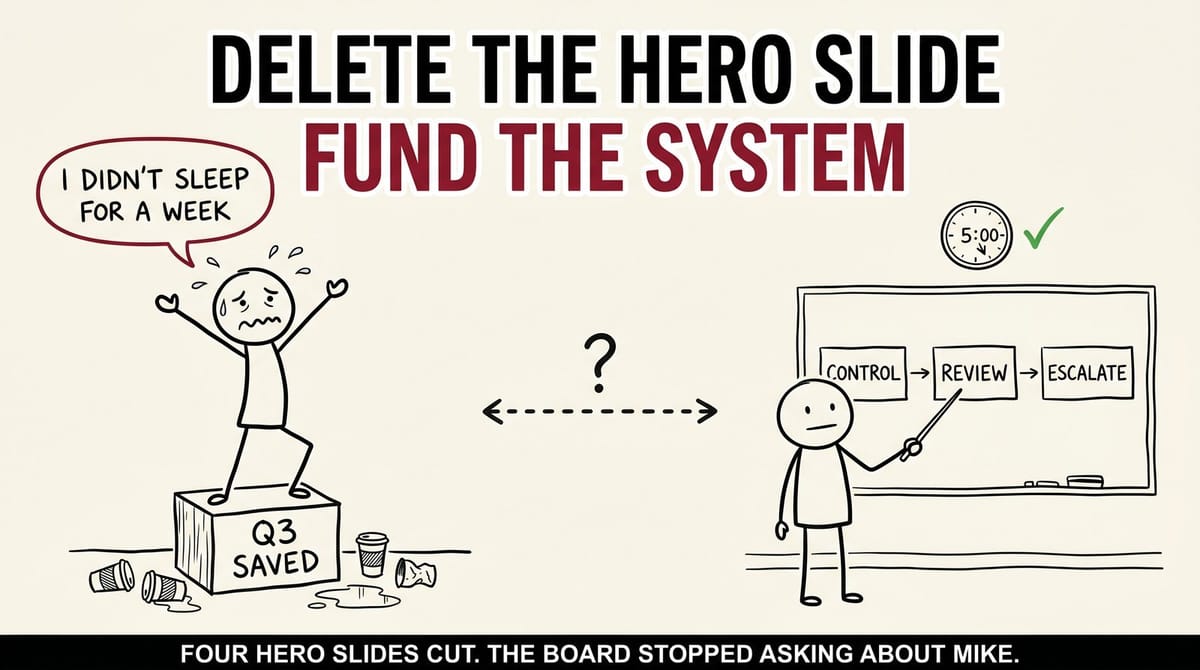
I deleted four slides from a leadership pitch deck last week. Every one of them was a hero story.
A financial services client had asked us to refresh their executive presentation. The first draft leaned on familiar tropes. Gritty leaders holding it all together. Teams going above and beyond in a crisis. Individual resilience as the main safety net.
We cut all of it.
The revised deck reframed the same business stakes with a different spine. Same client. Same numbers. The hero who saved Q3 got replaced with the decision infrastructure that meant Q3 did not need saving.
By draft three, every story about an individual leader heroically pulling the team through was gone. What survived was harder to write. Specific governance changes. Specific decisions that were made differently because of a new control point. Specific moments where a process caught what a person used to catch by working a Saturday.
It read as less inspirational and considerably more credible.
This piece is the long version of why that rewrite mattered. It is for B2B service firm founders, operations leaders, and anyone whose next leadership deck is sitting half-finished on their laptop. By the end you will have a framework, three concrete swaps, and a diagnostic you can run against your own deck in ten minutes.
The pattern that produces hero slides
I have watched maybe thirty leadership decks over the last five years in B2B services contexts. Most contain at least one hero slide. The shape is almost always the same.
A team faced a crisis. The leader did not sleep for a week. Heroic effort. Customer was saved. Quarter was saved. Cue inspirational quote from the leader.
The first time you see this in a deck, it lands. The second time, you notice it is the same story with different names. By the fifth time, you start asking the question the deck is hoping you do not ask: how often does this happen?
Because if the answer is "every quarter, in slightly different shape," that is not a story about heroism. That is a story about a system that requires heroism to function.
Systems that require heroism to function fail predictably. They fail when the hero quits. They fail when the hero burns out. They fail when the hero has a kid, or a parent in the hospital, or a vacation already paid for.
Boards and CISOs and sophisticated buyers know this. The hero slide reads to them as a red flag, not a humble brag. It tells them you are operating one Saturday away from a customer-facing outage and you have decided to frame that as a strength.
This is the part most founders miss. The hero slide is not neutral. It is actively expensive in the rooms where you most want it to land.
Why hero stories quietly erode trust with regulators and sophisticated buyers
There is a specific kind of meeting where the hero slide costs you the most. Diligence. Risk review. Audit committee. Renewal with an enterprise customer that has its own SOC 2 team. Any conversation where the person across the table has been on the receiving end of a vendor going down.
In those rooms, the question behind every slide is the same. Not "are these good people?" but "can I sleep at night knowing this firm is running my operation?"
A hero story does not answer that question. It surfaces it. Every time you tell the story of the operator who pulled the team through, the listener is doing the math on what happens when that operator is sick.
In contrast, a deck that says "we identified a control gap in our incident response process in Q2. We funded a structural fix. Here is the specific change. Here is the team accountable. Here is how we will measure whether it worked" answers the actual question. It tells the buyer this firm has the muscle to detect and close gaps without needing a hero to bail it out.
The same firm. The same underlying competence. Two completely different conversations.
What gets funded vs. what gets framed
Here is the gap that the financial services rewrite forced me to see clearly.
What gets framed as a strength in most leadership decks: people. The team. Culture. Resilience. Going above and beyond.
What gets funded in most operating budgets: marketing. Sales. New product. Recruiting.
What is rarely either framed or funded: the decision infrastructure that makes day-to-day operations not require heroism. Governance. Control frameworks. Decision-rights documents. Operational runbooks. Escalation patterns. Post-incident review systems that actually produce structural changes.
These line items live in the awkward middle. They are too operational to be exciting. They are too cross-functional to belong to one budget owner. They are not headcount, so they do not show up in a hiring plan. They are not software, so they do not show up in a tooling plan.
They are also the difference between a firm that scales and one that grinds.
When we rewrote the financial services deck, we did not invent new programs. We named what they were already doing under the "infrastructure" frame and put dollar amounts and outcomes next to each one. The same work that had been buried under "process improvements" became the central narrative of the presentation.
The board response was different. The questions stopped being "tell me more about the operations lead who saved that project" and started being "what is the next control we are going to fund."
That is the gap. The work was always there. The framing changed what the work was worth.
Enterprise Risk and Control Infrastructure in human language
Most operations teams I have worked with already do a version of this work. It is just buried under language that finance does not recognize as capital expenditure.
The translation looks roughly like this.
"Process documentation" becomes "decision infrastructure that enables consistent operations across teams."
"Tribal knowledge transfer" becomes "structural elimination of single-points-of-failure in operational risk."
"Quarterly review meetings" becomes "governance cadence that surfaces and addresses control gaps before they reach incident status."
"Incident postmortems" becomes "structured learning system that converts operational incidents into permanent control improvements."
None of this is spin. The work is the same. What changes is which category it lives in when finance is making cut decisions, and which department it belongs to when the org chart is drawn.
If your operations team is doing post-incident reviews, you have a governance function. If those reviews produce specific structural changes that get tracked and reviewed, you have a control framework. The fact that nobody has been calling it those things does not mean it is not there. It means it is not getting the budget and visibility it deserves.
Three swaps that change the deck
If you have a leadership deck on your laptop right now, here are three swaps to make before the next one ships.
1. Name the system, not the star
Swap "we worked nights and weekends to deliver" for "we redesigned the work so nights and weekends were not needed."
The first sentence celebrates the cost. The second one celebrates the fix. Boards reward the fix. Heroes get tired.
If you cannot articulate the structural change that prevented the next 2am call, you do not have a fix. You have a workaround that depends on one person's willingness to be on call indefinitely. That workaround has a half-life. It is the half-life of the most exhausted person on your team.
The deeper test: read your own deck out loud and listen for the active subject of each accomplishment slide. If the subject is consistently a person ("Maria led the team through..."), you have a hero deck. If the subject is consistently a system or a decision ("Our incident response process now requires..."), you have a reliability deck.
Both can be true at the same time. But the framing tells the listener which one you are funding.
2. Fund structure, not vibes
Treat governance, controls, and decision frameworks as capital investments. Put them in the same budget category as software or fixed assets. Stop calling them "process improvements" or "operational excellence initiatives." Those words make finance treat them as discretionary.
The reframe matters because the work is the same either way. What changes is whether it gets cut when the quarter tightens.
A practical move: in your next budget cycle, create a line item called "Risk and Control Infrastructure." Put the operations work that is currently scattered across "process," "training," "tooling," and "consulting" under that single line. Now you have a category that a board chair can actually fund without it feeling like vague overhead.
The CFOs I have worked with respond to this reframe better than I expected. Most of them want to fund operational reliability. They just need a budget category they can defend up and across.
3. Make the mandate explicit
Add one slide to your next leadership deck that says, literally: here is how we will operate differently so this does not happen again. No platitudes. Specific control. Specific decision. Specific person accountable.
That slide is the most underused piece of real estate in B2B service firm leadership decks. When it shows up, it gets noticed. When it does not, the deck reads as a motivational poster.
A simple template:
What changed: [the specific control, process, or decision-rights change]
Why it matters: [the operational risk it addresses]
Who owns it: [the named person and their reporting line]
How we will know it worked: [the specific metric or signal, with a date]
That is four lines on a slide. It is also the difference between a deck that gets believed and one that gets nodded through.
What this looks like in practice
The financial services deck rewrite I started this piece with did not invent anything new. Here is the actual shape of the before-and-after.
Before, the deck had a slide titled "Resilience Through Q4 Volatility." The body was a short narrative about the operations team working long hours during a volume spike. There was a closing quote from the operations lead about "the team pulling together."
After, the same slide was titled "Capacity Governance: How We Eliminated the Q4 Crunch." The body was three bullets:
- We added a quarterly capacity review checkpoint in our planning cadence, owned by the COO
- We funded a structural change to our intake process that smooths volume entering the pipeline
- Forward-looking signal: Q4 hours-over-baseline target is now zero (was 27 percent in last year's Q4)
Same client. Same underlying competence. The first version asks the board to admire the team. The second version asks the board to fund the next control.
The second version is what closes diligence rooms and earns budget. The first version is what makes the operations lead consider whether they want to do this for another year.
Why founders default to hero stories
A fair question at this point: if structural reliability is the better story, why do leadership decks default to hero narratives?
Three reasons, all worth naming.
First, hero stories are easier to write. They have a protagonist, a crisis, a resolution. They follow narrative conventions you absorbed before you were ten years old. Structural reliability stories require you to name a specific control, a specific decision, a specific accountability. That is more work.
Second, hero stories feel safer politically. Celebrating an individual is rarely controversial. Naming the structural gap that created the crisis can be. It implies someone was responsible for that gap. In a leadership context where most people are also someone's report, that implication is often something the deck author wants to avoid.
Third, and this is the deepest one: hero stories let leaders dodge the question of whether they should have built the system earlier. Every hero story is also, implicitly, a story about a system that was missing. The hero is the patch. Telling the hero story without addressing the system is a way of saying "we are good at patching" without admitting "we could have engineered around this and did not."
Sophisticated readers hear the dodge. They read the hero story and silently fill in the gap themselves. That gap is the thing your deck is supposed to address.
The cost of not making the swap
If you keep running on hero narratives in your decks, three things happen over the next year or two.
One: the operators doing the heroic work get tired. The best ones leave first because they have the most options. The ones who stay are not always the ones you would pick if you were starting over.
Two: the people you are pitching learn to discount the hero slide. Diligence teams see enough decks to recognize the pattern. Repeat enterprise customers compare what you said last quarter to what is in this quarter's deck. The pattern of "another hero saved the day" becomes a signal of structural fragility, not strength.
Three: the actual structural work stays unfunded. Because finance does not see "process improvement" as capital expenditure, the work that would make the heroism unnecessary stays in the discretionary column. It is the first thing cut when the quarter tightens. And then next quarter has a new hero story.
The way out is the deck rewrite. Not because the deck is the problem. Because the deck is the mirror of how the firm thinks about its own work. When you change the deck, you change what gets funded. When you change what gets funded, you change what the firm becomes good at.
The diagnostic
Open your last leadership deck. Count two things.
First: slides where the hero is a person. Stories about an individual leader, an operator who went above and beyond, a team that pulled through.
Second: slides where the hero is a system. Specific control changes. Specific governance decisions. Specific shifts in how a process catches what a person used to catch.
For most decks I have seen, the first number is at least three times the second.
That is the gap. The companies that flip the ratio over a few quarters tend to be the ones that stop running on adrenaline. The ones that do not, run on it until the people doing the heroic work get tired enough to leave.
A more specific test: pick the next deck you have to ship. Whether it is a board pack, a recruiting deck, or an executive offsite, find one slide that is currently celebrating a person and rewrite it to celebrate a system. Same outcome. Same credit to the team. Different center of gravity.
If the rewrite feels harder than the original, the rewrite is the one your firm actually needs to invest in. Hero stories are easy because heroes do not require infrastructure. The slide that names the infrastructure is harder because the infrastructure is the thing you are claiming to have.
Related reading
If this lands and you are thinking about how it shows up in a co-founder context (where the heroic pattern often runs through the founders themselves), The Founder Nobody Sees covers the same dynamic from inside a partnership.
If you have ever watched a family or a firm refuse to build the structural fix until it cost them everything, The Crash is about the long version of that lesson.
For the broader framing on what your B2B service firm site is actually supposed to be doing for pipeline and trust, the Pipeline Problem piece is the entry point.
What you can do this week
Three actions, in order.
One: count the hero slides in your current leadership deck. Honest count. If you cannot tell the difference, ask a peer who has not seen the deck before to do the count for you.
Two: pick the one structural change your firm has actually funded in the last twelve months. The one you can describe in a sentence with a name, a date, and a measurable outcome. If you cannot name one, that is the work.
Three: in your next leadership conversation, propose adding a "Risk and Control Infrastructure" line item to the budget. Even if it does not get approved this quarter, getting the category named is the prerequisite to ever funding it.
The companies that get this right do not stop celebrating their people. They just stop pretending that celebration is what is keeping the lights on.
What was the last specific structural change your team funded?
Related reading: Delegating without losing control and Fractional CTO, CMO and CBO at Chykalophia.
Get the next one by email
One practical fix every two weeks for owners of established B2B companies. Websites, conversions and operations, written plainly.

Peter Krzyzek
eter Krzyzek is co-founder and CTO of Chykalophia, the Chicago agency that builds strategy-led websites for established B2B companies, and co-author of Made to Sell.
Comments